Analysis of Middle East public opinion shows attitudes toward Israel, U.S.
A U-M analysis of rare public opinion data from the Arab world shows that most people support peace with Israel and favor democracy as the best form of government.
Moreover, men and women who are more religious and whose attachment to Islam is strong are just as likely as less religious individuals to favor compromise with Israel and to support democracy, says Mark Tessler, a political scientist at the Institute for Social Research (ISR).
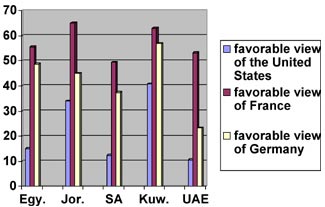
For the new study, Tessler and doctoral student Dan Corstange reviewed findings from many recent opinion surveys of ordinary men and women in Arab and Islamic countries. Some surveys were conducted by Arab scholars while others were done by U.S. polling firms and academic institutions, including ISR. Their analysis will be published in an issue of the Journal of Social Affairs.
One 2001 survey, based on a random sample of 1,318 West Bank and Gaza residents, found that three times as many people supported reconciliation with Israel as opposed it, and that supporters were just as likely as opponents to be religious or very religious.
Another survey of 2,756 Egyptians, conducted in 2000 as part of the ISR World Values Survey, showed that most Egyptians favor democracy, and that there is virtually no difference in the attitudes of more and less religious people.
A third survey of 1,223 Jordanians, also conducted as part of the World Values Survey, found that more than 70 percent felt that Islamic leaders should not influence politics compared to fewer than 20 percent who felt religious leaders should. Views about this issue are almost identical among men and women with different levels of mosque attendance and involvement in religious activities.
“Religion and culture are not fostering antipathy to Western norms and institutions,” Tessler says. “In fact, political and economic factors are much more important than religion in accounting for variance in attitudes toward politics, governance and international relations.
“At a time of increasingly strained relations between the U.S. and the Arab world it is particularly important to recognize the evidence that religious attachments do not foster the kinds of militant and totalitarian attitudes among ordinary people in the Arab world that some in the West allege,” Tessler says.
Funding for the research and analyses came from a variety of sources, including the Ford Foundation, the U.S. Department of State and the National Science Foundation.