Lack of dialogue between U.S., North Korea impedes relationship, Albright and ambassadors say
With a war being waged in Iraq, the United States is focusing its time and resources on the Middle East. But a panel of experts at the Business School, led by former Secretary of State Madeleine Albright, suggested March 18 that the government turn its attention to North Korea before a crisis breaks out there as well.
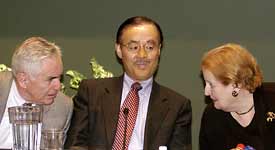
Hosted by the William Davidson Institute at the Business School, the panel brought together Albright, current Republic of Korea Ambassador to the United States Yang Sung Chul, and former U.S. Ambassador to Korea Donald Gregg for a discussion of U.S.-North Korean relations. All agreed that lack of dialogue between the two countries has hurt their rapport and impeded progress toward cooperation.
In her address, Albright described North Korea as one of the last bastions of the Cold War mentality. Her visits to Pyongyang while serving in the Clinton administration, she said, were rife with anti-American sentiment. Despite U.S. efforts to persuade it otherwise, she said, North Korea has decided to step up its nuclear weapons development and ignore the pleadings of other countries.
Albright attributes North Korea’s hawkish stance to its dictator, Kim Jong Il, with whom the United States has had tenuous relations at best. She also said the administration change from Clinton to Bush has strained this relationship further.
“It is hard to live in a country where the only statues are of him or his father and still have a sense of how democracy operates,” Albright said. “And especially when we [the Clinton administration] left office, we left a very interesting hand of cards on the table, and Bush has not picked it up, so the North Koreans have reason to suspect that there are mixed signals.”
Albright said diplomacy between the two nations has deteriorated since the current administration took over. She considers the 1994 Framework Agreement, which proposed that nuclear programs in North Korea cease in exchange for American monetary support, as a flawed but important step in improving the relationship. Bush’s advisors, she said, have not been forthcoming in resolving tensions and must open a dialogue with North Korea.
“I have never believed that dialogue is appeasement; I have always believed that you need to talk to the other side if you are going to be able to deliver a tough message,” Albright said. “The U.S. should have direct talks with the North Koreans and make very clear that what is going on is unacceptable and work again toward having a larger agreement of some kind.”
Yang, a native of South Korea and former member of its international assembly, added that the United States should not underestimate North Korea’s resolve to become a nuclear power. Despite widespread poverty and an unstable economy, he said, North Korea has the world’s fifth largest military and a dictator who is not afraid to use it.
Like Albright, Yang said that open lines of communication and an understanding of each other’s needs will lessen tensions between the United States and North Korea.
“The two countries must work together to achieve a balance,” Yang said. “As the saying goes, ‘It’s better to be late than never [to] choose the right course.’ Time is critical, and it favors neither side. Talk is better than no talk, and negotiation is no concession.”
Gregg, who also served as George H.W. Bush’s National Security Advisor, said the current administration needs to repair the United States’ relationship with North Korea. President George W. Bush’s proclamation of Iran, Iraq and North Korea as the “Axis of Evil,” he said, was a terrible mistake because it lumped together countries that are more different than alike in their stances toward nuclear power and the United States.
“When the president says something like that in his State of the Union speech, it’s there, and you can never take it back, and the ripple effect from that statement continues to grow,” Gregg said. “It is defended as best as it can be by Colin Powell, but when I hear their defense I think of applying fresh bandages to a wound that just won’t heal.”
Albright said now is the time to shift attention toward North Korea, a country that is aggressively developing a nuclear arsenal.
“I think it’s ridiculous that we are not calling this a crisis,” she said. “It is a crisis. If it quacks like a crisis, it’s a crisis. And I believe we need to pay greater attention.”