Nobel Prize-winning geneticist returns to Biological Station
LSA Communications
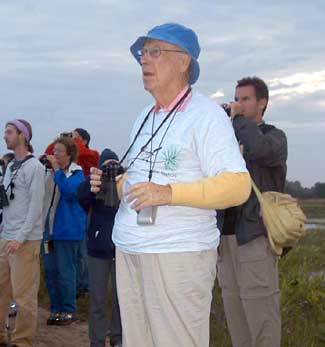
After 57 years, James Watson returned to the U-M Biological Station (UMBS) in northern Michigan in August. The Nobel Prize-winner picked up where he left off—with a pair of binoculars in his hand.
Watson last was at UMBS in the summer of 1946 as an ornithology student from the University of Chicago. The Biological Station draws faculty and students from U-M and around the world. On his recent visit, Watson happily joined a field ornithology class at a marsh with black terns and great blue herons flying overhead.
Watson’s early interest in ornithology led him to focus on genetics as a graduate student at Indiana University. Seven years after leaving UMBS, working as a post-doctoral fellow at Cambridge University, Watson and colleague Francis Crick elucidated the helical structure of the DNA molecule. They received a Nobel Prize in 1961, and forever changed modern biology.
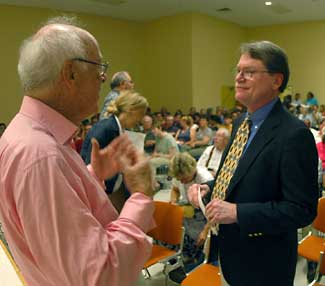
“One reason we won the race was that I was the only person who thought of it as a race,” Watson told an audience of 300 gathered at the station on the evening of Aug. 5 to hear his lecture, “From the Double Helix to the Human Genome Project.”
Watson’s lecture style was familiar to readers of his books, including his 1968 classic, “The Double Helix.” He delivered frank, and at times funny, commentary on the human drama of genetics research and likened it to the plot of a compelling novel. Of his famous book, he said it was “too good of a story not to be written up.”
Watson has remained a leader in the field of genetics to this day, lending his reputation and expertise to recent efforts such as mapping the human genome and applying this newfound knowledge to treating human diseases. Watson acknowledged that new advances, such as the ability to clone organisms and to transfer genetic material between species, raise moral issues within society. He said college courses in moral philosophy should be taught alongside molecular biology.
“We are trying to understand what our genes are programming us to do. We should accept this and not deny it. Don’t ask us to behave in ways that go against our human nature,” Watson said. “But I say this believing that human nature is more good than bad.”
At the lecture, LSA Dean Terrence McDonald and UMBS Director Knute Nadelhoffer also spoke. Nadelhoffer introduced Watson as having written “the most influential paper in biology in the 20th century.”
Watson returned to UMBS as part of a summer-long lecture series featuring distinguished scientists. The Biological Station, founded in 1909, is dedicated to education and research in environmental biology, including global climate change. Watson was this year’s Pettingill Lecturer, an endowed lectureship named in honor of the late Olin Sewall Pettingill, who taught at UMBS for 35 years—and was a world-renowned ornithologist.