Josh Rosenthal lecture
U.S. should ‘stand back’ in Iraq, journalist says
The United States’ best approach in Iraq may be to allow the residents of the country to rebuild on their own, “however imperfectly,” a journalist who has covered numerous wars said in a speech Sept. 8.
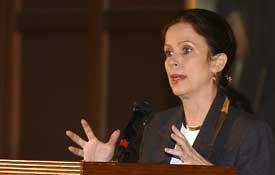
“The United States is now basically in charge of recreating a country the size of California,” Robin Wright, a global affairs correspondent for the Los Angeles Times, said in The Josh Rosenthal Education Fund Lecture. “We may be better served standing back a bit.”
The event, sponsored by the Gerald R. Ford School of Public Policy, honors Rosenthal, an alumnus who was killed Sept. 11, 2001, in the World Trade Center attacks.
Wright said the United States often is seen by the citizens of Middle Eastern countries as the prop keeping tyrannical leaders in power.
She said she is both pessimistic and optimistic about the situation in the Middle East. She is pessimistic because of the persistent challenges in Iraq, a country that reminds her of Lebanon on the eve of its civil war. With groups building their own militaries, clashes can erupt if any group feels it isn’t getting its fair share, she said.
“The United States will be lucky to extricate itself from Iraq without major calamity,” she said.
Other immediate trouble spots include Afghanistan, with an uncertain future of its government and the country’s “fiefdoms of warlords,” she said. And the Palestinian-Israeli conflict continues to be a “precarious” situation, she said.
Iran, Saudi Arabia and Pakistan are in what Wright called a “middle tier” of nations that may pose less immediate threats but are areas of concern for the United States. A third tier of potential hotspots includes Turkey, Egypt, Syria and Jordan, but she said she hopes none of these will require immediate action.
Wright is optimistic because many nations are moving toward democratic rule. She also notes that the spread of the information age is giving people a new look at the world and that satellite dishes are helping to transform views in the Middle East. A third reason for her optimism is the demographic makeup of many of these countries; with large populations under age 25, many citizens are unhappy with religious theocracies and other types of governance, she said.
Among the best ways for the United States to combat terrorism are by finding alternative sources of energy and improving education, particularly by requiring elementary students to learn two foreign languages, she said.
Rebecca Blank, dean of the Ford School, introduced Wright. Marilynn Rosenthal, Josh’s mother, said that two years after the terrorist attacks, “our knowledge has broadened but I continue to wonder if it has deepened.” Lectures such as Wright’s, she said, can help lead to a deeper understanding of worldwide Islamist movements.
Several hundred people attended the lecture; many listened to it from another location after the Pendleton Room in the Michigan Union quickly filled to capacity.