Traveling down a new road
Five years ago the demand for parking on campus was at an all-time high, says Pat Cunningham, director of Parking and Transportation Services. The crunch coincided with Cunningham jumping into the driver’s seat of the newly merged parking and transportation department after 12 years as a manager of transportation at U-M.
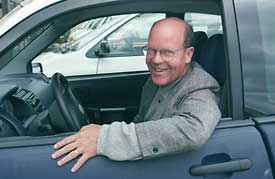
“We decided we needed to create more parking spaces, but we had to radically change our transportation on campus as well,” says Cunningham, who is retiring this month after 26 years at the University.
The transformation included enlarging the bus fleet, improving commuter service rotation from 15 to 10 minutes and expanding the route to North Campus, as well as the introduction of Ann Arbor Transit Authority (AATA) bus passes and free van pooling.
These improvements in campus transportation were necessary steps toward fulfilling another key goal: increasing the use of remote parking by University employees, he says.
“We freely admit we can’t provide a parking place for everybody in the central areas anymore. We have to rely on some people parking remotely and taking buses,” Cunningham says.
So far he has seen success in this, with a 10-25 percent increase in people using remote commuter lots and taking the bus, and 2,900 employees using AATA bus passes, which are subsidized by the University.
“We have really exceeded our expectations in getting people to do this,” he says.
Hank Baier, associate vice president of facilities and operations, praises Cunningham as a vibrant, visionary campus leader in providing effective transportation services while addressing the difficult demands of campus parking.
“During Pat’s management, the growth in the U-M transit system has resulted in transportation of 4.3 million passengers a year,” Baier says.
One reason it has become a more attractive option for employees is the rising cost of campus parking. The only way to get more parking on campus at this point is to build more parking structures, Cunningham says. This comes with a hefty price tag; one parking spot costs $20,000 to construct, Cunningham says.
“As we have seen prices of parking increase in central areas, it becomes more attractive to use remote parking, and it is advantageous of the University to promote this,” he says.
Parking initiatives are continuing to be developed with 400 spaces having opened in the Palmer Drive parking structure. Baier will present a new long-term parking plan, prepared by Cunningham, to the Board of Regents and the Senate Assembly as his final acts at the University.
Cunningham has left another beneficial mark on campus. U-M’s vehicle fleet—which consists of 1,000 buses, trucks and cars—has become one of the most environmentally conscious in the country.
“We have perhaps the cleanest diesel-burning buses in the U.S., and we are proud of that fact,” Cunningham says. “We also have the largest fleet of alternative fuel vehicles in the state of Michigan and of any university anywhere.”
More than half the fleet vehicles now run on bio-diesel, a combination of 20 percent soy oil mixed with 80 percent ultra-low sulfur diesel fuel, or E-85, a mixture of 85 percent ethanol, usually made from corn, and 15 percent regular unleaded gasoline.
“The university community has been happy to endorse the use of them,” he says. “I have not had any complaints about the inconveniences, including the slight increase in expense.”
Even facing some major roadblocks, such as budget cuts and a fire that destroyed the transportation facility in August 2000, parking and transportation has continued to expand and improve its services.
“We have been able to improve busing on campus remarkably during the last 15 years, and I can say the top administration in the University has always supported any transportation improvements we have wanted to make on campus,” Cunningham says.
As he retires this month to Indialantic, Fla., to enjoy windsurfing and life on the beach, Cunningham looks back with pride on his five years as director and the upgrades he facilitated.
“We have made more improvements in the last five years than in the previous 20 years all together. That makes the job fun—doing new things and trying new programs,” he says.
There will be a farewell reception for Cunningham 2-4 p.m. Sept. 19 at the Kipke Conference Center at the Campus Safety Services Building. For more information, call (734) 763-5356.