CRLT Players hit the road
Editor’s note: This is one in an occasional series of articles that highlights the teaching and learning integral to the University’s rich academic core.
U-M’s interactive theater troupe that breaks down barriers by bringing research to life has taken its show on the road.
The Center for Research on Learning and Teaching (CRLT) is helping area educators as well as a growing number of faculty audiences across the country open up and get more involved with sensitive topics that include dealing with people with disabilities, gender differences, race relations and internal politics present in some classrooms.
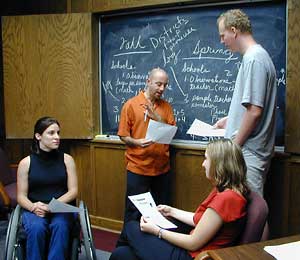
The CRLT Players put on many programs at U-M for faculty and graduate student instructors, and the group has been asked to visit other campuses, including North Carolina State University, the University of Illinois and Michigan State University. The troupe also uses video technology to beam shows to other parts of the country. The goal is to get educators more involved in the thought process, showing rather than telling.
The results of U-M research findings form the basis for scripts. The theater troupe then puts on sketches for groups of educators on how to deal with specific work issues instructors encounter in classrooms. The actors remain in character while taking questions and interacting with members of the audience to fully flesh out ideas on any topic about which the academic unit wants its faculty to learn more.
“It makes ideas real and in the present,” says Jeffrey Steiger, the troupe’s director. “You can talk about ideas, and it makes research come alive. It’s safe. Since actors are portraying characters, bringing a classroom or situation to life, the audience feels more comfortable asking questions they might not otherwise ask.”
For example, some sketches test an educator’s conflict management skills when one student brings up something that sets off a classroom debate about racial stereotypes, gender differences, or ways other students and the teacher react to a student with a disability.
The CRLT Theatre Program also offers traditional theatrical productions, workshops and consultations. Other sketches examine gender and power in a faculty meeting or the difficulties that can exist in the graduate student and faculty mentoring process.
Constance Cook, director of CRLT, says the more than 40-year-old center provides a comprehensive array of curricular and instructional development activities. “We are here to improve teaching on this campus,” Cook says.