Detroit Connections: ‘More than an art club’
Editor’s note: This is one in an occasional series of articles about teaching and learning at the University.
On the walls of Harms Elementary School in Detroit, stars dance in the night sky with rocket ships, and a girl holding an umbrella surfs on a green fish. A sun says, “I love you.”
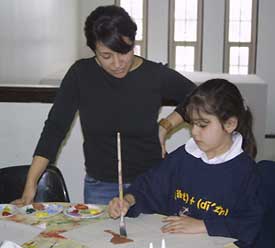
These are the works of students who participate in the Detroit Connections program, an after-school collaboration with U-M students and professors. The program is designed to bring art into under-resourced schools, and to use it to boost students’ performance in areas such as math, science and writing.
On a recent day, dozens of elementary school students worked in small groups with a School of Art & Design student. They painted pictures on circular boards.
“It’s pretty cool because we get to make stuff and put it on the walls,” says Cherlene Sousa, a third grader. She says she looks forward to the weekly program. “I think, ‘It’s Tuesday, and I get to work on the painting.'”
Ten to 15 U-M students take the Detroit Connections class each semester. This term, they are working with about 30 third, fourth and fifth grade students at Harms, and about 20 fourth graders at Greenfield Union Elementary in Detroit.
Funding comes primarily from Arts of Citizenship and the School of Art & Design, with some additional money from the Center for Research on Learning and Teaching and grants obtained by Harms.
Janie Paul, assistant professor of art and design and founder of Detroit Connections, appreciates the support but says the program needs more funding to continue bringing these programs to elementary students in these under-resourced schools.
When the program started at Harms in 2000, science scores were low. Due to numerous efforts at the school, including Detroit Connections, scores have improved, Principal Patricia Diaz says.
Science projects have included learning about the animals students paint, such as what they eat and whether they are invertebrates. Math projects include working with shapes and proportional enlargements.
“This is more than an art club. From day one, it was going to be more than an art club—it was going to work on curriculum,” Diaz says. With regard to science scores, she says, “It’s just been up, up, up.”
The most rewarding experience for Diaz and Ceci Mendez—adjunct assistant professor who runs the program in the winter term—is when a student begins to understand the ideas about math, science, writing and art that the program teaches.
During a recent day at Harms, Noe Angelito, a fifth grader, worked on a project with birds and dinosaurs. “I draw any shape I want to. I drew this shape, and it looked like a crow,” he said. “You don’t need to draw it perfect, just like a shape.”
That’s music to Paul’s ears. She and the others in the program try to make students understand the inter-connectedness of shapes and objects in the world: a triangle is a rhino’s horn, a circle is the center of a flower’s bloom. They also want the students to feel free to invent and to learn how to make something out of nothing.
“That’s the essence of what we’re doing,” she says of Angelito’s comment.
This year the students at Harms are focusing on writing-related art projects. One was a poetry exercise that taught them similes, though the students at first didn’t know they were writing poems or similes.
On slips of paper, they wrote descriptions of things. If someone said his hair is brown, he then wrote on a slip about something else that is brown. One girl ended up with a poem filled with similes about her arms: “My arms are light like a lamp/and feel soft like a baby’s hair/and hairy like a sheep/and strong lifting like a pulley.”
Paul has put together two curriculum books, one with the help of Mendez and the other with assistance from others, that show how to do the math- and science-related art projects. Each project includes a length of time, a list of the necessary materials and step-by-step instructions. Paul hopes to make the curriculum books available to other universities, after-school clubs and teachers.
The program has a powerful impact on the college students, Paul says. “It really makes them think about their position in the world,” she says. They start the class thinking it’s about them helping the children, she says, but they discover it’s a more reciprocal relationship. “Both the college students and the children have needs that they meet for each other.”
The impact on the elementary students is visible whenever they look with pride at their paintings or run up to the college students and instructors to greet them with hugs.
“I know there are many children every time for whom it will be a life-changing experience,” Paul says.
For more information about Detroit Connections or the curriculum books, contact Paul at janiep@umich.edu.