Black America needs to realize economic clout

Calling it “perhaps the last call for the dream,” writer, social historian and executive editor of Ebony magazine Lerone Bennett Jr., encouraged an MLK Day audience to redouble its efforts along the road to improved human relations in America.
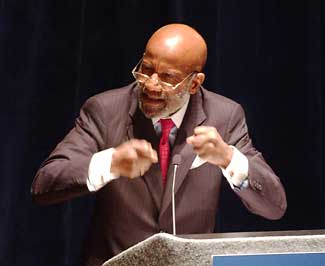
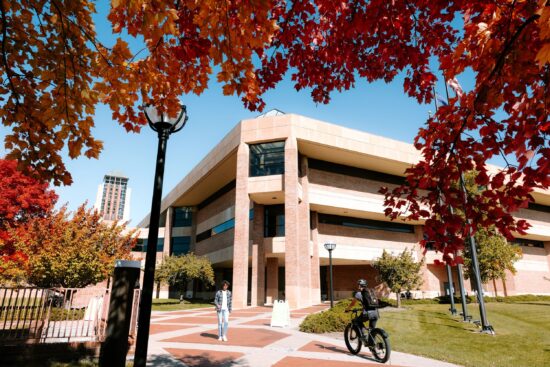
Bennett cited the dream and vision put forth by the Rev. Martin Luther King Jr. more than 40 years ago. His address at the Stephen M. Ross School of Business was part of the University’s 18th annual MLK Symposium.
Highlighting Bennett’s message was the economic significance African Americans represent in today’s world. He said the collective gross national income of Black America is more than $700 billion. If Black America were a separate nation, he said, it would make it the ninth-richest economy in the world, ahead of Mexico, Spain, India, Brazil, Australia and others.
“We need to tell the giant that he is a giant, and to start acting like one,” Bennett said. By speaking with their wallets and voting with their convictions, African Americans can have a great impact on their own economic and political futures, he said.
Broadening the definition of diversity is a necessary first step, said Bennett, who reminded the audience that King’s vision included freedom and equality for all races, genders and religions, and that all people will benefit from improved race relations.
“We have made enormous gains in politics since the 1960s, but this has not destroyed visible institutional signs of racism. The task at hand is dealing with this functional paradox in the post-King world,” Bennett said. “So everything has changed, yet nothing has changed. We haven’t reached a level of integration of power, money and resources. We need diversity that includes these things.”
Another paradoxical reality of 2005, according to Bennett, is that although there are more educated and successful African Americans in today’s society, urban areas continue to be plagued by poverty and crime.
To bring new vitality to urban areas, Bennett said, a national development project aimed at the reconstruction of urban America should be created. He believes it would take $40-$50 billion and many years to accomplish, but that by establishing a program not unlike the Civilian Conservation Corps of the 1930s, unemployed workers could have a hand in bringing this revitalization to light.
Bennett encouraged African Americans to take their ideas and talents into their communities and cities.
“I would say we have to do everything. Make yourself a committee of one. Mobilize and work as an agent of change wherever you can,” he said.
Bennett has been at the helm of Ebony for more than 40 years. His series of articles from the 1960s resulted in his seminal work “Before the Mayflower: A History of Black America, 1619-1962.” The book, an examination of the history of African Americans in the United States, gave Bennett a reputation as a first-rate historian.