Health care gaps have many sources, require many solutions
|
|

Closing the well-documented disparity in illness rates between African Americans and whites “is about research, but it’s also about policy and politics,” said Vanessa Northington Gamble, the 15th annual Health Sciences Symposium speaker on Martin Luther King Jr. Day.
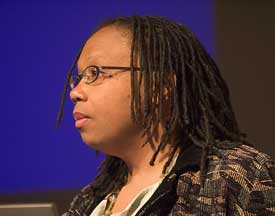
Gamble, director of the Tuskegee University National Center for Bioethics in Research and Health Care, reviewed the history of the health-care gap in America and explored ways in which practitioners and the community might work together to improve it.
Health disparities are nothing new for African Americans, Gamble pointed out. W.E.B. DuBois published a landmark study of the problem in 1906, concluding that it was a social problem, not a physical one. This would have flown in the face of the popular Eugenics movement of the day, which held in part that Blacks simply were not cut out to live healthy lives, she said.
A 1985 study found that minority populations suffer 60,000 “excess deaths” when compared with white populations.
The mix of factors contributing to this imbalance in health statistics includes socio-economic status, language differences, health insurance, the severity of illnesses, and a well-documented “provider bias,” Gamble said. If it were an insurance issue alone, Britain and Canada wouldn’t show the same sorts of minority health disparities that the U.S. has, she noted.
So there isn’t a single cause of the disparity, and there won’t be a single answer, Gamble said.
Numerous efforts over the years, including a National Negro Health Week and a special department of the U.S. Public Health Service failed to make much of a dent in the problem, Gamble said.
The Veterans Administration maintained a separate hospital in Tuskegee for Black World War II veterans, which amounted to system-wide segregation of the black patients.
“It was still the case that the color of your skin determined not just the quality of care, but whether you’d get care at all,” Gamble said. Despite the gains of the Civil Rights era, those gaps still exist.
A 1999 Georgetown University study found that an African American woman with the same health insurance as her white counterpart would be 40 percent less likely to be recommended for cardiac catheterization, she said.
A major facet of improving African American health care is to understand the problem better, Gamble said. African-American participation in clinical trials would be a very important part of that understanding, but the legacy of unfairness and injustice, especially the notorious Tuskegee syphilis study, is a huge barrier to overcome.
“I think it’s critical that African Americans be part of clinical trials, but I also understand why they don’t participate,” Gamble said.
The program opened with an energetic half-hour of Congolese rhythms from the group Bichini Bia Congo, and closed with a full singing of “We shall Overcome” led by Dr. David Gordon, associate dean of the Medical School for diversity and career development.
Gordon exhorted the audience to work toward solutions for the leading health problems of African Americans—such as cardiovascular disease, stroke and diabetes—because solving these problems for one group would solve them for everybody. “I challenge all of you to make that dream a reality,” he said.
Gamble’s talk was co-sponsored by the schools of Dentistry, Medicine, Nursing, Public Health and Social Work, and the College of Pharmacy.