Unmanned space science critical, says professor
Space scientist Thomas Zurbuchen told U.S. House and Senate members last week that non-manned space science is critical for gathering information from planets too distant for humans to visit.
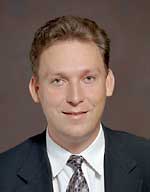
(File Photo by Bill Wood, U-M Photo Services)
Zurbuchen, an associate professor in the Department of Atmospheric, Oceanic and Space Sciences, also said that science would support future manned missions.
Zurbuchen and colleague Derek Sears of the University of Arkansas discussed space science issues at a luncheon sponsored by the Science Coalition, a group of 55 major research universities that includes U-M and allied groups. The quarterly luncheons are designed to familiarize science staffers with cutting-edge issues in the world of federally funded basic research.
On space weather, Zurbuchen explained how radiation and particles emitted from the Sun stream across the solar system and how Earth and other planets deal with the constant bombardment. He said sudden bursts of plasma from the Sun can disrupt communications and power grids on Earth and cause serious problems for astronauts traveling to distant planets.
Sears discussed his research into near-Earth asteroids, including a probe that will be sent to land on an asteroid to learn more about its composition. Sears said while the likelihood of Earth being struck by a large asteroid is small, such an impact could end life as we know it.
Sears said scientists want to learn more about asteroids in hopes of someday being able to deflect any that could collide with Earth.
Zurbuchen receives funding from NASA, the National Science Foundation and the Navy, among other federal agencies.