UM-Dearborn students, professors working on Ford SYNC apps
Six engineering students at UM-Dearborn were invited to be among the first developers to adapt Ford Motor Co.’s new SYNC application programming interface (API) for in-car voice-controlled smartphone mobile apps.
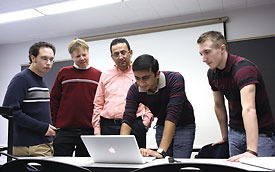
Engineering professors Paul Watta and Brahim Medjahed (second and third from left) oversee students Kristopher Bechamp (far left), Samip Desai (second from right) and Brandon King (right) as they work to adapt Ford Motor Company’s new SYNC application programming interface for in-car voice-controlled Smartphone mobile apps.
Under the direction of Brahim Medjahed, assistant professor of computer and information science, and Paul Watta, associate professor of electrical and computer engineering, students Kristopher Bechamp, Samip Desai, Matt Hartzel, Brandon King, Ed Malinowski and Rob Muir were granted use of Ford’s developers’ license, becoming the world’s first SYNC app developers and creating two SYNC-enabled mobile applications using SYNC APIs.
And, the student-created apps adhere to automotive safety standards through the National Highway Traffic Safety Administration and the U.S. Department of Transportation.
“This was a wonderful way for our students to gain invaluable real-world experience,” Medjahed says. “They had the opportunity to participate in a collaborative research project with a global enterprise as significant as Ford while developing their entrepreneurial skills.”
Medjahed and Watta submitted a proposal to Ford to work on the project, which was funded as part of the Ford Michigan Alliance Program, and once accepted, discussed the opportunity with potential students before selecting six from the CIS and ECE departments, five of which are undergraduates.
“This was a fast-track project,” Medjahed says. “We were able to develop and demonstrate a proof-of-concept to Ford in three months. We were fortunate to work with very good students and received tremendous support from College of Engineering and Computer Science Dean Subrata Sengupta and Henry W. Patton Center for Engineering Education and Practice Director John Cristiano to buy the equipment needed for this project.”
Beginning the project, the students visited the iPhone App Store to winnow down the roughly 100,000 active apps to those that would be relevant for in-car use. Hoping to modify an existing app, the next hurdle was gaining access to the source code behind the apps. Legal restrictions, extensive developer agreements and the short timeline forced a reality check: None of the readily available open-source software was applicable to the in-vehicle scenario. So the students scrapped the initial plan to modify an existing app, and instead collaborated on their own applications for SYNC — built from scratch.
Ford developers already had been working on an API, internally referred to as “SYNCLink,” allowing connectivity between mobile device applications and the vehicle interface. The students sorted through more than 100 different concepts with the Ford API team, finally narrowing their focus to two areas; audio infotainment (internet music, news and talk show streaming sites) and GPS location-based navigation services.
The resulting apps included a mash-up of infotainment features code-named “SYNCcast” and “FollowMe.” SYNCcast lets users enjoy Internet radio in the vehicle. The navigation app called “FollowMe” allows two or more friends to follow a lead vehicle to a location without the need to physically follow each other, thanks to GPS turn-by-turn directions transmitted from the leader to the followers and read aloud to the drivers.
The work done through Ford’s collaboration with UM-Dearborn is expected to lead to a planned 2010 release of the full open API to trusted developer partners.