Royal Shakespeare Company gives voice to ‘Cardenio’
The Royal Shakespeare Company (RSC) recently gave voice to Shakespeare’s tragicomic play “Cardenio” in the Residential College’s Keene Theater.
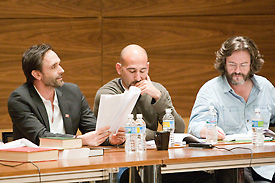
Director Gregory Doran, right, discusses David Edgar’s play “Written on the Heart” during an insight with Trevor Long, left, and Jason Olazabal, both actors with LAByrinth, a New York-based theater company. The reading at Blau Auditorium was part of a collaboration between the Royal Shakespeare Company and U-M that focused entirely on the creative process. Doran also is director of the Shakespeare play “Cardenio.” Photo by Scott Galvin, U-M Photo Services.
This fourth collaboration between RSC and U-M was the first focused entirely on the creative process. By tapping many experts, resources and students throughout the university, three plays were brought closer to the stage.
In addition to “Cardenio,” the interdisciplinary groups worked on “Written on the Heart,” a new play by David Edgar about the man who translated the King James Bible; and a play about Sor Juana Inez de la Cruz, a controversial 17th-century South American nun who defied tradition to write poetry and plays that remain an important part of Western literary tradition.
Although the text of “Cardenio” was lost, there are records that the play was presented on a few occasions in 1613 and 1727. With the intervention of playwrights, historians and literary scholars, the full dramatic and comic strengths have been recovered and the puzzle of the forgotten play resolved.
Shakespeare wrote the play with his younger partner, Fletcher, inspired by the tragicomic story of Cardenio, as told by Cervantes in the first part of “Don Quixote” (1605). It was thought that Shakespeare also drew from Lewis Theobald’s “Double Falsehood.”
The restored work is a literary encounter between Cervantes, Theobald, Shakespeare, Fletcher and contemporary writers to reproduce the romance between Cardenio and Luscinda, the two characters that intersect with Don Quixote and Sancho in the universal classic. RSC Director Gregory Doran has worked closely with a Spanish playwright to start the process, and at U-M was able to interact with scholars as they polish the work. Ultimately, it will be produced in England and Spain in both Spanish and English.
In a sober and completely black stage, nine actors, some from RSC and some from New York’s bilingual company LAByrinth, sat in a semicircle in street clothes, reading the libretto taken from the fragments found after centuries of neglect, intrigue and mystery. The cadences of the voices showed the collective creativity, experimentation and improvisation that resulted in a smooth and consistent reading, with no signs dividing the new from the old segments.
The dramatic level of the actors, who used only their voices, gestures, subtle movements of an eyebrow or shoulder, created a contagious state of mind and mood, and kept the spectators that filled the two levels of the theater in anticipation.