Scholarship & Creative Work
New insights into how stem cells determine what tissue to become
Within 24 hours of culturing adult human stem cells on a new type of matrix, U-M researchers were able to make predictions about how the cells would differentiate, or what type of tissue they would become. Their results are published in the Aug. 1 edition of Nature Methods.
Differentiation is the process of stem cells morphing into other types of cells. Understanding it is key to developing future stem cell-based regenerative therapies.
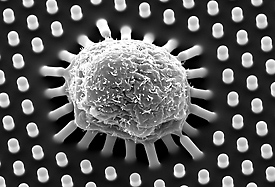
A human mesenchymal stem cell growing on a plate of long microposts, which can be seen bending in response to the cell’s forces. Photo by Courtesy College of Engineering.
“We show, for the first time, that we can predict stem cell differentiation as early as Day 1,” says Jianping Fu, an assistant professor in mechanical engineering and biomedical engineering who is the first author on the paper.
“Normally, it takes weeks or maybe longer to know how the stem cell will differentiate. Our work could speed up this lengthy process and could have important applications in drug screening and regenerative medicine. Our method could provide early indications of how the stem cells are differentiating and what the cell types they are becoming under a new drug treatment.”
In this study, Fu and his colleagues examined stem cell mechanics, the slight forces the cells exert on the materials to which they are attached. These traction forces were suspected to be involved in differentiation, but they have not been as widely studied as the chemical triggers. In this paper, the researchers show that the stiffness of the material on which stem cells are cultivated in a lab does, in fact, help to determine what type of cells they turn into.
— Nicole Casal Moore, News Service
Bees at shade-coffee farms help maintain genetic diversity in forests
Shade-grown coffee farms support native bees that help maintain the health of some of the world’s most biodiverse tropical regions, according to a study by a U-M biologist and a colleague at the University of California, Berkeley.
The study suggests that by pollinating native trees on shade-coffee farms and adjacent patches of forest, the bees help preserve the genetic diversity of remnant native-tree populations. The study was published online in July in the Proceedings of the National Academy of Sciences.
“A concern in tropical agriculture areas is that increasingly fragmented landscapes isolate native plant populations, eventually leading to lower genetic diversity,” says Christopher Dick, a U-M assistant professor of ecology and evolutionary biology. “But this study shows that specialized native bees help enhance the fecundity and the genetic diversity of remnant native trees, which could serve as reservoirs for future forest regeneration.”
An estimated 32.1 million acres of tropical forest are destroyed each year by the expansion of cropland, pasture and logging. Often grown adjacent to remnant forest patches, coffee crops cover more than 27 million acres of land in many of the world’s most biodiverse regions.
Over the last three decades, many Latin American coffee farmers have abandoned traditional shade-growing techniques, in which plants are grown beneath a diverse canopy of trees. In an effort to increase production, much of the acreage has been converted to “sun coffee,” which involves thinning or removing the canopy.
The enhanced genetic diversity of the shade-farm trees could provide a reservoir for future forest regeneration, as the coffee farms typically fall out of production in less than a century.
— Jim Erickson, News Service
Military nurses and combat-wounded patients struggle to cope with stress
Military nurses say treating combat-wounded patients provides a sense of meaning and purpose that helps them cope with the stresses of a demanding, sometimes heart-wrenching job, according to a new U-M-led study.
“It was the first time in 16 years that I’ve felt I’ve really done something,” one of the military nurses told researchers. “I have nothing in my life that has been more rewarding,” another nurse reported.
At the same time, nurses said the military failed to provide specialized training to help them care for themselves as they struggled with the emotional work of dealing with severely injured service members.
Twenty military nurses and eight combat-wounded patients were interviewed by U-M researchers and their colleagues for a study published in the current edition of Perspectives in Psychiatric Care. The U-M authors are Bonnie Hagerty, an associate professor in the School of Nursing, and Reg Williams, a professor in the School of Nursing and at the Medical School’s Department of Psychiatry.
Many service members said they were reluctant to acknowledge that they needed help in dealing with psychological issues associated with their injuries. In fact, several said that seeking such assistance often is viewed as a sign of weakness or a barrier to future military careers.
“Any change in policy or procedures that promotes more immediate attention to the psychological needs of wounded service members will have to be accomplished through a changed culture in which stigma is minimized and seeking psychological assistance is rewarded,” the authors wrote.
— Jim Erickson, News Service
Healthiest pregnant women feel a strong sense of community
It takes a village to keep a pregnant woman at her healthiest, a new U-M study shows.
The study compared African-American and European-American women and women of lower and higher socioeconomic status to see what effects communalism, or a strong sense of community, had on African-American women and women of lower socioeconomic status.
The pregnant African-American women and women of lower socioeconomic status had overall higher levels of stress, negative effect and blood pressure than women of higher status based on race or education and income. However, these ethnic and socioeconomic disparities were not observed among women with higher communalism.
The study followed 297 African American and European American women through 32 weeks of pregnancy. Results suggest that a sense of community was more important for a pregnant woman’s mental health than ethnicity or socioeconomic status over the lifespan, says Cleopatra Abdou, a social health psychologist who completed the study as a Robert Wood Johnson Foundation Health and Society Scholar at the School of Public Health.
The findings of Abdou and her colleagues also suggest that communalism negates the effects of ethnic minority status and lower socioeconomic status on a pregnant woman’s blood pressure.
“This paper suggests that it can be very important to distinguish culture from ethnicity and social status, not only as concepts, but also in terms of effects on health and other important life outcomes,” says Abdou, who starts this fall as assistant professor at USC in the Davis School of Gerontology.
The paper is scheduled to appear this month in the American Psychological Association’s Journal of Cultural Diversity and Ethnic Minority Psychology.
— Laura Bailey, News Service
Spread of malaria still a looming problem
There are hundreds of millions of new cases of malaria annually, but much of what scientists believe about preventing the spread of malaria in urban settings is mistaken, a new U-M study suggests.
Factors such as house construction and use of anti-mosquito coils aren’t as important as where someone spends the night, says study co-author Mark Wilson, professor of epidemiology at the School of Public Health.
Wilson and former doctoral student Jose Siri studied malaria risk in Kisumu, Kenya, and found that the greatest risk factor for a child living in an urban area was whether the child spent at least one night a month in a rural area. Those children were nine times more likely to contract malaria.
“We found that factors like house construction and mosquito coils weren’t important, whereas traveling to rural areas was,” says Wilson, who also is a professor of ecology and evolutionary biology. “That probably relates to the lack of the use of bed nets in those rural areas.”
The study, which recently was published in the American Journal of Tropical Medicine and Hygiene, suggests that travelers should carry bed nets with them if they travel from the city to rural areas.
The study results show that special information and prevention efforts are necessary for the growing group of urban residents who travel to rural areas.
Foreign tourists are at relatively lower risk when staying in the city because hotels will already have screens and mosquito nets, and tourists are very likely taking anti-malarial drugs, Wilson says. However, if they embark upon a more exotic or adventurous vacation, they should be sure to bring along a treated mosquito net, he adds.
— Laura Bailey, News Service
Pilot safety protocol could help dentists reduce errors
Pilots and dentists have more in common than one might think: Both jobs are highly technical and require teamwork. Both are subject to human error where small, individual mistakes may lead to catastrophe if not addressed early.

Image courtesy School of Dentistry.
A dental professor at U-M and two pilot-dentists believe that implementing a checklist of safety procedures in dental offices similar to procedures used in airlines would drastically reduce human errors.
Crew Resource Management empowers team members to actively participate to enhance safety using forward thinking strategies, says Russell Taichman, U-M dentistry professor and director of the Scholars Program in Dental Leadership. Taichman co-authored the study, “Adaptation of airline crew resource management (CRM) principles to dentistry,” which appears in the August issue of the Journal of the American Dental Association.
Airlines implemented CRM about 30 years ago after recognizing that most accidents resulted from human error, says co-author Harold Pinsky, a full-time airline pilot and practicing general dentist who did additional training at U-M dental school.
“Using checklists makes for a safer, more standardized routine of dental surgery in my practice,” says David Sarment, a third co-author on the paper. Sarment was on the U-M dental faculty full-time before leaving for private practice. He also is a pilot and was taught to fly by Pinsky.
CRM checklists in the dentist’s office represent a major culture shift that will be slow to catch on, but Pinsky thinks it’s inevitable.
For the next step, the co-authors hope to design a small clinical trial in the dental school to test CRM, Taichman says.
— Laura Bailey, News Service
Black hole at Milky Way core powers galaxy’s fastest stars
The black hole at the center of the galaxy is to blame for sling-shotting “hypervelocity stars” out of the Milky Way at up to 1.8 million miles per hour, according to new evidence from research involving a U-M astronomer.
Hypervelocity stars, discovered about five years ago, are the fastest stars astronomers have ever observed. They are escaping the galaxy at beyond what was thought to be its stellar speed limit.
The researchers used the Hubble Space Telescope to trace the trajectory and origin of HE 0437−5439, a speeding star in the southern hemisphere too faint to be seen with the naked eye. A paper about their findings has been accepted to Astrophysical Journal Letters.
“This is the first objective evidence that these hypervelocity stars do come from the center of the galaxy,” says Oleg Gnedin, an assistant professor in the Department of Astronomy. “It’s an example of a very violent interaction that happens as a direct consequence of the black hole there.
“We had theorized that you could only get such high velocity if you kick a star from very close to a black hole in a special way that involves another star or object. It’s a three-body interaction. The black hole rips apart a binary or tertiary star system, captures one of the companions and jettisons the others.”
Tracking hypervelocity star paths across the sky could help astronomers map the shape and gravitational potential of our galaxy and its dark matter halo, Gnedin says. Dark matter is a substance that astronomers cannot directly observe, but they deduce it exists because they detect its gravitational effects on visible matter.
— Nicole Casal Moore, News Service
Think before you drink during job interviews
Most people don’t drink alcohol while working, so it’s probably not smart to order a drink during a job interview over lunch or dinner — even if the boss orders a glass of wine or beer, a new study suggests.
“Alcohol consumption plays a prominent role in many professional interactions, including job interviews, negotiations and informal meetings,” says Scott Rick, assistant professor of marketing at the Stephen M. Ross School of Business. “By introducing alcohol, managers can create a relaxed atmosphere that facilitates information exchange and relationship development.
“But merely holding an alcoholic beverage may reduce the perceived intelligence of the person holding it, in the absence of any actual reduction in cognitive performance — a mistake we term the imbibing idiot bias.”
Rick and colleague Maurice Schweitzer of the University of Pennsylvania’s Wharton School conducted a series of six experiments with more than 1,700 people to measure how consuming or merely holding an alcoholic beverage influences the perceived intelligence of the person drinking the glass of wine or beer.
They found that job candidates who ordered alcohol in simulated interviews were perceived as less intelligent and less hireable — though no less likeable, honest or genuinem — than those who did not, regardless of whether the boss ordered an alcoholic beverage first.
Moreover, even if the boss ordered the drink for the job candidate (i.e., the candidate did not choose to drink), the result was the same. This suggests that the bias does not reflect a belief that less intelligent people are more likely to consume alcohol, but rather an implicit association between alcohol and cognitive impairment.
— Bernie DeGroat, News Service
Same-sex relationships increase self-esteem, drops homophobia in teens
Involvement in a same-sex relationship boosted self-esteem in teen males and lowered internalized homophobia in teen females who identified as gay, lesbian or bisexual, a new U-M study shows.
Surprisingly for the same teens, having an opposite-sex relationship had no affect on self-esteem, depression or anxiety.
Dating in adolescence is critical to developing sexual and social identities, says Jose Bauermeister, assistant professor at the School of Public Health. It’s even more salient for gay, lesbian and bisexual youth because there is such a stigma attached to their sexual orientation.
Studies have shown that these teens may suffer more psychological distress, victimization, physical threats and violence than heterosexual youth. Gay, lesbian and bisexual teens who conceal their sexuality, often have a lower self-image or internalized sense of homophobia — which can lead to depression and anxiety.
Bauermeister’s research group set out to determine the influence of same-sex and opposite-sex relationships on symptoms of depression, anxiety, internalized homophobia and self-esteem over time in 350 gay, lesbian or bisexual teens from three Gay Lesbian Bisexual Transgender drop-in centers in New York City.
The protective effects of same-sex relationships are different for young men and women, says Bauermeister, who oversees the SPH Sexuality and Health Lab. A same-sex relationship is protective in that it reduces internalized homophobia for girls even after only one relationship. For men, a same-sex relationship is protective in that it raises self-esteem, but the relationship must be prolonged.
The takeaway?
“Providers and caregivers of (gay, lesbian and bisexual) youth need to create supportive environments where kids can talk about and support their sexual identity, which may include their dating experiences with same-sex and opposite-sex partners,” Bauermeister said.
The paper will appear in the journal Youth and Adolescence this month.
— Laura Bailey, News Service
Race, wages create obstacles for welfare mothers seeking help from temp agencies
Many welfare mothers who seek employment through temporary agencies share similar skill deficits, work barriers and family constraints as those hired directly by employers, a new study shows.
Welfare recipients who temp, however, are more likely to be African American, as well as earn significantly lower hourly wages, according to researchers at U-M and Hong Kong Polytechnic University.
The study analyzed employment patterns of current and former welfare recipients in temporary jobs during a six-year period following the implementation of welfare reform.
“Temp work is an integral component of many welfare recipients’ employment trajectories as they transition off welfare,” says Mary Corcoran, U-M professor of public policy and political science.
Five interviews (waves) between 1997-2003 were conducted for white and African-American women with children who received welfare.
Race was strongly associated with temping. African-American recipients are more likely to temp (68 percent compared to 48 percent) and less likely to be in jobs with supervisory responsibility than similarly qualified and situated white recipients.
“This may reflect racial discrimination in access to direct-hire and supervisory jobs,” says Juan Chen, the study’s lead author from Hong Kong Polytechnic University.
The findings appear in the recent issue of Social Service Review.
— Jared Wadley, News Service