New $46 million labs to enable mechanical engineering, nanotechnology research
A next-generation nanomechanical engineering lab complex at U-M will enable researchers to study the forces at work at the smallest scales and to advance nanotechnologies in energy, manufacturing, health care and biotechnology.
The Center of Excellence in Nano Mechanical Science and Engineering is a $46 million facility made possible in part by a $9.5 million grant from the National Institute of Standards and Technology (NIST), announced Sept. 29.
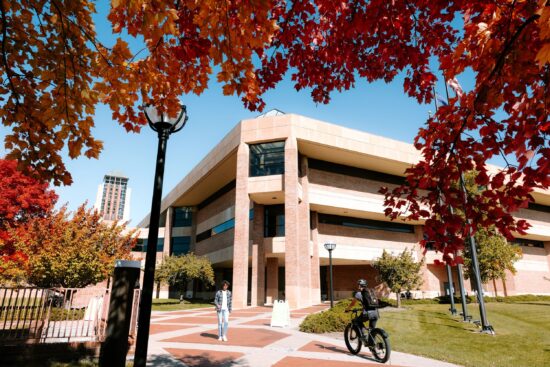
The three-story complex will include 60 lab modules and space for 18 professors in a 62,880 square-foot addition to the G.G. Brown Laboratories on Hayward Street on North Campus.
“Michigan Engineering has always been strong in traditional, large-scale mechanical engineering areas including automotive research. This new facility will propel us to the next level. It will allow researchers to pursue exciting projects at the frontiers of mechanical science and engineering, where the discipline intersects with nanoscience and biology,” says David Munson, the Robert J. Vlasic Dean of Engineering.
“We would like to thank our federal lawmakers U.S. Rep. John Dingell, U.S. Sen. Carl Levin and U.S. Sen. Debbie Stabenow as well as Gov. Jennifer Granholm for their support throughout this process,” he says.
This center will complement the College of Engineering’s Lurie Nanofabrication Facility, a state-of-the art lab where researchers focus on building devices at the nanoscale. In the new complex, researchers will develop the tools to measure, image, study and test nanoscale phenomena and devices.
The center will be designed with a tightly controlled experimental environment. Existing labs in mechanical engineering, designed for macroscale research, don’t have the right temperature, dust, vibration and noise controls for researchers to take accurate nanoscale measurements, says Jack Hu, associate dean for academic affairs in engineering. Hu is a professor of mechanical engineering and the G. Lawton and Louise G. Johnson Professor of Engineering. He led the proposal effort to NIST.
“Our current setting is full of water pumps and various machine tools, which are not appropriate for the new research we are pursuing,” Hu says.
“Nanotechnology is full of promise,” Hu says. “It has applications in manufacturing, in medicine and in solar and thermal energy conversion, to name just a few fields. Fundamental to all these areas is a good understanding of the mechanical behavior of nanoparticles and we don’t yet have that. Through this facility, we are providing an enabling platform for this research and innovation.”
Work in the lab will be divided into four thrusts: nanomeasurement, single biomolecule analysis, nanoscale energy conversion and nanomanufacturing, and nanoelectromechanical and microelectromechanical systems for medical research and diagnostics.
Construction is expected to start in spring 2011 and finish in May 2013. In addition to the NIST funding, this project is supported by $15 million from U-M, $6.5 million from the College of Engineering, and $15 million in private commitments.