First spacecraft to orbit Mercury carries U-M device
NASA’s MESSENGER vehicle now orbits the planet Mercury, and will continue to orbit the environmentally hostile planet every 12 hours for the duration of its yearlong mission.
An onboard device dubbed FIPS (Fast Imaging Plasma Spectrometer), designed and built at U-M, will take atmospheric measurements.
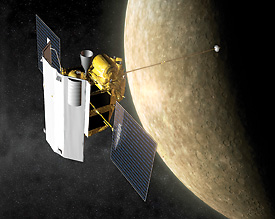
An artist’s interpretation of MESSENGER at Mercury. Image courtesy NASA.
“(The launch is) the culmination of decades of aspirations and dreams for the U-M FIPS team,” says team leader Thomas Zurbuchen, professor in the Department of Atmospheric, Oceanic and Space Science and Department of Aerospace Engineering at the College of Engineering. “FIPS will be the first plasma instrument to explore the plasmas in Mercury’s space environment.
“This will also be a celebration for the more than 60 students, scientists, engineers and staff who have collaborated on this project since its beginning in the late ’90s.”
MESSENGER, or MErcury Surface, Space ENvironment, GEochemistry and Ranging, was launched in the summer of 2004, with flybys of Venus in 2006, 2007 and three Mercury flybys between 2008 and 2009. On March 17, MESSENGER achieved orbital insertion above the planet closest to the Sun.
Never before has the surface of Mercury been observed in so much detail. Of all the terrestrial planets in the solar system including the Earth, Venus and Mars, Mercury is the most unusual and least explored among them. FIPS will analyze ions and solar winds contained in Mercury’s magnetosphere, the magnetic bubble that protects the surface of the planet, much like that which shields the Earth from solar radiation.
Michigan Engineering doctoral student and research computer specialist Jim Raines is running the FIPS instrumentation and Bob Lundgren is the lead engineer.
“In today’s NASA, it is very unusual to fly an experiment without heritage, but the scientists knew there would be a significant gap in the mission science without FIPS, so they accepted the risk of developing a new instrument, and Michigan was charged with the task,” Lundgren says.
Raines says: “We have waited a long time — most more than 10 years — for this moment to come and we look forward with great excitement to the discoveries that MESSENGER will make. With FIPS in particular, we hope to learn a lot about the dynamic and at times violent space environment of Mercury, including the direct impact of the solar wind plasma on the surface and its interaction with Mercury’s thin atmosphere and magnetic field.”
Zurbuchen also is associate dean for entrepreneurial programs at the College of Engineering.