New Taubman Scholars named
The second round of Taubman Scholars has been announced at the A. Alfred Taubman Medical Research Institute. Seven leading U-M clinician-scientists will receive the prestigious grants, which will give them unprecedented freedom to conduct “high risk, high reward” research with the intent of moving scientific discoveries out of laboratories and into doctors’ offices.
In addition, four Emerging Scholars were appointed; these are clinician-scientists who are early in their careers but show great promise for being future leaders in medical research.
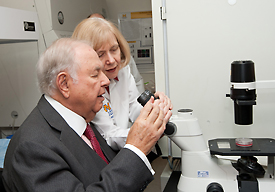
A. Alfred Taubman discusses research with Taubman Institute Director Dr. Eva Feldman. Photo by Scott Soderberg, U-M Photo Services.
The Taubman Institute was established in 2007 by philanthropist A. Alfred Taubman to provide U-M medical researchers the freedom and resources they need to pursue transformative investigations into understanding and treating a host of human diseases.
The Taubman Scholars represent the core program of the institute. They receive three-year grants consisting of $150,000 per year. These are the equivalent of medical “genius grants,” allowing them to explore new frontiers of medicine, such as stem cell therapy.
The Emerging Scholars will receive $50,000 a year for three years. In addition, four of the original Taubman Scholars have been named Senior Taubman Scholars to continue their research, with grants of $50,000 per year for three years.
The Taubman and Senior Taubman Scholars will receive unrestricted funding from the Taubman Institute’s endowment, which was created using $44 million in gifts to the U-M Medical School from retail pioneer A. Alfred Taubman.
Altogether there will be 15 Scholars in the Taubman Institute, whose laboratories employ 250 scientists. The Institute also hosts the Consortium for Stem Cell Therapies, the only facility in the state deriving embryonic stem cell lines.
“I am inspired by the energy, the creativity and the intelligence of these researchers, and am delighted that other donors have also been spurred to support these scientists,” Taubman says. “I am glad the Taubman Institute continues to support this tremendously important work.”
The original Taubman Scholars compiled an impressive list of accomplishments, including five human clinical trials of new treatments for disease and a total of 132 articles in leading scientific journals.
“The ground-breaking research of this group of physician scientists will be further advanced by the additional flexible research support provided through the Institute,” says Dr. James Woolliscroft, dean of the Medical School and the Lyle C. Roll Professor of Medicine.
All of the scholars were nominated by the initial group of scholars and other key research leaders of the Medical School. The nominees were evaluated and chosen by the Institute’s Scientific Advisory Board.
“Our scientists are tremendously grateful for the ongoing support of our work. This funding gives us true freedom to pursue innovative avenues to solving the complex health care questions of our time,” says Dr. Eva Feldman, who also is a Senior Taubman Scholar and Taubman Institute director.
The new Taubman Scholars are:
• Dr. Nicholas Boulis, adjunct associate professor of neurology and associate professor of neurosurgery at Emory University.
• Dr. Frank Brosius, professor of internal medicine and molecular & integrative physiology, and division chief, Nephrology.
• Dr. Charles Burant, Robert C. and Veronica Atkins Professor of Metabolism, professor of internal medicine and molecular and integrative physiology, and director, U-M Metabolomics and Obesity Center.
• Dr. Arul Chinnaiyan, S.P. Hicks Endowed Professor of Pathology; professor of urology; director, U-M Center for Translational Pathology; and Howard Hughes Medical Institute Investigator.
• Dr. David Ginsburg, James V. Neel Distinguished Professor of Internal Medicine and Human Genetics Warner-Lambert/Parke-Davis Professor of Medicine and Howard Hughes Medical Institute Investigator.
• Dr. Theodore Lawrence, Isadore Lampe Professor and chair of Department of Radiation Oncology.
• Dr. Kenneth Pienta, professor of internal medicine and of urology; director of Experimental Therapeutics, Michigan Center for Translational Pathology; and principal investigator, Specialized Program of Research Excellence in Prostate Cancer.
The Emerging Taubman Scholars are:
• Dr. Ronald Buckanovich, Marvin and Betty Danto Family Foundation Emerging Scholar and assistant professor of internal medicine and of obstetrics and gynecology.
• Dr. James Dowling, Frances and Kenneth Eisenberg Emerging Scholar, assistant professor of pediatrics and communicable diseases and of neurology, and director, Muscular Dystrophy Clinic.
• Dr. Johann Gudjonsson, Frances and Kenneth Eisenberg Emerging Scholar and assistant professor of dermatology.
• Dr. Erika Newman, Edith Briskin Emerging Scholar and assistant professor of pediatric surgery.
The Senior Taubman Scholars are:
• Dr. Valerie Castle, Ravitz Professor and chair, Department of Pediatric and Communicable Diseases; and pediatrician-in-chief and director of the Taubman Institute’s Neuroblastoma Research Program.
• Dr. Eva Feldman, Russell N. DeJong Professor of Neurology, director of the Taubman Institute and director of the Program for Research & Discovery.
• Dr. David Pinsky, J. Griswold Ruth MD & Margery Hopkins Ruth Professor of Internal Medicine; professor of molecular & integrative physiology; chief, Cardiovascular Medicine and director, Cardiovascular Center.
• Dr. Max Wicha, founding director of the Comprehensive Cancer Center and Distinguished Professor of Oncology and Internal Medicine.