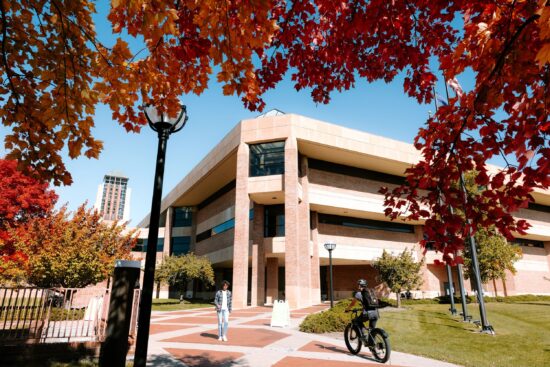
Smart building exteriors for reduced energy costs and a cleaner environment
Research

Within the “envelopes” of commercial and residential buildings rests the promise of major, new energy efficiencies in the built-environment, U-M researchers say.
A team of architects, civil engineers, and materials and environmental scientists will embark this fall on a two-year collaborative project they call Integrated Responsive Building Envelopes (IRBE). Together they will explore the potential of intelligent building exteriors, or envelopes, that are capable of monitoring weather, daylight and occupant use to manage heating, cooling and lighting in dynamic ways that protect the environment and promote energy efficiency.
“We’re exploring the interface between a building’s external environment and the shelter it provides, and exploring the adaptation of that interface to better control the flow of energy,” says Jerome Lynch, a principal investigator on the project and an associate professor in the departments of Civil and Environmental Engineering, and Electrical Engineering and Computer Science.
“We are working to mitigate the total energy consumption of buildings and their environmental impact, while enhancing their comfort and aesthetic appeal.”
Building energy and environmental footprints are huge, says Lynch, noting that in urban centers like New York City, they account for 75 percent of greenhouse gas emissions. Nationwide, buildings account for an estimated 72 percent of the electricity consumed each year.
While greener, more efficient buildings typically have been associated with roof-top photovoltaic panels or wind turbines, the IRBE vision focuses on advanced building materials with embedded sensing and control devices that respond to shifting exterior conditions and occupants’ preferences. These include windows that automatically balance the availability of natural with artificial light to meet occupants’ needs and walls that can store, heat, cool and transmit a comfortable supply of air as temperatures fluctuate throughout the day.

Panels like this responsive envelope system prototype could line the interior walls of tomorrow’s smart buildings, responding dynamically to human interaction, and adjusting to meet lighting and climate control needs. Photo by Peter J. Smith.
“We’re looking to provide hybrid building systems that are intelligent and responsive, by taking advantage of multi-functional materials that change their performance characteristics in response to various climatic conditions,” says Geoffrey Thün, also a principal investigator on the project and an associate professor of architecture at the Taubman College of Architecture and Urban Planning.
“The goal here is to make building envelopes with the dexterity to be more energy efficient and provide more user satisfaction while responding to seasonal and diurnal variations.”
The IRBE team will examine a range of materials and assemblies that can be utilized for the envelope. These could include transparent and opaque materials, glazing and pressurized film systems as well as new types of green, ductile concrete. The team also will explore the creation, placement and use of sensing and actuation devices within these envelope systems to enable them to respond instantly to shifting conditions inside and out.
In addition to Lynch, a specialist in sensor technologies, and Thün, an expert in dynamic building envelope component design, the IRBE team includes seven other researchers who will create discreet responsive components, including sensors that will be tested in their labs to examine their inter-relationships as an aggregate system.
The project has received $535,000 in seed funding from the Office of the Vice President for Research (OVPR), the College of Engineering, the Taubman College, and the Rackham Graduate School.
The IRBE team sees the OVPR grant as an opportunity to develop their concepts to the point where the can pursue additional external funding to refine their concepts. The timing, says Lynch, couldn’t be better.
“This project’s scope is very bold and has the potential to break a lot of old paradigms,” he says. “People have talked about these ideas as if they are 20 years away from becoming reality. We think the time is now and that’s what this project aims to prove.”