Paved trail connecting Matthaei to campus gets boost from MDOT
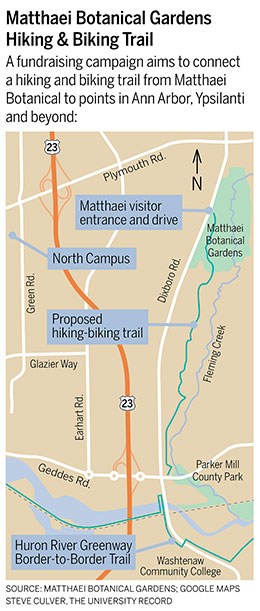
The dream of creating a paved, two-mile bike and walking path to help link Matthaei Botanical Gardens to Central Campus is expected to become reality next year.
The 10-foot-wide trail will make it easier for hundreds of students accessing the Matthaei Botanical Gardens area to get to study and work areas.
The Michigan Department of Transportation recently announced a conditional commitment of nearly $1.2 million toward construction of the trail — provided other entities including U-M can raise a matching amount to complete the nearly $2.5 million project.
“It creates a safe, non-motorized option to Central and North Campus for the University of Michigan. And for the local and state government entities it’s a critical strategic connector to Washtenaw County, to the Border to Border trail and Parker Mill County Park (both south of Matthaei), and to the governor’s (statewide) Iron Belle Trail,” says Karen Sikkenga, Matthaei Botanical Gardens and Nichols Arboretum associate director.
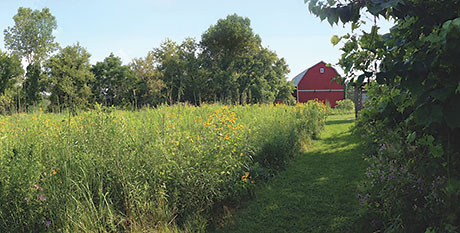
The trail winds through several ecosystems. Travelers will see forests, hills and wildlife including butterflies, and the trail should be excellent for birders. “We’re hoping to build it by end of next season, in 2016,” Sikkenga says.
While MBGNA has long sought to establish the trail, efforts stepped up a year and a half ago. That’s when a student intern was injured by a car, while riding a bike along Dixboro Road.
“We already had started advocating for the trail, but that encouraged a strong sense of urgency because we really want our students to be safe,” Sikkenga says.
The trail project provides a great example of what governments can do to make something happen when they agree on a goal. While U-M owns the land, only local governments are eligible to receive certain construction grants.
“It’s exciting how many different funding sources there are, and how this project aligns the strategic priorities of so many different constituents,” Sikkenga says. She says collaboration between U-M and Ann Arbor Township was key.
Ann Arbor Township Supervisor Michael Moran agrees: “The combined efforts of Ann Arbor Township and the University of Michigan will result in a trail project far better than either of us could have accomplished alone.”
U-M will coordinate trail design and pay contractors, with help from a $50,000 donation from Ann Arbor Township. Washtenaw County Parks and Recreation is contributing $250,000, and Ann Arbor Township has requested $300,000 from the state Department of Natural Resources. U-M also is providing public access to its land for the trail, and $600,000 in help is being solicited from corporate neighbors and individual donors, Sikkenga says.
The 10-foot-wide sturdy bituminous trail with 2-foot shoulders, following MDOT specifications, will be sturdy “and won’t get potholes quickly,” Sikkenga says. It will strictly be for non-motorized use — including bikes, strollers, walkers and hikers; no snowmobiles.