‘Millennium’ solar car to race in U-M team’s first Australian winter
Team's 18th car will drive with less solar power than ever but is amped by a dream solar array system
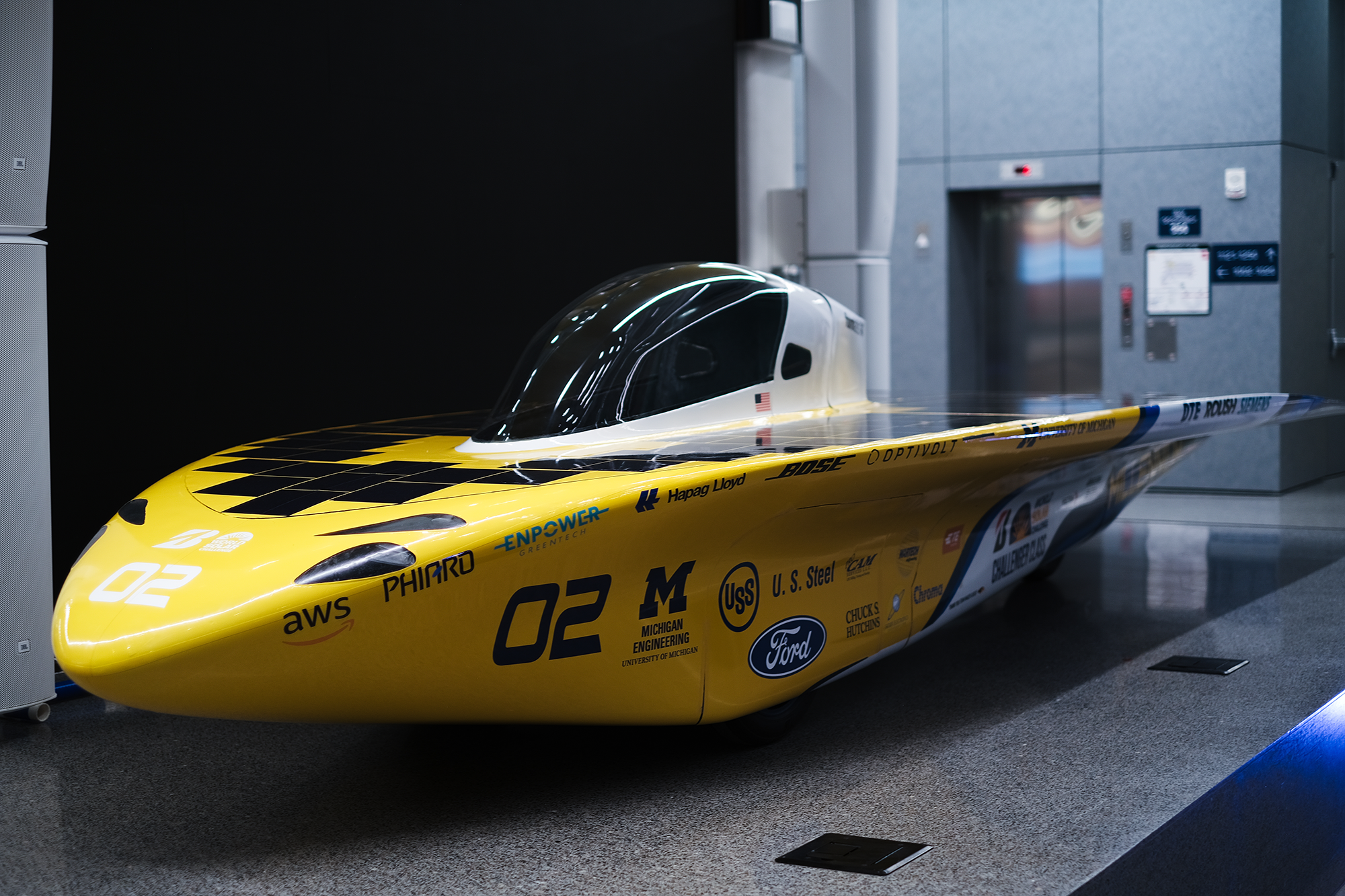
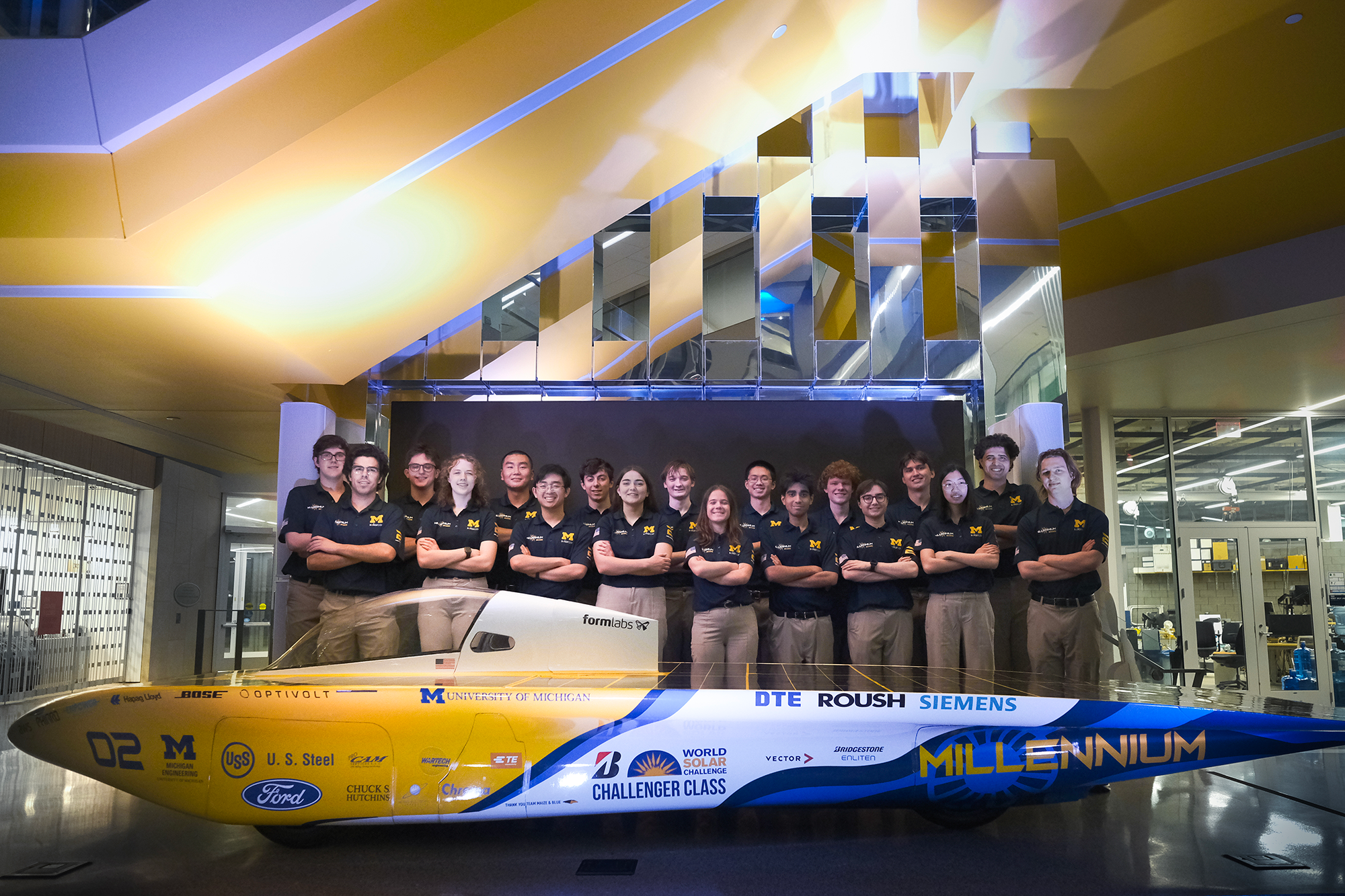
Equipped with a streamlined design and state-of-the-art solar panel management system, the U-M Solar Car Team unveiled its newest car, “Millennium,” at the Michigan Theater on May 23.
It will compete in the Bridgestone World Solar Challenge in August, a biennial race that draws engineering student teams from Europe, North America, Asia and Australia. The race begins in Darwin on Australia’s northern coast and ends at Adelaide on the country’s southern coast, around 1,800 miles away.
This year’s race will be the first to start in August, during the Australian winter. Traditionally, the World Solar Challenge takes place during the Australian spring in October. Race organizers threw the curveball to spark innovation in “green technology, energy efficiency and mobility,” according to a statement from the World Solar Challenge.
“Daily solar irradiation is around 20% lower than in October, and teams will need an even greater focus on energy efficiency,” Chris Selwood, the event ambassador for the Bridgestone World Solar Challenge, said in the statement.
The race’s timing isn’t the only new obstacle. This year’s regulations reduced the permitted battery capacity by over 60%. But the U-M team is eager to take on the challenge.
“I was extremely excited by the decision,” said Matthew Anderson, a junior in mathematics and the team’s engineering director. “There’s so much institutional knowledge that is built up around an October race — whether it’s the optimal angle for the solar array; the weather data we’ve accumulated; or even how the Port of Los Angeles operates. It’s made this year even more challenging for us, but it’s also going to be extra challenging for the competition, and we’re an adaptable team.”
Millennium sports a custom motor built without the heavy, iron core that can weigh down other electric motors. Its solar array is also 50% larger than the array on the team’s previous car, and a new hardware and software system allows it to tap into each cell individually to maximize power output. In the team’s past solar array systems, the under-performing cells were ignored, which reduced the total amount of power the arrays generated.
“The new system can double the amount of power produced in some circumstances,” said Taylor Kessinger, a recent master’s degree graduate in electrical engineering, who has been on the team for six years and co-led the development of Millennium’s solar cell-balancing system. “It’s a dream that the team has had for eight years, and it’s been awesome to work with our sponsor Optivolt to finally make it happen.”
The new balancing system is not just new to the team, but it’s relatively new to the entire solar panel industry.
“By engineering an efficient solution to the typical limitations of solar power, our team shows the world that solar belongs in more places than acres of gigawatt installations,” said Ronak Parikh, a senior in electrical engineering who co-led the development of the cell-balancing system.
The U-M team also designed Millennium to be reliable, which it learned is critical to success during the 2023 World Solar Challenge. An electrical issue shut down the 2023 car, Astrum, in the middle of the race’s “hot lap” — a speed test that determines the racers’ order at the starting line. The car that finishes the hot lap in the shortest time is the first to take off from the starting line during the main event. Because the U-M team couldn’t finish its lap, it started behind 31 other cars.
“We had a difficult start to the race, but we were able to overtake a lot of the competition, in part because we had a relatively low number of pit stops to fix other mechanical issues,” said Ian Bakker, a senior in electrical engineering and the team’s crew chief.
To reduce the chance of technical issues, the team consolidated redundant systems when designing Millennium. In the streamlined design, fewer parts can break with less to troubleshoot when an issue arises.
“We built a list of key lessons from all of our previous cars that we’ve used to streamline Millennium’s design,” Anderson said. “We’ve really tried to appreciate what the team’s last 35 years of experience have to offer. That’s why we’ve named the car Millennium, to reflect on our history.”
U-M Solar Car is a student-led engineering project team. It has won the American Solar Challenge 10 times, had podium finishes in the Bridgestone World Solar Challenge seven times, and won its first international championship in 2015 at the Abu Dhabi Solar Challenge. With more than 170 students from schools and colleges across the university, it’s one of the largest student organizations on campus.