Frank Lloyd Wright-inspired mural enlivens North Campus
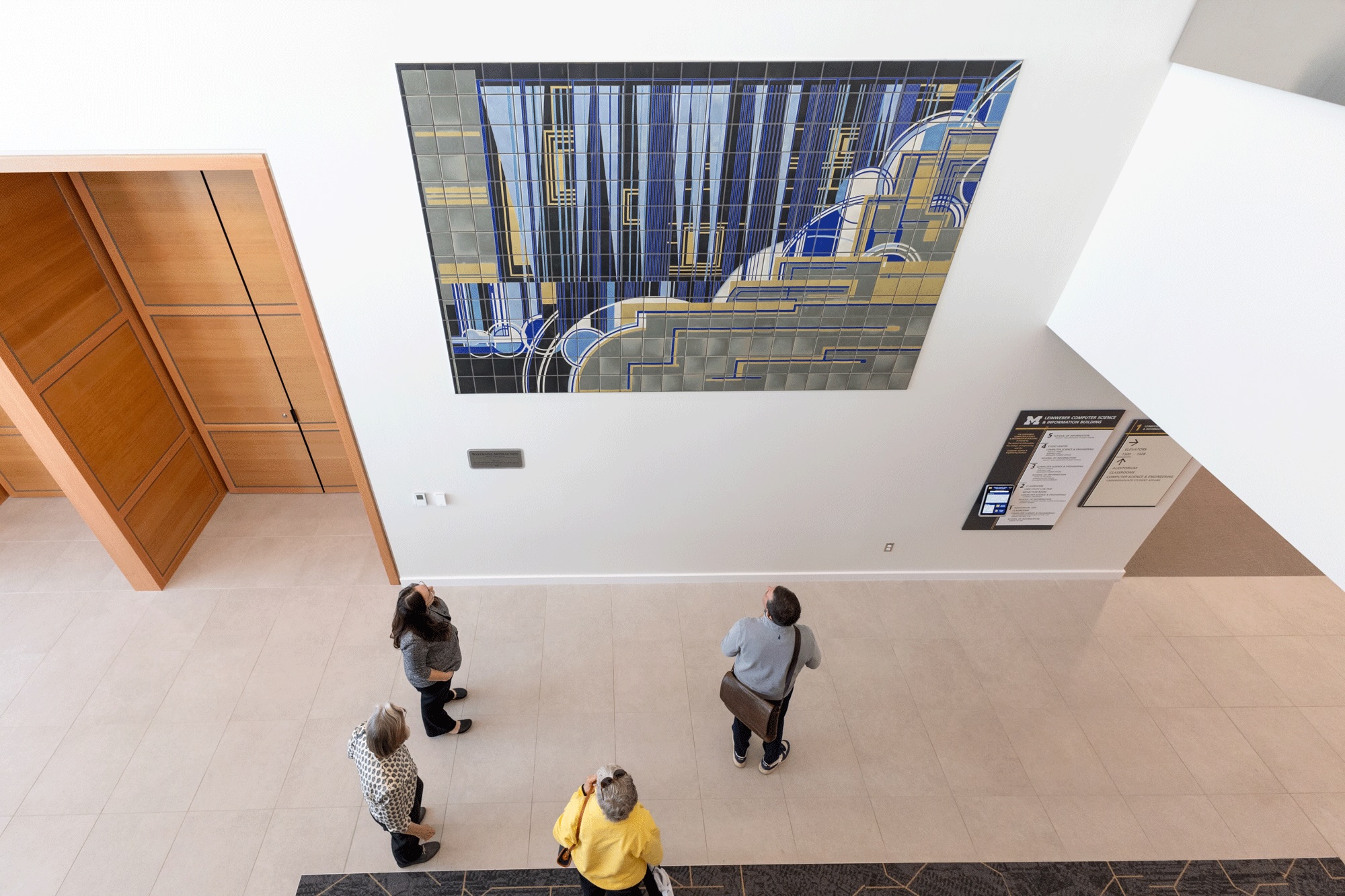
A bold new mural, titled Waterfall Abstraction, now welcomes visitors to the Leinweber Computer Science & Information Building on North Campus. The piece is located inside the Gerstacker Grove entrance.
Commissioned through a gift from Professor Emeritus John Laird and Ann Alpern, the mural continues the couple’s legacy of enhancing campus spaces with art.
Several years ago, Laird and Alpern funded a stained-glass installation in the Bob and Betty Beyster Building, and this new commission at the Leinweber Building was envisioned as a visual companion piece.
From Frank Lloyd Wright’s archive to U-M
The mural was designed by Nawal Motawi, a Penny W. Stamps School of Art & Design alumna and founder of Ann Arbor’s Motawi Tileworks. Its visual inspiration comes from Waterfall Abstraction, a drawing by Eugene Masselink, who was a Frank Lloyd Wright Taliesin Fellow.
Motawi, who has been the exclusive licensee to re-create Wright’s designs in tile since 2008, had long admired the piece but found it too complex for a smaller tile.
“When the donors showed me the Beyster Building’s stained glass, my mind went straight to Masselink’s design,” she said. “This project finally gave me the right space to bring it to life.”
The result is an 11-by-7-foot mural composed of 308 six-inch tiles, arranged to echo the flow of the building’s stairwell. Motawi simplified and adapted the intricate original, adjusting vertical lines and introducing a slightly new color palette. Where Masselink’s sketch relied on blue and tan, Motawi added deep yellow and a black background.
“With a black background, the design really sings,” she said
The artistic process
The mural was created using the Cuenca technique, an ancient method of hand-applied linework and glaze. The Motawi team transferred Masselink’s design onto each tile, then traced the lines with a piping tool filled with clay at a toothpaste-like consistency. The ridges created by this process allowed Motawi’s glaze artists to fill in each section with color, similar to frosting a cake.
Two veteran Motawi artists — Dee Dillaha and Stacey Weid — carried out the delicate piping process, which demanded precision and patience across hundreds of unique tiles. To ensure the large work came together seamlessly on site, every tile was carefully marked for orientation and sequence before being passed to the installer.
Making connections
For Motawi, the challenge of adapting Masselink’s design was balanced by the joy of working on a piece that already inspired her.
“When I’m simplifying a Wright design, I have to be careful not to design the enchantment right out of it,” she said. “You know you’ve gone too far when it stops singing.”
The mural also resonates on a personal level for Motawi. She has created large-scale installations across U-M’s campuses, including at UM-Dearborn, Michigan Medicine, and the Michigan Union. As a U-M alumna, she admits to extra pride in seeing her work on campus.
“It’s different when you’re creating for your own university,” she said.
Waterfall Abstraction is now open for viewing by students, faculty, staff, and the public.
“I love the idea that this piece might become part of people’s memories,” Motawi said. “For students especially, this will be a backdrop to years of important experiences. That’s what public art can do; it connects us to place, and it stays with us long after.”