CRLT consultant finds sobriety and support at U-M
For most of her adult life, Meg Stowe appeared to be thriving.
She worked as a beloved teacher and tutor, finished her master’s and Ph.D. in English — and landed a dream job as an instructional consultant at the University of Michigan’s Center for Research on Learning and Teaching.
In private, however, Stowe was battling a lifelong vulnerability to alcohol, shaped by childhood trauma and family alcoholism.
“I was a very functional alcoholic,” she said. “I had a perfect GPA. I was getting papers published. I was going to conferences. I earned teaching awards. Everything looked fine on paper, but I couldn’t go to bed without drinking.”
Today, Stowe is in recovery, her life structured around new routines, community and purpose. She credits her progress to her own willingness to be honest about her addiction — and to the practical and emotional support she found as a U-M employee.
“It’s not an exaggeration to say I would not have been able to get sober without the resources and flexibility I have here,” she said.
Growing up around alcohol and instability
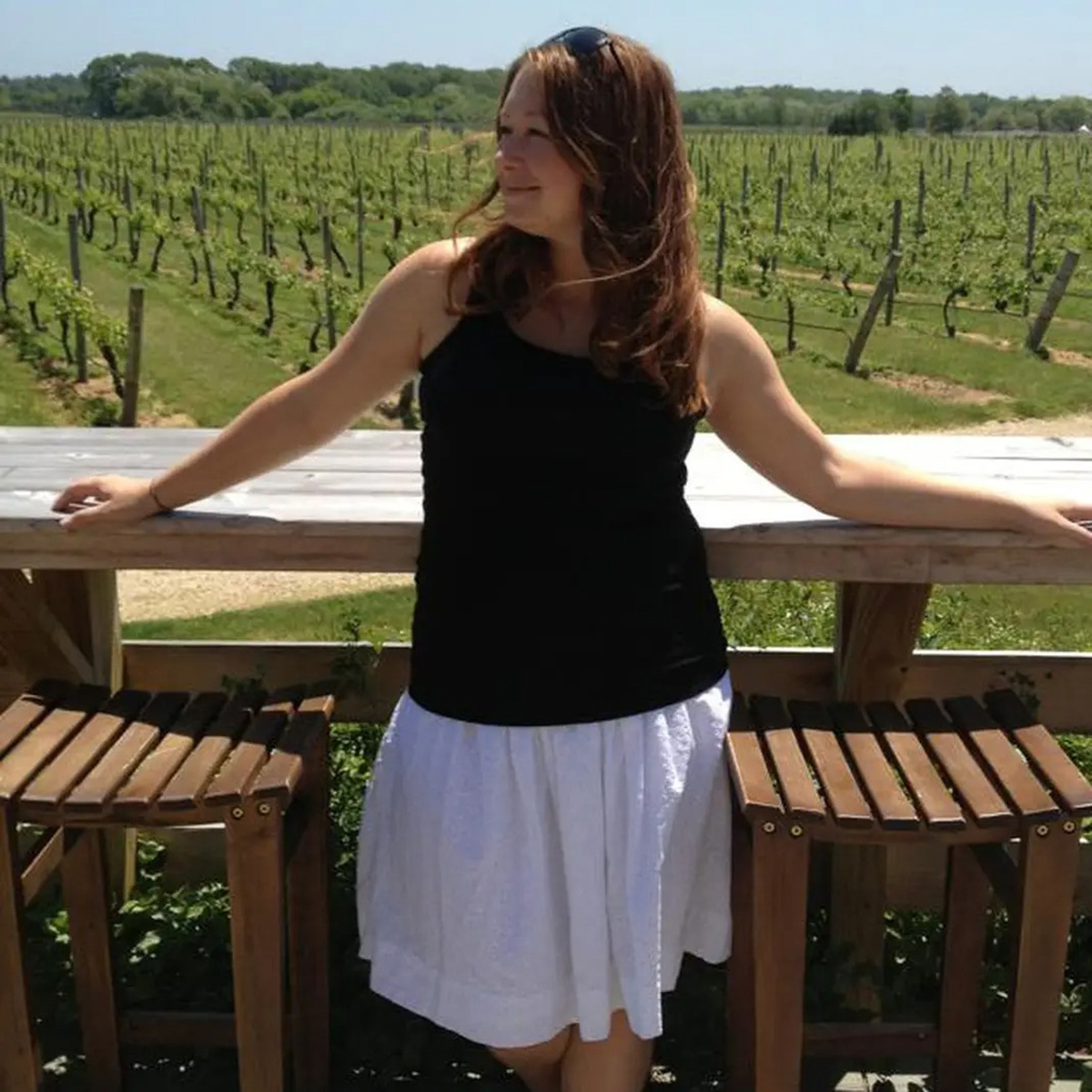
Stowe’s relationship with alcohol began long before her first legal drink.
She grew up in New York in a family where addiction was common and alcohol-related tragedy was normal. Her father was an alcoholic. So were her grandparents and great-grandparents. Her grandmother died in an accident tied to her drinking, and her grandfather died of cirrhosis of the liver.
“It was always there,” Stowe said. “Alcohol was just part of the background of my life.”
When she was 12, Stowe’s mother died. She and her younger sister were placed in foster care. By 16, Stowe had run away and later became legally emancipated.
Amid that upheaval, alcohol took on a new role.
“Being in foster care, alcohol became a coping mechanism,” she said.
From restaurants to wine and a culture of drinking
As a teenager, Stowe worked in restaurants, where wine and cocktails were central to the dining experience.
NOMINATE A SPOTLIGHT
- The weekly Spotlight features faculty and staff members at the university. To nominate a candidate, email the Record staff at urecord@umich.edu.
She learned about wine as part of her job, and that knowledge eventually led her to an appealing opportunity. In her mid-twenties, she relocated from New York to Florida and became a wine consultant and manager for Total Wine & More.
“It was kind of an entry-level job into viticulture,” she said. “My job was basically to taste all of the wine, learn the background and history, go to Napa and Sonoma, and then teach wine to our customer base.”
The role fit her curiosity and work ethic. But, she said, it also put gasoline on a fire that was already burning.
“The problem was already there,” she said. “But working in the industry just encouraged me to go further with it.”
Hiding in plain sight
After several years in the wine business, Stowe realized she’d rather be teaching. Before joining Total Wine & More, she had worked part-time teaching high school students in New York through Boards of Cooperative Education Services, a consortium of public schools that serves students with special needs and behavioral disabilities. She loved the work.
So, she pivoted to teaching high school in Florida, then decided to pursue a master’s degree and eventually a Ph.D. in English at the University of South Florida.
Her schedule during those years was relentless. She was a high school English teacher during the day, took graduate classes at night, then taught composition courses and tutored in any remaining time to help cover the cost of her education.
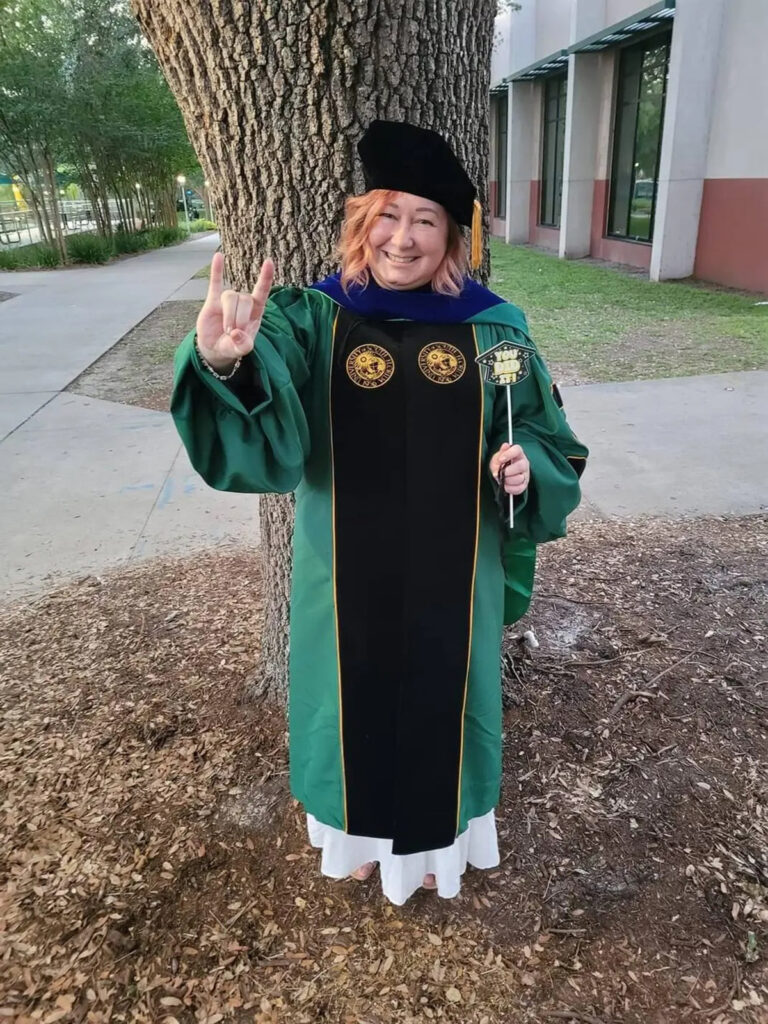
Later in her Ph.D. program, Stowe also added academic advising, additional adjunct teaching and running an honors living-learning community, all while writing her dissertation.
“It was nonstop. I never had a down moment for years,” she said.
The academic culture she inhabited was also deeply entwined with alcohol.
“Graduate school was probably the biggest shift in terms of how my alcoholism affected me, because it was a huge drinking culture,” she said. “Every activity was centered around alcohol — grading, studying, conferences, social events.”
While she looked like a success from the outside, inside she was exhausted and dependent on alcohol to wind down at day’s end.
“The fact that I was so high functioning and getting everything done meant I could tell myself I didn’t have a problem,” she said.
A new job, a new home and a hard truth
In May 2022, Stowe completed her Ph.D. A few days later, she started a new position at CRLT. Her husband, Mike Stowe, who works in the Newnan Advising Center, joined her soon after. They settled in Detroit, commuting to Ann Arbor.
For the first time in years, the pace of Stowe’s life changed. She had one full-time job, rather than several. She no longer had coursework competing for her energy.
“With that came the realization that I was spending a lot of my downtime drinking,” she said.
She still clung to the idea that she didn’t really have a problem because she never drank during the day. But every evening, she and Mike would open a bottle of wine with dinner, then another, and sometimes another.
“We kept trying to moderate,” she said. “We’d say, ‘We’re only going to drink wine, not hard alcohol. Or we’re only going to drink on weekends and holidays.’ But we could never stick to it.”
She started to think of herself as a problem drinker, but still not an alcoholic. Still, the failed attempts at moderation piled up. Stowe tried an outpatient program and stayed sober for its six-week duration, only to skip the final session and resume drinking almost immediately.
Finding help — and using her U-M health benefits
The turning point came when she decided to be candid with her U-M primary care physician, Jasmine Parvaz.
“I told her I was having a hard time stopping drinking,” Stowe said. “She suggested I could try naltrexone, and that I had access through the university to see an addiction specialist and get addiction counseling with my U-M insurance.”
That conversation opened a door.
Through University Health Service — now University Health & Counseling — Stowe began working with therapist and addiction specialist Cayla Yuhn. Rather than insisting she immediately stop drinking, Yuhn focused on helping Stowe understand her patterns: when and why she drank.
At the same time, Stowe began meeting with psychiatrist Paula Goldman at Michigan Medicine. Together, they explored medical options and the science of alcohol cravings.
Eventually, Goldman suggested trying Vivitrol, an injectable, long-acting form of naltrexone that can reduce cravings for alcohol. The once-monthly shot is expensive, but Stowe’s U-M health plan covered it fully for a year.
“I was the first person at Michigan to try Vivitrol,” Stowe said. “And it changed my life. I had absolutely no cravings for alcohol whatsoever. It felt like it flipped a switch in my brain.”
Instead of constantly negotiating with herself, she found that alcohol simply stopped sounding appealing.
Alongside the medication, she continued cognitive behavioral therapy with Yuhn and later began attending Alcoholics Anonymous.
Shared sobriety at home
Stowe’s husband is sober today as well.
“We have the same sobriety date,” she said. “He didn’t go on Vivitrol or naltrexone, and he doesn’t go to recovery meetings, but it’s been easier for him because now we don’t have alcohol in the house. We’re no longer making the other person responsible for our recovery.”
Sobriety has changed their home life in many positive ways, including their budget.
“It was incredible how much money we were spending on alcohol,” she said. “We were finally able to buy a house.”
Without evenings defined by drinking, Stowe has filled her time differently.
She and Mike host regular board game nights with friends, many of them colleagues from U-M. She goes to musicals and plays with co-workers. She and her mother-in-law have traveled abroad multiple times, visiting Paris, London, Strasbourg and Edinburgh.


Closer to home, Stowe has drawn on her own childhood experiences in foster care to mentor teenagers in the foster system through the Judson Center, a Detroit-area nonprofit.
“It’s incredibly fulfilling,” she said. “I know what it feels like to grow up without a stable safety net. Being able to act as a stable, caring adult in someone else’s life feels like a direct gift of my sobriety.”
A workplace that makes recovery possible
Stowe also manages several chronic health conditions, and she said she is only able to juggle her schedule of appointments because of her health coverage and the culture on her team at CRLT.
“Our insurance at U-M is incredibly generous,” she said. “If I didn’t have access to this coverage, there’s no way I could have afforded the amount of care I’ve had, especially the addiction treatment.”
Her manager at CRLT has also given her the flexibility to schedule and attend appointments.
“CRLT has been extremely flexible with me,” Stowe said. “They know I’m being treated for multiple conditions and that I’m in recovery. They’ve supported me in taking time off when I need it and in being honest about how I’m doing. That kind of support has made a huge difference in my recovery.”
Reframing alcoholism as illness, not failure
For Stowe, one of the biggest shifts in her journey has been how she thinks about alcoholism itself.
“I was really reluctant to believe I was powerless over this thing because I was so high-functioning and high-achieving,” she said. “I thought if I admitted I was an alcoholic, it meant I was weak or not the person I wanted to be.”
Now, she sees it differently.
“It’s like being a diabetic,” she said. “You have a disease that has side effects, and there are ways to treat it. You just have to trust the process, be honest with yourself and the people who love you and make the decisions you need to make for your health.”
That reframing has allowed her to talk openly with colleagues and supervisors about being in recovery, even though, she admits, it makes her nervous.
“It feels scary to be this open about something that’s still really stigmatized,” she said. “I want people to respect me as someone with a Ph.D., someone who teaches other people how to teach. But I think it’s so important to de-stigmatize alcoholism that I’m willing to do that work.”
She hopes her story reaches others who, like her a few years ago, are outwardly successful but quietly struggling.
“If more of us talked about these experiences as high-achieving people, as people in graduate programs, as people doing important work, there would be more opportunities for others to experience what I feel is the joy of sobriety,” she said.
“There’s this beautiful other life you could be living that you don’t know you have access to because you’re afraid to talk about it.”