U-M campus community strengthens waste-reduction efforts
Ruthven project highlights the impact of shared action
Across the University of Michigan, more faculty, staff and students are looking for simple, meaningful ways to support campus sustainability.
Waste reduction — one of the most visible and accessible ways for individuals to make a difference — has emerged as a key area where everyday choices create measurable impact for the campus community and the planet.
MORE INFORMATION
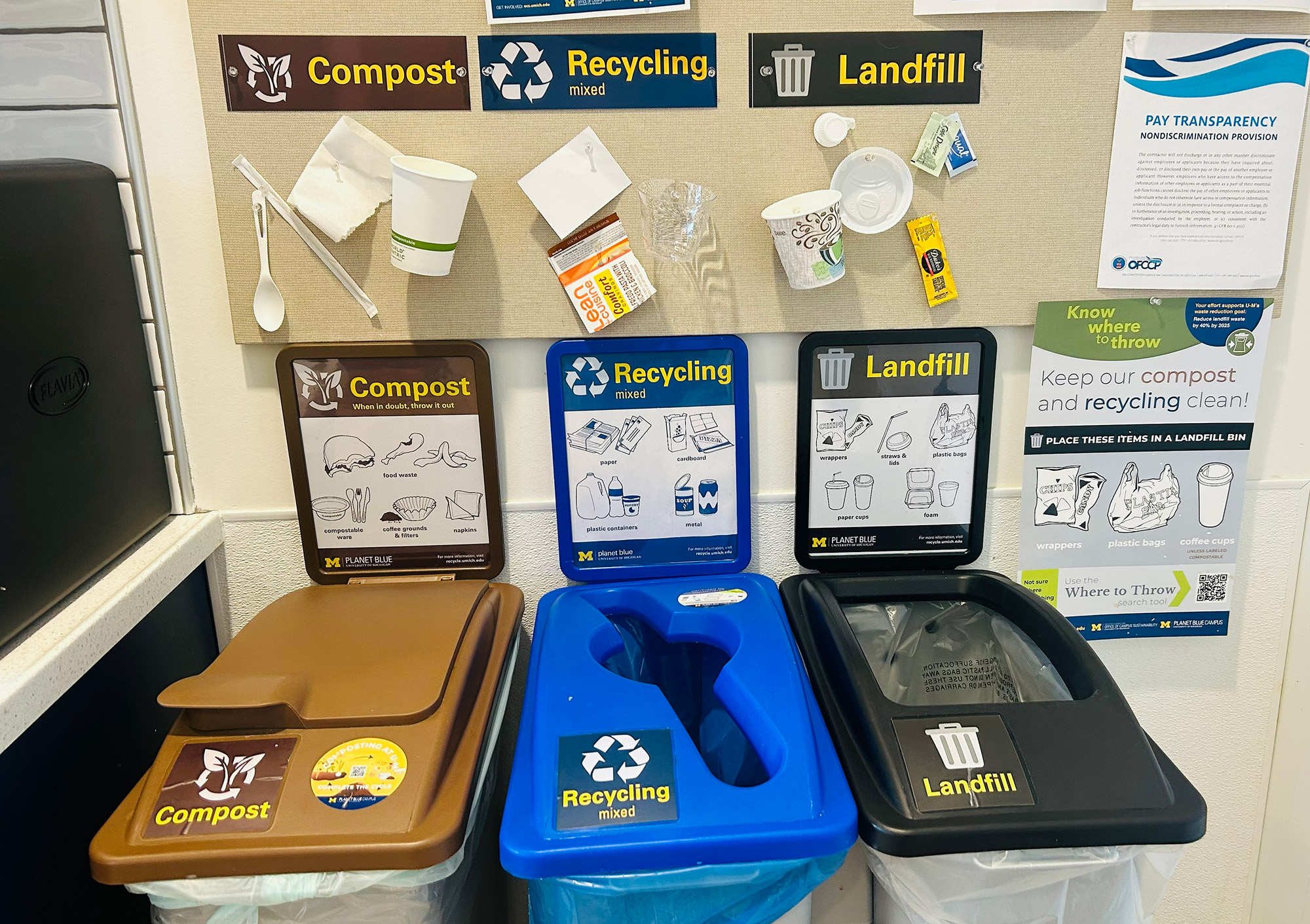
The university has established standardized waste bins and signage across campus to ensure that no matter where someone works, studies or visits, they can confidently sort their waste. Research and campus waste audits consistently show that placing bins in the right locations leads to cleaner recycling and compost streams, less contamination and fewer materials sent to landfill.
“Clear, consistent infrastructure makes waste sorting easier and empowers people to get involved,” said Nicole Berg, sustainability program manager in the Office of Campus Sustainability. “It strengthens our collective impact and improves the systems we rely on every day.”
Campus momentum
Over the past year, several U-M buildings have refreshed and standardized their waste-bin infrastructure, generating substantial gains for the campus community:
- At Hatcher and Shapiro Libraries, a compost-bin pilot led to a 40% increase in compost collection.
- Walgreen Drama Center saw a 380% increase in compost after adding standardized bins near student studios.
- The Perry Building increased its diversion rate by 28%, supported by staff champions and zero-waste events.
- The Administrative Services Building removed nearly 100 deskside bins, avoiding thousands of plastic bags each year.
- The North Campus Administrative Complex saw a 70% increase in diversion after removing non-standard bins and fully aligning with U-M’s bin standards.
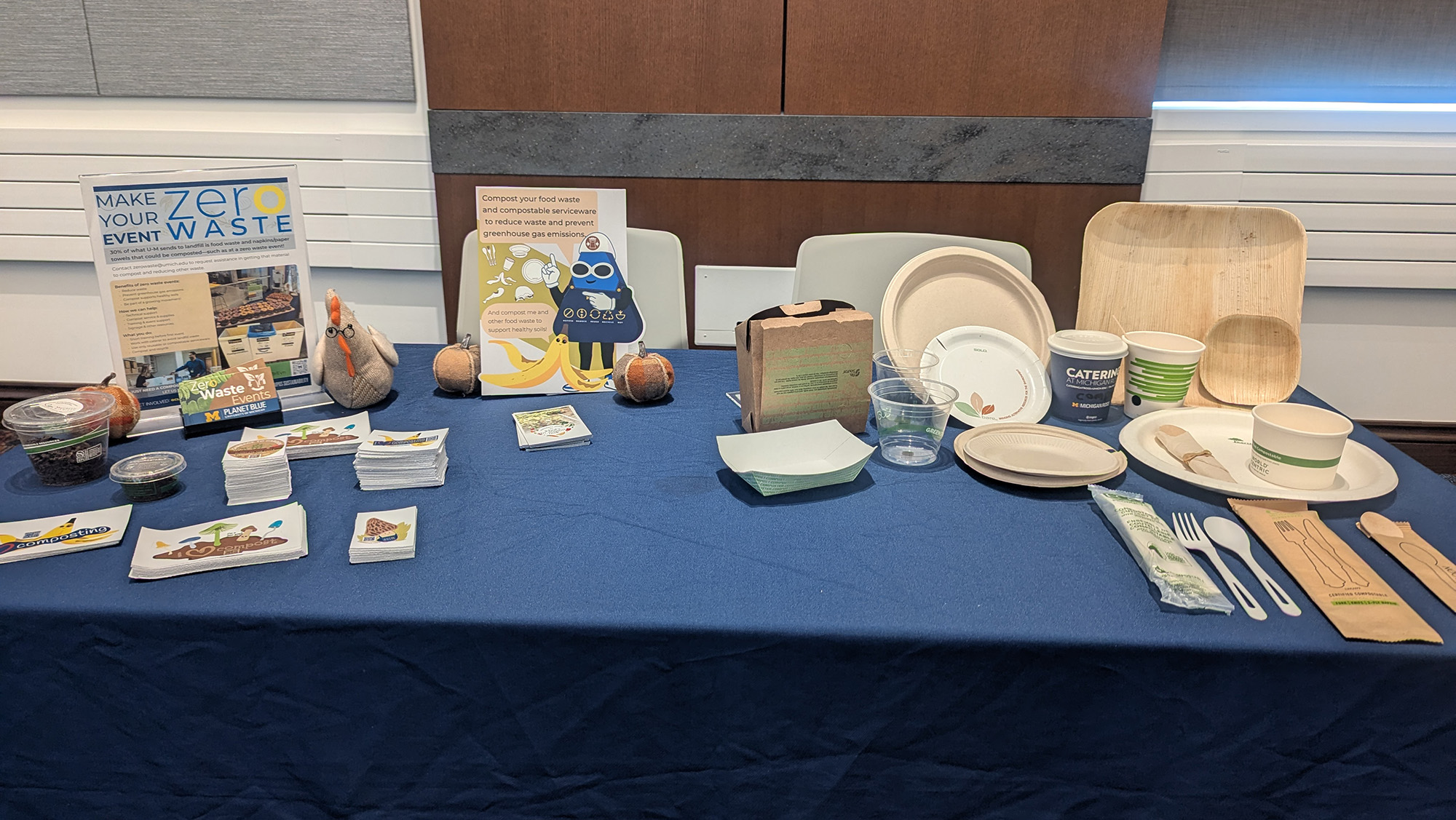
- The campus supported more than 500 zero-waste events last year, expanding access to reuse, recycling, and composting and reducing contamination at high-volume gatherings.
Beyond these building-specific gains, the campus also collected more than 12 tons of student move out donations and rehomed more than $776,000 of lab materials in fiscal year ’25. More than 800 staff kitchens now operate as zero-waste spaces.
Together, these efforts reflect a growing culture of participation and demonstrate how small actions across units can scale into meaningful institutional progress.
Ruthven test site
This fall, the Ruthven Administration Building became the latest site to evaluate the performance of centralized waste stations. Working with the Office of Campus Sustainability, the building removed deskside landfill bins and installed standardized recycling, compost and landfill stations throughout common areas.
Early results include:
- A 28% increase in materials diverted to recycling and compost.
- An 80% reduction in recycling contamination.
- A reduction in plastic liners equivalent to about 9,000 fewer bags used each year.
- A 20% decrease in total waste, suggesting people became more aware of what they were throwing away.
Based on the first month of performance data, compost collection is on track to reach approximately 3.9 additional tons per year, which would prevent roughly 1.1 metric tons of carbon dioxide equivalent — similar to avoiding 5,000 miles of car travel. If current trends continue, additional recycling and compost diversion could total more than 5.5 tons per year, roughly the weight of an adult male elephant.
“This effort introduced centralized waste stations in shared spaces with the goal of increasing visibility, encouraging awareness and learning how these changes could support more sustainable waste practices across campus in the future,” said Kim Kiernan, vice president for facilities & operations.
An area where some occupants kept their deskside bins, did not experience similar improvements. The contrast reinforces research showing that the full benefits of bin centralization are only realized when deskside bins are removed.
“Small changes like this help create cleaner, more efficient buildings,” Berg said. “People notice that the bins are consistent and easy to use, and the difference shows in the streams.”
Why it matters
Centralized waste stations provide numerous benefits to the university community. They reduce contamination in recycling, expand access to composting, reduce pests and odors and cut down on the plastic liners used in deskside trash collection. They also lessen repetitive bending and lifting for custodial staff and support healthier workplaces by encouraging proper disposal of tissues and food waste into bins that are emptied daily.
“Efforts like these help build the shared systems that make sustainability easier for everyone,” said Shana Weber, associate vice president for campus sustainability. “When sorting is clear and infrastructure is consistent, the entire community benefits — from reduced contamination to healthier workspaces and stronger alignment with our long-term goals.”
The model is used at peer institutions across the country, including Massachusetts Institute of Technology, Harvard University, Stanford University, the University of California, Los Angeles, Michigan State University, and Columbia University, and at companies such as Google and Etsy.
Centralized systems also align with broader sustainability goals by reducing greenhouse gas emissions, conserving resources and improving the quality of recycled and composted materials that re-enter the regional economy.
Campus as Lab model
Like many sustainability efforts at U-M, this work aligns with the campus as a lab model, which utilizes university spaces as testing grounds for data-driven systems improvements and creating hands-on learning opportunities. Data and feedback from efforts like the one in Ruthven help inform future operations standards and long-term sustainability planning.
“These efforts help us understand what works best at U-M,” said Anya Dale, manager of Campus as Lab in the Office of Campus Sustainability. “They allow us to approach sustainability as a shared learning experience and use real data to shape long-term change.”
Get involved
Community members can support the university’s waste-reduction goals by following instructions on standardized bins and signage, utilizing the Where to Throw tool to learn how to sort items, opting for reusable options whenever possible, and joining or forming a Green Team within their unit.
Units can also work with the Office of Campus Sustainability to access opportunities for improving bin placement and enhancing building-wide waste management systems.