Look to Leadership: Life Sciences Institute paving the way for next-generation scientists
At a time when federal funding and policies for science are rapidly shifting, many young scientists are wondering what the future of this field will look like.

As leaders, it is important for us to communicate to this next generation that scientists remain among the most trusted sources of medical and health information, and according to a recent national poll, more than 9 in 10 adults across the political spectrum believe it is important for the United States to remain a leader in research to improve health.
This survey from the nonpartisan group Research!America goes on to show that public trust in science remains high, as does the belief that basic scientific research that advances the frontiers of knowledge is necessary and should be supported by the federal government.
As a public university, we have both the privilege and the duty to expand access to the cutting-edge resources at our world-leading institution and to continue training the next generation of innovators for the future of science. That is what the Aspirnaut Summer Research Internship at U-M aims to do, as the first in a pipeline of education programs at the Life Sciences Institute for scientists from the high school through postdoctoral levels.
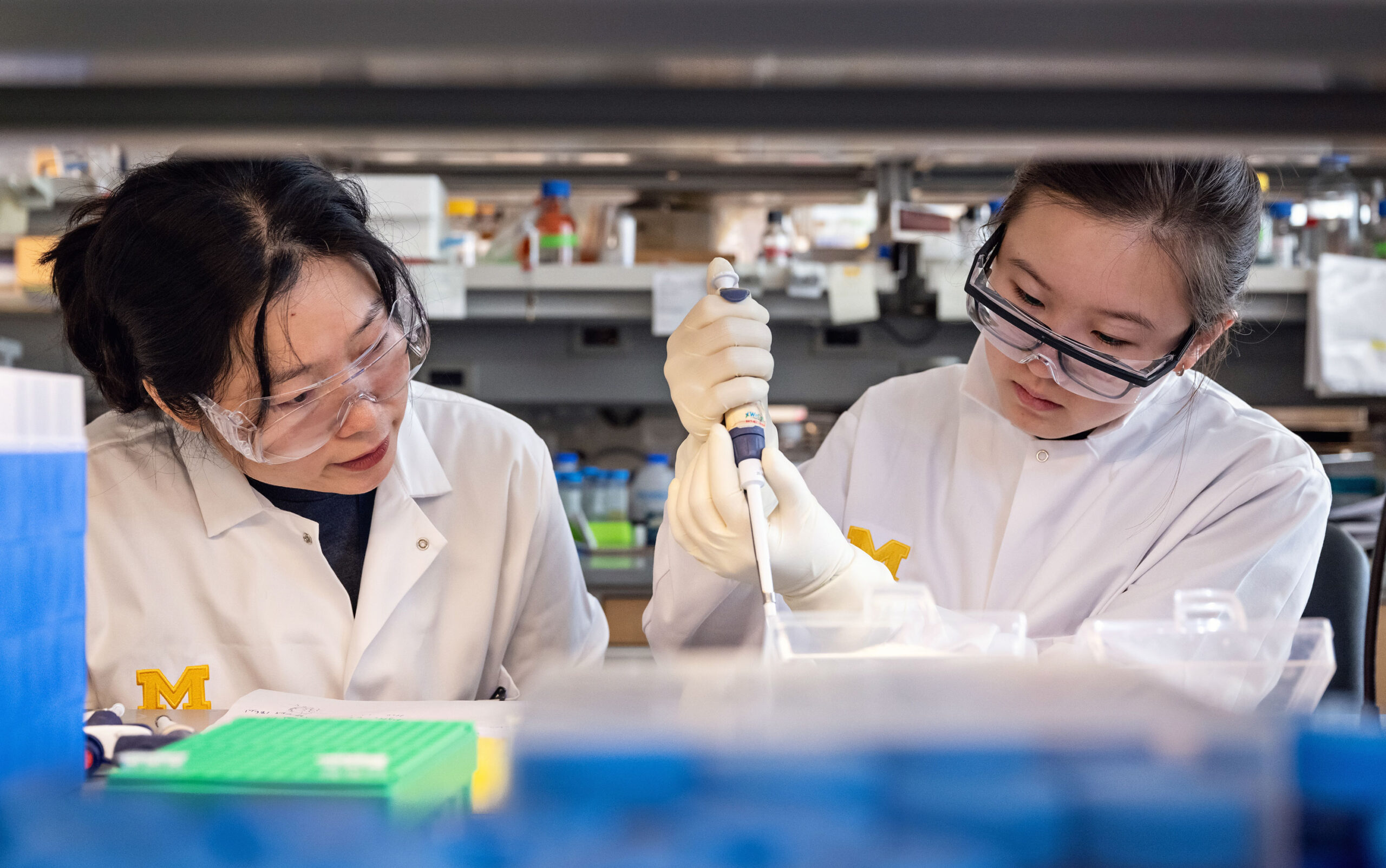
The Aspirnaut Summer Research Internship at U-M brings six to 10 talented high school scientists to campus each summer for a six-week paid internship in which students immerse themselves in the role of a scientist. We actively recruit from regions of the state from which the university does not ordinarily enroll many students.
get engaged
- A Faculty Forum on March 13 will explore how the Aspirnaut Summer Internship, D-RISE and BioMed Focus programs are providing a foundation for future success in science. Learn more.
Since the program launched in 2018, we have trained 60 interns from over 30 Michigan counties, including the Upper Peninsula. More than 40% of Aspirnaut interns have come from counties that had fewer than 100 students enrolled in U-M in 2023 (representing less than 1% of the 2023 student enrollment).
The internship is designed to provide participants with the knowledge, skills and experiences that will empower them to succeed in their next educational steps. While in the lab, they conduct their own research project and build research skills under the guidance of graduate student and postdoctoral mentors.
Outside of the lab, the interns develop skills that will prepare them for a successful transition to college, through writing workshops, professional development activities, standardized test preparation and the experience of living in dorms on a college campus.
RELATED STORIES
Several years in, we know that this design works: 100% of Aspirnaut alumni have matriculated at a postsecondary institution, almost half of them at U-M; 80% were the first in their family to attend college. More than half of the Aspirnaut alumni have gone on to major in a life sciences field, and another 15% are majoring in another STEM field.
It’s not just the data that lets us know the impact of expanding access to U-M’s resources; it’s the words of the interns themselves that tell us that this program is changing the trajectory of their lives. At the end of each summer, we invite the interns to participate in a survey about their experience. And each year, we hear that the program has inspired a new group of students — some of whom had never considered scientific research as a career option, or even thought they could attend college — to pursue further education and careers in research.
Certainly, the Aspirnaut program does not work in isolation, at the university or even within the LSI. We collaborate with myriad programs around campus — such as the Research Experience for Youth (REY) in the College of Engineering, D-RISE in the LSA Department of Chemistry, and BioMed Focus in the Medical School and the U-M Museum of Natural History — to maximize the impact of our resources and programming.
Within the LSI, the Aspirnaut program functions as the first steppingstone in a path that extends through undergraduate, graduate and postdoctoral programs we administer to connect aspiring scientists with their futures in STEM.
In addition to hosting undergraduate U-M researchers throughout the academic year, for example, we also open LSI labs to students from any Michigan college or university through our summer Perrigo Summer Undergraduate Fellowship. We have already seen Aspirnaut interns return as Perrigo undergraduate fellows, and had Perrigo fellows return to LSI labs while pursuing their Ph.D. at U-M.
Immersive, educational programs like the Aspirnaut program, the Perrigo fellowship, D-RISE, BioMed Focus, and so many more at U-M enable our university to serve our whole state and bolster the future of science. And they ensure that, regardless of what changes our students see on the horizon, they can Look to Michigan for opportunities to develop their scientific passions and gain the knowledge and skills to launch careers that can change lives.
— Roger Cone is the Mary Sue Coleman Director of the Life Sciences Institute, the Tadataka Yamada Distinguished University Professor of Molecular and Integrative Physiology in the Medical School, and a professor of molecular, cellular and developmental biology in the College of Literature, Science, and the Arts. His extensive research and discoveries related to the nervous system’s control of energy storage have earned him numerous awards and recognitions, including election to the National Academy of Sciences, and the National Academy of Medicine, and the American Academy of Arts and Sciences.