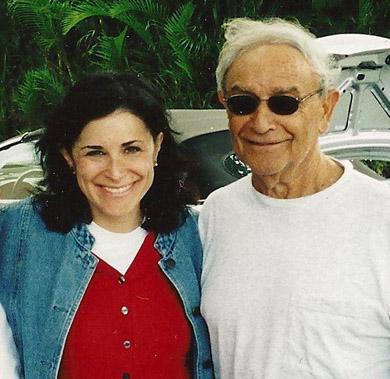
The author and her father. Their experience with poly-pharmacy — a condition with symptoms similar to dementia, brought on by a cocktail of prescriptions — led Julie Halpert to begin facing up to the end-of-life questions most of us would prefer to avoid. (Photo courtesy Julie Halpert.)Last spring, my 78-year-old father began a downward descent. Instead of initiating conversation in his usual gregarious way, he would stare into space, unresponsive, never wanting to leave the house. He scrambled to find the right words in conversation. Ultimately, a neurologist diagnosed him in the early stages of Alzheimer’s. We were told he needed to stop driving and would require constant supervision. Immediately, my sister and I were forced to confront a situation we never prepared for, scrambling to take turns spending time with him, showing my mother how to begin handling the finances and driving him to a round of doctor’s appointments. My father at the time was on 18 medications for his various chronic illnesses, including asthma, diabetes and low functioning kidneys. After reviewing these medications, the internist decided to take my father off eight of them. Within a few weeks, he started to emerge from his coma-like state. His alertness returned, along with his sense of humor and memory, and he was back to exercising regularly. His neurologist revised the diagnosis to medication-induced dementia. Now, just seven months later, he’s like his old self again.My father’s problem, called “poly-pharmacy,” is quite common, says Ken Langa, a professor of Medicine at the University of Michigan whose focus is geriatric care. As you age and face a host of chronic illnesses, it’s not uncommon to have several specialists prescribing varying medications that can interact to create a hazardous cocktail of side effects—one that’s often mistaken for dementia. Though I’m eternally grateful for my father’s turnaround, his experience made me realize just how ill equipped he, my mother, and his children were in dealing with the effects of aging. And I’m not alone. Preparing to handle an aging population will be one of the most daunting challenges our nation faces in the years ahead. In the U.S., an estimated 48.9-million people are caring for an adult, according to a 2009 study by the National Association for Caregiving and the American Association of Retired Persons. That number will most certainly escalate, as the number of people age 65 and older is expected to double by the year 2030, to 70-million, according to the U.S. Census. Social Security Commissioner Michael Asture calls this situation an upcoming “silver tsunami.” And, as baby boomers typically have smaller families, there will be fewer children – who often are geographically far apart—to share the burden of caring for an aging parent, Langa says. The University of Michigan Health System is one of many institutions adapting their care regime to take up the challenge of late-life care. U-M’s Geriatric Center, for example, is an umbrella that that can cover all aspects of care for older people. Jeffrey Halter, professor of Internal Medicine and director of the center, says that older patients may have heart and kidney problems, along with arthritis, memory difficulties and depression. “People spend their time going to a lot of doctors, and often there is nobody who has the time and background to pull a lot of this together,” he said. The Center had 20,000 patient visits last year, and it tackles more than medical issues, to include psychological, social and family support through interdisciplinary medicine that cuts across traditional department lines. There’s also a pharmacy team member who reviews all of the patient’s medications—so that problems like poly-pharmacy dementia can be headed off before they begin.
But families also need to take steps to face the future. Many don’t consider addressing end-of-life issues until a parent gets sick. Even when parents show symptoms that they’re failing, children may be slow to accept that they need to take on the parenting role. “They are, in many cases, in denial,” says Patricia Grace, founder and CEO of Aging with Grace in Philadelphia, Pennsylvania, a group providing resources for elder care. “To see the person who cared for you and took you to buy your prom dress or taught you to play sports dehabilitated and soiling themselves is devastating,” she says. At the same time, parents are often reluctant to discuss a delicate subject that implies their future death. That typically results in adult children having to make difficult decisions in a crisis—decisions that may even conflict with their parents’ desires. For both generations, it’s hard to think about the inevitable. But preparing in advance will help lighten the burden of what promises to be a stressful situation. Here are some tips on how to get there.Jeffrey Halter, M.D.
Have “the talk”
Is it too early for you to discuss these issues with your aging parents or adult children? If you think so, it’s probably the perfect time: when you can address the questions early, while everyone is still healthy. This conversation should take place in the parent’s home, ideally with all of the siblings present. “It’s better to have these kinds of discussions around a celebration when everyone is doing great than when faced with a catastrophe,” says Jeffrey Halter of U-M’s Geriatric Center. Children can begin by asking a parent if they’ve given thought to what they would do if they couldn’t take care of themselves. Keep the tone positive, saying things like, “We want to help you, just like you helped us, but we need to know your wishes.”
Head off sibling rivalries
When a parent’s health begins to decline, it can set off a firestorm of emotions among the adult children. These events can bring children closer together or tear them apart—and often do a little of both. Conflicts over money, resentments from those assuming the largest burden of a parent’s care, even lingering divisiveness over who is the “favorite child” can make end-of-life situations incredibly stressful. These types of tensions can get in the way of smooth decision making, Langa says. He’ll often suggest that siblings air their concerns, since merely acknowledging the tension can be a first step in moving forward in a healthier way. It’s best for siblings to sit down together, without their parents, and discuss a future plan of action, should parents become ill. Ken Langa, M.D.Langa suggests dividing up responsibilities, with one sibling handling health care and another dealing with finances to minimize conflicts. Joann Genovichy-Richards, AARP’s executive council volunteer, says it’s not uncommon for siblings to take sides on different approaches to a parent’s medical care, so the more that can be hashed out in advance, before a crisis, the less stressful that situation will be. If there is too much bad blood, she suggests third-party counseling for “short-term crisis intervention.”
Plan, plan, plan
Patricia Grace says that retirement living can cost as much as $50,000 a year, “so funds will deplete quickly.” Families need to speak frankly about what aging parents want, what they can afford, and what children can contribute, if necessary, to their living expenses.
Write a living will, and a regular will.
Assign a durable power of attorney.
Compose a regular will.
Discuss plans for future residence.
Plan your funeral, setting aside funding for it if possible.
Get a medical quarterback—geriatrics centers like U-M’s are sprouting up nationwide and can coordinate a senior’s care.
Cherish the present.
As parents and adult children go about the emotional process of getting end-of-life affairs in order, this is a good time for both generations to let each other know how much they appreciate each other. “Life is precious and short and I think we should not take our families for granted, young or old,” says Jan Busby-Whitehead, M.D., Professor of Medicine and Director of the Center for Aging and Health in the UNC School of Medicine. Express your concern, care and love and spend time with each other, if possible, so there are no regrets at the end.