Summer school for geniuses
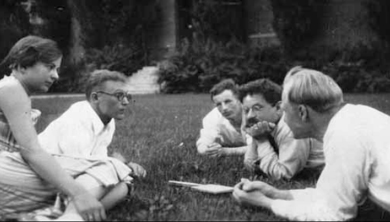
In the late 1920s and ’30s, no collection of scientific minds sparkled more brightly than the Summer Symposia in Theoretical Physics at the University of Michigan.
Geniuses sprawled on the sunlit grass of the Diag and wandered in and out of lecture halls and labs in the old West Physics building. A starstruck young graduate student might turn a corner and bump into the Danish Nobel Prize winner Niels Bohr, who, though in his 40s, was “like an extremely sensitive child who moves around the world in a sort of trance,” according to a colleague; he gave a two-week course on “The Foundations of Quantum Mechanics” in 1933.
One might encounter the muscular Italian Enrico Fermi, who, as a 17-year-old in Pisa, had written an essay on the physics of sound that his examiner said would have qualified him for a doctorate; he lectured on “Quantum Electrodynamics” in 1930.
Or one might exchange a few words with American wunderkind J. Robert Oppenheimer, not long out of Harvard, where he had generally taken six courses a semester for credit and audited four others; he graduated summa cum laude in three years. He lectured on the “General Quantum Theory of Transitions” in 1931.
Bohr had plumbed the structure of the atom. Fermi had pioneered the theory of beta decay. Oppenheimer would become the scientific director of the Manhattan Project. These three were among the architects of a scientific revolution and, before long, of the atomic bomb. Every summer for 15 years between the world wars, they and their colleagues came to Ann Arbor to teach and talk.
***
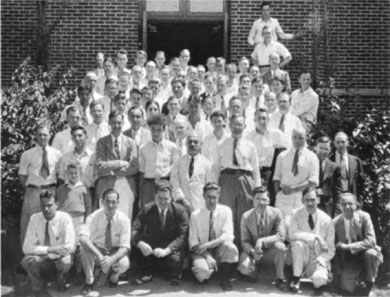
DURING THE 1920S AND ’30S, U-M’S SUMMER SYMPOSIA IN PHYSICS BROUGHT TOGETHER SOME OF THE WORLD’S MOST OUTSTANDING THEORETICAL PHYSICISTS. THEIR COLLABORATIONS WERE A BOON TO AMERICAN AND U-M SCIENTISTS AND STUDENTS, AND ALSO ACCELERATED FINDINGS IN ATOMIC STUDIES AND QUANTUM MECHANICS. (PHOTO FROM MICHIGAN ALUMNUS, COURTESY OF U-M BENTLEY HISTORICAL LIBRARY.)
Until the 1920s, American physicists worked chiefly on practical problems using mechanical equipment in laboratories; this was experimental physics. But in Europe, physicists led by Albert Einstein were probing the nature of the universe by purely mathematical means — that is, as the Polish-born physicist Stanislaw Ulam would wryly put it, with “a few scribbles on a blackboard or on a sheet of paper.” With such scribbles, Einstein and his European colleagues were opening up epochal theories about time, space, and matter. This was theoretical physics.
Michigan’s physicists became aware of the new ideas in Europe earlier than most of their American colleagues. This was due largely to Harrison McAllister Randall (1870-1969), the longtime physics chairman who, with the aid of Professor Walter Colby, recruited key faculty with European training — at first Oskar Klein, later Otto LaPorte, Samuel Goudsmit, and George Uhlenbeck. He also recruited David M. Dennison, the son of a U-M classics professor who had earned his PhD at Michigan and gone on to postdoctoral work under Bohr at the University of Copenhagen. (U-M’s physics and astronomy building is named for Dennison, who was a member of the faculty for half a century.)
Excitement about the new ideas led Randall to convene summer sessions where professors and students could get up to date. From 1924-27, experimental physics was included. But Randall thought the talks in theoretical physics were so much more rewarding that he rededicated the summer sessions to theoretical physics alone. Armed with their European contacts, the young Michigan theoreticians succeeded in luring many of the best new thinkers to Ann Arbor — though never Einstein himself — and they taught their own summer courses, too. It was the only summer program in the U.S. where American physicists could learn about the new ideas from the founders of the field. So every year, some 100 professors and graduate students gathered for informal talks and official courses — some just two weeks long, some up to eight weeks in duration.
They were put up wherever rooms could be found, even in fraternities.”It was a place where you came to learn the modern approach to the theory of molecules, atoms, and nuclei,” said Professor Jens Zorn, who joined the physics department in 1962. “Quantum mechanics really got rolling in 1926 and nuclear physics made great advances in 1932. In those years the number of people who really knew quantum mechanics was fewer than 500, and a substantial fraction of those were participants in the Michigan Summer Symposia.”
Zorn said physicists who attended the symposia developed critically important friendships and collaborations: “One can track the origin of many significant publications to exchanges of personal letters and manuscripts between physicists who had become acquainted at the Summer Symposia. Those interactions, supplemented by the exchanging of reprints of journal articles, were important sources for students and researchers, since the handful of books on quantum mechanics and nuclear physics did not cover the latest advances.”
Bradford Orr, the current chair of physics, said: “These symposia … were critical to America’s achieving international status in theoretical physics.”
The summer school wound down with the coming of World War II. When Randall Laboratory was renovated in the 1980s, Jens Zorn asked the workmen to slice off the front of the main lecture bench. It was cut into sections to be given as gifts to recognize contributions to the department.
“This bench,” Zorn said, “had been touched by the greats.”
On December 11, in commemoration of the Summer Symposia in Theoretical Physics, the American Physical Society will dedicate U-M’s Randall Laboratory as one of 20 APS historic sites.
Sources for this article included Jens Zorn’s interview with Nicole Casal Moore of U-M’s College of Engineering and Thomas M. Kuhn’s 1964 oral history interview with David M. Dennison, sponsored by the Center for the History of Physics at the American Institute of Physics.