An alum's atonement
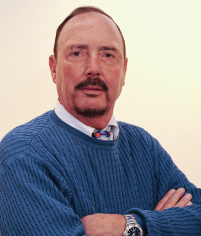
Robert Wollack, president of Wolverine Human Services, stands outside the door to a meeting room in one of his Detroit juvenile facilities; inside, a small group of teenagers sit around a table with a staff member. Wollack sticks his head in to say hello—in turn, each child approaches to shake Wollack’s hand and exchange pleasantries. All except one girl, who refuses to get up from her chair.This particular group of children was meeting with a counselor as part of the benefits offered at the community center, but there’s a wide range of reasons why kids find themselves under the WHS umbrella: some need a safe place to go after school; some have been convicted of crimes and are assigned here as a residential alternative to jail; some are intellectually challenged; some need emergency placement due to dire circumstances in their home life, like abuse, neglect, or behavioral conflicts. Whatever the reason, Wollack’s thinking is that these children need something beyond punishment and confinement.And so, demonstrating correct greeting skills—a basic nicety among many that several of these children never learned or even witnessed at home—is important at WHS, and all of the kids would know it is especially important when Wollack, who founded the non-profit over 20 years ago, is present. Wollack awards all who did greet him with 50 points—about 10 times the regular amount given in the WHS programs for demonstrating this skill—which the kids can redeem for books, music, toiletries, candy and so on at on-site “stores.” Knowing how important those points are to the kids, Wollack offers the girl another chance for her to greet us, without insisting. But she won’t even turn around to look us in the eye. After finishing his walk-through, Wollack is about to return to his car when the girl and a staff member come ambling across the parking lot. Shyly, the girl quickly introduces herself and shakes hands, then turns to go back. Wollack seems glad, and shouts after the staff member, “Give her 25 points.” A beat passes, and Wollack shouts again, “Give her the whole 50 points.” Giving a child the means to succeed, and developing the enthusiasm to do so is what Wollack lives for—and rewarding a child for good behavior is what his program is based upon.On a personal level, Wollack’s encouragement of these children, step by step, handshake by handshake, is also a kind of atonement. Though you wouldn’t know it to look at him, he’s no ordinary do-gooder. Yes, he’s a graduate of the U-M School of Social Work, a teacher, a community and industry leader, a tireless advocate for the poor and disadvantaged, and the outspoken leader of his nonprofit organization—the second largest provider of social services to at-risk children and their families in the state of Michigan. But Robert Wollack also made serious mistakes in his past, ones that affect the work he does every day.Born and raised in the Bed-Stuy neighborhood of Brooklyn, Wollack, the oldest of 8, had a rough childhood himself, encountering hunger and violence many days. He was tough. Trained as a butcher, he abandoned that business for a stint as a green beret, then joined the New York Police Department. In addition to the accolades and decorations he earned as a cop, Wollack also drank, snorted cocaine, received “on the arm” freebies, slept through shifts, and collected protection money with his lieutenant. He arrested certain troublesome drug users at the request of one of the largest heroin dealers in the nation, who paid the officers for covering him.Eventually, Wollack got in so deep that there was a price on his head. By the time he was 27, he was arrested, charged, and convicted for conspiracy to sell cocaine. Wollack then served over two years of a six-year sentence at the Federal Correctional Institution in Milan, Michigan.So how does a fallen cop and ex-con become a children’s advocate and a leader in social services? Like the underprivileged girl in WHS’s John C Vitale Community Center, he had a second chance, and he turned himself around. This second chance came in prison. There, Wollack met a recent U-M School of Social Work graduate, Mark Glesener, and his U-M SSW professor, Chuck Wolfson, who conducted group and family therapy sessions for the inmates. Inmates were faced with a choice: “getting better at being a criminal”—and likely coming back to prison with a longer sentence in the future—or changing. Wollack chose change. Working with Glesener and Wolfson provided opportunities: vocational testing, education, post-prison job opportunities. His more educated inmates—many whom were there as a result of protesting the Vietnam War—motivated Wollack intellectually. He started taking college classes and read constantly. While his bad behavior in the NYPD was not only condoned by his superiors but expected, Wollack witnessed a different sort of professional life in prison: one that was safe and worthwhile. Inspired by the therapy he witnessed and participated in, he came to believe that social work could be his way of helping people too. When he was released, with Glesener’s and Wolfson’s encouragement and help, Wollack attended Eastern Michigan University to gain additional credits toward his bachelor’s degree. Before he ever earned that degree, he was accepted into the U-M SSW himself. Wollack struggled to come to terms with his past, but put it to work for him: “I did very well [in the U-M SSW], because I had life experiences.” While in school, Wollack also worked at local group homes. He invited U-M athletes to stop by the homes, as he suspected they would make good role models for the kids and increase their self-esteem. In fact, he found the athletes so helpful that when he founded his agency, Wollack hired many former U-M athletes to his staff. As he was doing this social work, he discovered a few key tactics for helping kids and families: discipline, for instance, communication, the structure that organized sports can provide. In the years to come, he developed these into his social work approach. Wollack graduated with honors from the U-M School of Social Work in 1978. In 1986, after working in social agencies in Michigan and in Arizona, Wollack founded his own social services non-profit. Calling it Wolverine Human Services, as a nod to U-M and the many alumni and former athletes that had helped him, he started with one boys’ home in Detroit. Now the organization includes 15 programs or centers, including homes for girls and boys; treatment and residential programs for the sexually reactive to the cognitively impaired to the drug addicted, among others; foster and adoption programs; an emergency shelter; and a soup kitchen and community center.WHS provides basic needs, but Wollack’s real goal is to offer something just as precious: a second chance.He knows the benefits of a clean slate first-hand. And he knows how desperately children need second chances when their histories are sullied with past crimes, abuse, poverty, addiction, disability, neglect—or, often, a combination of problems. “I knew how to arrest people, how to control people,” says Wollack, “and now I was working on the other side of the system, which was helping people. So I understood the whole system. I understood the backgrounds of the kids, I worked them as a cop, I lived them as a kid. So I’ve always worked with the poor and needy, my entire life. I was locked up with them too.”Wollack’s seven principles—reality, responsibility, respect, communication, negotiation, education, love—are displayed in most rooms of his facilities, along with photos of Gandhi and Martin Luther King Jr. He and his staff practice those principles actively, daily, with the kids. “Kids need to be helped,” he says. “That’s the reality of the situation….We can protect these children, we can train them, we can teach them, we can give them what they need.” WHS also offers vocational programs in butchery, culinary arts, janitorial training, and horticulture. Wollack hopes to give the kids he works with “an opportunity to participate in the workforce.” In addition to this and their academic pursuits, the kids are also able to eat regular meals and visit the doctor and dentist, sometimes for the first time in their lives. Most importantly, while walking through the various WHS buildings, even the maximum-security facilities, the impression one gets of Wollack, his programs, and his staff is that they hold all children in high esteem. His sometimes-gruff toughness—he identifies both as a street fighter and an outspoken leader whose passion is going to kill him—and unfiltered directness is softened by his openness, accessibility, and oft-utilized catchphrase—”peace and love”—with which he closes phone conversations or meetings, or writes in signings of his book. With a staff of over 600, Wolverine Human Services has been a huge success, despite recent setbacks due to county and state funding cuts. In 2000, Wollack was asked to give the commencement speech at U-M’s School of Social Work. He remembers it as “probably the proudest moment of my life.”
Today, he remains very busy. His compelling and surprising book, published in May of 2010—They Will Be Victors—details his personal and professional journey. In it, he reflects on “those whose choices take them to places they would rather not have visited, but whose salvation lies in what they are learning, and what they will ultimately do with their lives.”
His wife Judith has taken over day-to-day operations of WHS, letting Wollack focus on big picture projects like lobbying, advocacy, and starting a foundation, the Friends of Wolverine Human Services, to further create opportunities for rehabilitation for young people. And he still wears a U-M ring—he owns two—every day. The ring, he says, “represents my life…this is my life. Without this ring, I wouldn’t be where I am today.”