Before the G.P.A.
For more than half a century, the system of As through Es that we take for granted—the system responsible for so much toil and anguish down through the generations of students—was quite foreign to the University of Michigan.
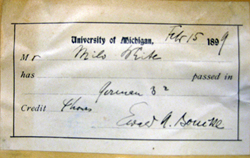
In its early years, the state was populated by pioneering farmers loyal to the frontier egalitarianism of Andrew Jackson. In their eyes, the whole business of ranks, distinctions, and awards had the perfumed odor of European aristocracy. In the classroom, professors expected the Michigan student to meet a standard of hard work and intellectual attainment. If he—there were no “shes” at Michigan until 1870—proved he had done so in regular recitations and exams, he earned a “pass.” If not, the judgment was “fail” or “condition,” the latter meaning the student could be reexamined on the part of a course where he fell short. No further distinctions were considered necessary. No honor points, no pluses and minuses, no grade-point averages.
Since few academic records survive from U-M’s earliest years, it’s hard to determine how the earliest students were evaluated. But the no-grades policy was certainly in place by the Civil War. In 1866, President Erastus O. Haven, a classics scholar, explained that Michigan students were assumed to be both “competent and inclined to perform their duties without an appeal to the puerile ambition engendered by rank in classes and prizes and medals… It is doubtful whether these even promote good scholarship… and it is certain that they engender strife and envy, if not hatred…”The proper stimulants to study,” Haven added, “are not medals, or position in class, or prizes, but the gratification produced by an enlarged acquaintance with truth, and by the greater influence for good thereby produced.”
The greatest defender of Michigan’s policy was at first a reluctant convert. James Burrill Angell, president of U-M from 1871 to 1909, came to Ann Arbor from New England, where marking systems were standard. As a student at Brown, he had earned high enough grades to win election to the honorary society Phi Beta Kappa, and as president of the University of Vermont, he had presided over a faculty that graded its students. So Michigan’s system struck him as odd.
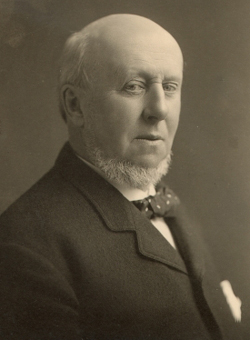
Yet after a single year at U-M, Angell declared: “I may properly say that I am fully convinced by what I have seen here…of the uselessness of [a marking] system for students like ours. I have never seen a better average of class work than I find here in the classes of the teachers, who insist on having good work done by their pupils, and who possess in a fair degree the power of inspiring them with enthusiasm.”
The policy was in keeping with Angell’s vision for Michigan–that it should provide “an uncommon education for the common man.” Over his 38 years as president he argued repeatedly that “broader, heartier, better work” was done by those who studied simply “for the sake of learning” than by those who were merely scrapping for grades. “A collegiate course cannot be wisely shaped with primary reference to driving drones to work,” he declared. “It should provide every manly and noble incentive to worthy achievement.”
Of course there were students for whom no incentive worked. For them Angell had a simple solution. He sent them home. And he was no ivory-tower theorist. He was in the classroom every year, teaching a highly popular course in the history of international law. Angell thought a student’s weekly work was a better gauge of academic progress than his performance on high-pressure exams. A graduate of 1904, Charles Sink, recalled a period in Angell’s course when he finished his exam much earlier than his classmates. When Sink handed in the paper, Angell looked up “with much surprise,” since Sink had finished so early. A few days later, a letter arrived at Sink’s rooming house. It was a summons to the president’s office. Sink hurried over. Angell greeted him warmly but said his exam had been a poor job. He had looked up Sink’s record, the president said, and discovered not so much as a “condition,” let alone a “fail.”
He invited Sink to sit and handed him a bluebook with a new set of questions. When Sink finished this second exam, Angell read it carefully, then asked why this one was so much better than the first. Sink confessed that Angell’s original exam had been the third of three he’d taken that day.”Three examinations in one day is too much,” the president said. “That accounts for it, because your paper today is excellent. I am going to pass you.”
Other students in the class might have complained that Sink got a special break. But in this noncompetitive regime, the point was simply to evaluate how much Sink had genuinely learned, not to administer an arbitrary set of rules. Angell concluded that the test had been at fault, not Sink.
Angell stepped down from the presidency in 1909, and the no-grade policy barely outlived his tenure. Younger academics trained in highly competitive institutions thought grades were the proper carrots and sticks to induce harder work. Corporations and the professions were increasingly looking to colleges and universities to pick the brightest out of the bunch. And Michigan students—aware that their Ivy League rivals could boast of high grades—added their own demands for a system of honors and distinctions.
Phi Beta Kappa established its first chapter at Michigan in 1907, and in 1912 the faculty approved an across-the-board system of awarding grades for each course from A through E. To students, the innovation would soon seem to be a grim fact of nature, as inevitable as winter following fall. But those who yearn for some better inducement to learning than the weary scramble for grades might think over the example and advice of President Angell.
“One of the encouraging signs in our American collegiate life,” he wrote in 1874, “is [the] willingness to admit that possibly something yet remains to be learned about collegiate methods and the courageous readiness to try new ways.”
Sources included the President’s Reports to the Board of Regents; “The University of Michigan: An Encyclopedic Survey”; The Chronicle; The Michigan Daily; and Shirley W. Smith, “James Burrill Angell: An American Influence” (1954).