'Remember your mother!'
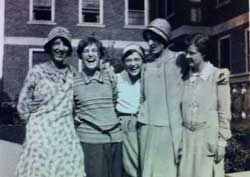
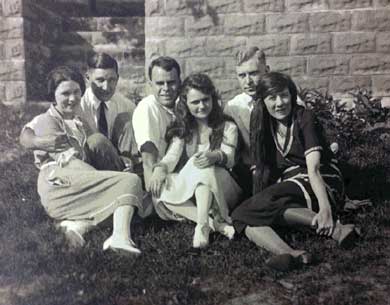
“You are no longer a high school boy or girl,” U-M President Marion LeRoy Burton warned members of the entering class in 1921. “You are a college man or woman. This University is a place of freedom … But do not forget, I beg of you, that independence and freedom do not mean anarchy and license.”
With those stern words, the popular President Burton introduced the campus to a little book called “Advice to Freshmen by Freshmen.” Just 109 pages long, it gives a revealing glimpse of student life at the start of the “Roaring Twenties.”
“I should like to advise every Freshman,” Burton wrote, “to read this little book very carefully.”
* * *
“Advice to Freshmen by Freshmen” was written by a little collective of students at the end of their first year on campus. Their names are lost except for one, Lionel G. Crocker, a member of Theta Chi listed as the copyright holder. The dedication—”To The Pleasant Associations With Freshman Rhetoric In 202 West Hall”—suggests it was begun as a class project.
The authors’ advice hints at a social order under stress. Enrollments were surging, and the 19th-century ethos of college as a bastion of the upper crust was giving way to a more democratic culture. The writers of “Advice” were finger-waggers, instructing those they saw as rubes and social climbers in the manners and morals of a passing regime.These were the key instructions:
Respect class hierarchy. Freshmen should know their place, like children.

Mind your appearance.
Important at all times, this was downright urgent in the ordeal of the Greek rush, especially for women, since, though “there are many fine independent girls in school,” it was understood that “down in her innermost soul, every girl who comes to college cherishes the hope that she will be a sorority girl.”

A girl going through Rush must mind every detail.
“Have your shoes shined and your hair net intact; remember that you are on exhibition and you want to look your best; a mere trifle like a missing hook often is the reason why a charming girl does not ‘make’ a sorority to which she has been rushed.”
Men, too, must be on guard against small slips, especially “if you are a stranger” to a particular fraternity, with no “legacy” connections with the “brothers.”
“You may rest assured that you are going to be subjected to a pretty stiff inspection. The points that count most are money, personality, athletics, and scholarship … Watch your step. Every act … counts either for or against you. If you are blessed with an abundance of money, don’t advertise it … If you are exceptionally witty and bright, keep the dimmers on until the proper time.”
Be a good mixer.
Like young Babbitts, the writers of “Advice” preached the value of broadening your circle of acquaintances (but only of the better sort) and making friends (but not too many).

“There are many places you will meet people, men mostly. Women at Michigan are not, by far, to be looked down upon but men are important. There will be dances, mixers, smokers and other functions. If you can break away from your studies for a few minutes, your time won’t be wasted … By the end of the first semester you will call many by their first names or nicknames, but not too many. Often calling a man by his first name on a short acquaintance is regarded as an imposition and is resented.”
Women were cautioned to “be a good sport”—”the sum total of all that is desirable in a Michigan Co-ed”—that is, “to bend to the wishes and inclinations of others occasionally [and] gracefully, but without losing your own personality.” Above all, don’t be a bore, since “bores are numerous here, and needlessly so.”
“A bore drifts into other people’s rooms, occupies their best chair; eats their fudge; reads their new magazines before they themselves have a chance to; plays their Victrola and scratches their best records. A bore talks hours at a time about people whom you have never heard of and in whom you haven’t the slightest atom of interest … She is avoided like the plague.”
Resist temptation.
With the Jazz Age just underway, the authors of “Advice” were on the lookout for the lower forms of pleasure, even motion pictures, for “a very dangerous disease in a college town is the movie mania.”

In the era of Prohibition, bootleg booze was a danger.
“You will probably hear about the ‘student stills.’ Please remember that it is not necessary to be ‘stewed’ to be a ‘stude.’ If you have heard, resist the temptation.”
Men should be polite to the women on campus, even friendly. But they were warned against the disreputable practice of “fussing”—paying constant, fawning attention to co-eds.
“The habitual ‘fusser’ is the worst campus pest. Avoid perpetually escorting a co-ed around the campus. It is positively sickish to see a college man studying in the library with a co-ed … Are you forgetting what you came here for?”
The darker temptations could not even be mentioned by name.
“Do away with the idea that a young man has to ‘sow his wild oats.’ Some students come here hoping to see how bad the world can be and go much farther than they expect. Terrible diseases are in many cases the result. Think of the folks at home. Remember your Mother.”
The co-eds themselves were apparently above temptations of the flesh. The advice on morals was directed only at men.
What about you? What was the best advice YOU got when you started college? What was the worst? What advice was the most hopeless or pointless? Share your stories in the comments section.