50 years of miracles
Tied for first
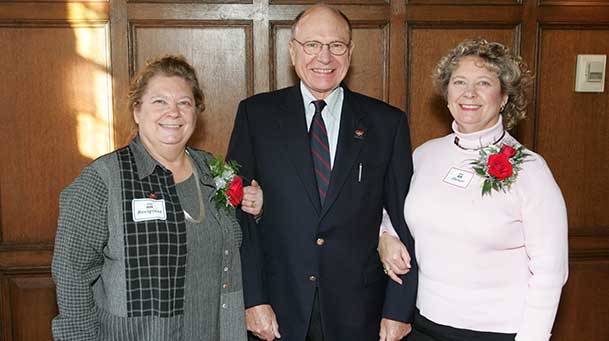
Identical twin sisters Janice and Joan Ottenbacher were just 15 years old when they underwent a groundbreaking operation at the University of Michigan.
Janice was dying, her kidneys failing. Joan agreed to donate a kidney. And as their parents waited anxiously, the twins successfully survived the first kidney transplant done in Michigan.
Fifty years later, the sisters are healthy and thriving. They both became nurses, got married, had children and grandchildren.
Recently the twins joined with the University of Michigan community to celebrate the 50th anniversary of the U-M transplant program.
“I should have not been here, 50 years ago, if it weren’t for God’s hand in our life and the technology and the doctors and nurses at the hospital,” says Janice Ottenbacher Schroeder, who now lives in Craig, Colo.
Joan Ottenbacher Teltow, who lives in Casco, Mich., says Janice paid her $25 for the kidney. But the best gift was having her sister live a long healthy life.
Leading the nation
Since the twins’ transplant in 1964, the University of Michigan Transplant Center counts more than 10,026 organ transplants, of which 1,065 were for pediatric patients. Only about a dozen centers nationwide have done that many procedures.
“We are quite proud of the superb legacy and commitment to compassionate care, education, and innovative research at the University of Michigan Transplant Center,” says Tony Denton, chief operating officer, U-M Hospitals and Health Centers, and executive director, University Hospitals. “Our physicians, nurses, and care and support teams make a real and positive difference for patients and families each day.”
“An amazing milestone”
Transplant surgery has come a long way since the Ottenbacher twins’ operation in 1964. At that time, transplant was very new and often limited to identical twins because immunosuppressant drugs weren’t needed to prevent the donor from rejecting the organ.
In the last 20 years, important medical breakthroughs such as tissue typing and immunosuppressant drugs have allowed for a larger number of organ transplants and a longer survival rate for transplant recipients.
“It’s an amazing milestone, and we’re thrilled that Janice and Joan have done so well since that first transplant,” says Jeff Punch, M.D., director of transplantation at U-M. “The team at the University of Michigan Transplant Center has always been on the cutting edge, and we look forward to a future where we continue to push the state of the art.”
U-M surgeons perform transplants of hearts, lungs, pancreases, livers, kidneys, and corneas. About 400-450 transplants are done at U-M annually, mostly kidney transplants followed by liver, heart, lung, and pancreas.
More information about becoming an organ, tissue, bone marrow, or blood donor is available at www.wolverinesforlife.org.
This story comes courtesy of the University of Michigan Health System, which originally published it May 27, 2014.
(Top image: Twin transplant recipients Janice Ottenbacher Schroeder (left) and Joan Ottenbacher Teltow (right) with transplant surgeon Dr. Jeremiah G. Turcotte. Image courtesy of UMHS.)