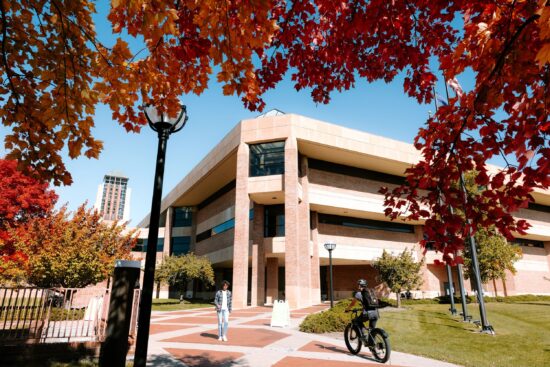
Episode 4: How we went blue, featuring Albert Ahronheim

Podcast Transcript
Episode 4: Albert Ahronheim — “How we went blue”Albert Ahronheim: You know, I try to put myself back into that particular moment. I remember parts of it, but in general, what I would do is…. he sang to me. I’m assuming he’s singing “bom bom bom buh-dah, bom bom bom buh-dah, bom bom bom buh-dah bump bump bump.”
James Tobin: Yeah!
Ahronheim: And I’m not sure I guess that he probably shouted “let’s go blue,” actually. I told you I have the score – the original score – here in my sketch and I looked at it and I thought that this is definitely George’s handwriting. He wrote: “yell ‘let’s go blue.” And I thought that was very funny because I don’t remember if I realize that that was what was going to happen there or not. So probably after I finished the sketch and I showed it to him before I did the full arrangement, he probably wrote “yell ‘let’s go blue’” there. I recognized his handwriting immediately, and I thought wow that is really very funny because I did not remember that at all. So he would’ve sung that baseline to me or some version of it, and then I sat at the piano and I thought about it. I try to figure what it was structurally that we were trying to do. And I could have made a lot of different choices. I could have just repeated: “bom bom bom buh-dah, bom bom bom buh-dah, bom bom bom buh-dah…” You you, you can just keep going like that and get the audience more, and more riled up or something in expectation. I really have no idea what I was probably thinking at the time. But I settled on doing the baseline by itself once, in other words: “bom bom bom buh-dah”. And then doing it again an octave higher. Partly because I wanted to get the rest of the band in it. And if you start with just the baseline then it’s probably just the tubas. But you know, I took lessons with Jerry Bilik, you know who Jerry Bilik is?
Tobin: Oh yeah, that great arranger.
Ahronheim: One thing that he always taught, was that for the most part, everybody plays all the time because you know, you’ve got 100,000 people that are a 100 yards away – more than that and you’re not in a concert hall – so there’s no reverberation. And so you have to use all your resources as well as you can. So, at the very beginning, I had the tubas playing but I also had the trombones playing and alto horns playing and all the woodwinds down in the lower octave. This is getting very esoteric, probably. (laughs)
Tobin: No, it’s fascinating! Actually, maybe this is a good point to play the start of the 1977 version that you sent us.
Ahronheim: Okay.
(Music plays)
Ahronheim: Yeah look at that nice, easy, swinging tempo! (laughs) So you can hear, or maybe you can’t, that the tubas are playing *sings low* “bom bom bom buh-dah!” But the trombones are also playing down there. But the first trombones are playing *sings higher* “bom bom bom buh-dah!” I was singing it in falsetto. And together it makes a nice chunky sound, and carries for a long distance, and it cuts through with the more treble-y sound with the first trombones. And so that’s how the first statement goes.
Tobin: Let’s go to the next part.
(Music plays)
Ahronheim: The trumpets are up one more octave in unison and then the next two bars, I just wanted… I just got bored with that damn baseline. And so if the baseline is the melody, then it goes on for four bars and it goes “bom bom bom buh-dah, (louder) bom bom bom buh-dah!” And then I changed, I added my own melody, which is *sings third part melody* start at the beginning and it was counted through.
Tobin: Okay, gotcha
(Music plays)
Albert Ahronheim: So there’s the base, and the trumpet added. And that whole thing repeats.
Tobin: I see.
(Music plays)
Ahronheim: So I know that what I was thinking was, I wanted to come up with a substantial piece of music as opposed to just this repeating baseline idea.
Tobin: I see.
Ahronheim: So there’s the second section which is I guess you call the contrasting section. The baseline becomes just the baseline accompaniment of a completely different melody, where the trumpets go… and I’ll sing it for you… better do it in an octave that I can sing *sings new melody* “let’s go blue!” With the trombones having a different countermelody behind that. So the baseline just sort of becomes a true baseline as opposed to the melody.
Tobin: I see.
Ahronheim: I think that it was probably “what can I do after that baseline?” You know, I wanted to do something else. So I just started singing something that seemed to generate from that, came up with that thing for the trumpets, then I harmonized the trumpets. And then I realized that in sort of a true Michigan Marching band, Jerry Bilik fashion, (laughs) the trombones needed a countermelody not to make it too highfalutin-sounding but its counterpoint – like baroque music – was sounding very very artsy and highfalutin. It’s just that the trombones are going down while the trumpets were going up or while the trumpets are holding steady in this case. And that just gives the whole thing more movement, more fun, more volume, more interest. It’s arranging more than it is composition. But, composition and arranging are intimately related. What I did is an arrangement based on this baseline. I came up with that new melody, well I guess that’s composition, you know, but I don’t want to make too much of it. It’s not Beethoven.
Tobin: It’s not Beethoven, but it sure has had an enduring power.
Ahronheim: It’s a lot of fun. There’s no question that it’s fun. I had no idea how much fun it was going to be.
In the mini-podcast above, Albert Ahronheim and writer Jim Tobin deconstruct this iconic tune, starting with Ahronheim’s initial conversation with George Cavender.
If memory serves
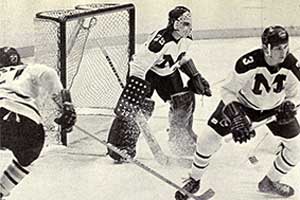
The way Ken Burke remembers it, the whole thing started — though it certainly didn’t end — with the tuba players in the University of Wisconsin band.
It happened some time in the hockey season of 1973-74. Burke, a junior in the business school, was hanging out with a couple friends in his apartment at the corner of Tappan and Oakland.
One of them was Tom Blaske, a law student. He and Burke had both played tuba in the Michigan Marching Band.
The other guy was Robbie Moore, a neighbor of Burke’s. He was also the All-American goalie on Michigan’s hockey team.
Moore always got a kick out of the pep bands that played at hockey games. That night he got talking about a tune he’d just heard on a road trip to Madison.
Burke and Blaske both remember what Moore said: “There’s this cool thing the Wisconsin hockey band does.”
And he sang a catchy little tune that had stuck in his head, with three staccato notes at the end — bup-bup-bup.
That was it. Burke thought no more about it — until the following fall, when the Marching Band traveled to Madison. There Burke heard the Wisconsin horns play that ditty with the bup-bup-bup, the same one goalie Moore had sung.
Again, that was that — until one winter night when Burke walked down to Yost Arena to watch a hockey game.
In the stands he spotted the hockey pep band, a ragtag bunch of volunteers who pumped up the crowd with jingles and Michigan songs.
Burke walked over to a tuba player he knew named Joe Carl, one of the pep band’s unofficial organizers.
He said: “Hey, Joe, give me your horn for a minute.”
And he played the little tune that Moore had sung in the apartment.
Burke told Carl: “You guys should play that, and then after the bup-bup-bup, you could shout, ‘Let’s go blue!’”
And they did.
Bup-bup-blue
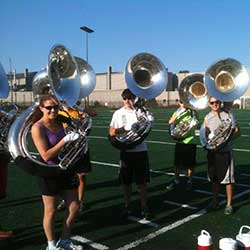
Now, Carl’s memory of what happened is slightly different. But he remembers that Wisconsin’s band was somewhere in the stew.
“The band traveled to Wisconsin for the football game,” Carl said recently. “And the Wisconsin band — they’re kind of rowdy, kind of interesting — and I do remember them doing something that ended with a bup-bup-bup, you know?
“It was their sousaphones as they’re marching into the stadium. We were waiting there to come in the stadium, and here comes the Wisconsin band, and they were doing something. I couldn’t recognize what the piece was … but I do remember it ended with this bup-bup-bup. I remember hearing that.”
That something with the bup-bup-bup came back to Ann Arbor in his head, Carl said, then to that hockey game at Yost.
“I don’t remember how that came around to ‘Let’s Go Blue,’” he said, “other than it was just kind of: They seemed to be goofin’ around, then we started goofin’ around.”
And that certain tune began to pop out of Michigan tubas that night.
Then, just after the bup-bup-bup — if Carl’s memory serves — an alto horn player named John Endahl yelled, “Let’s go blue!”
And the crowd loved it.
“Yeah, the crowd picked it up, absolutely,” Carl said. “And you get a crowd there in Yost Arena and it sounded like 10,000 people. It was really cool. It certainly caught us by surprise.”
A-plus arrangement
By the following football season, George Cavender, director of U-M bands, had heard the “Let’s Go Blue” tune-and-cheer, and he loved it, too.
So one day he buttonholed Albert Ahronheim, who had been the Marching Band’s drum major. Now he was Cavender’s graduate assistant and the band’s principal arranger, and he had studied with Jerry Bilik, the U-M-trained composer, arranger, and musical director who conceived “M Fanfare.”
Cavender said: “Hey, Al, there’s this tune that this tuba player’s been playing at the hockey games, and it goes like this …”
Cavender sang it.
“I want you to do a full arrangement for the Marching Band.”
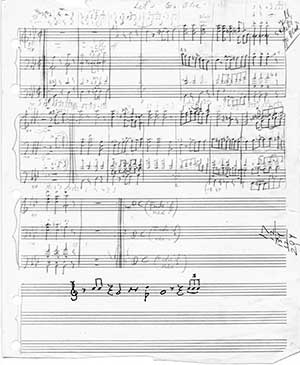
So Ahronheim sat down at a piano and got to work — singing notes, playing notes, and scribbling on a blank score.
Gradually, the arrangement emerged.
He started with the original tuba bassline — the low, thumping notes — and added trombones.
Then he wrote a new melody to burst in at a higher octave — trumpets playing a swinging Dixieland kind of thing. Then all the instruments ascended together into a riot of melody and counter-melody, punctuated at the end with those three popping periods — BUP-BUP-BUP!
Ahronheim got it down on paper. He handed it to Cavender, who looked it over and scribbled in the margin, at the appropriate point: “Yell ‘Let’s go blue.’” (See the upper right corner of the image, above.)
“It’s arranging more than composition,” Ahronheim said recently, “but the two are intimately related. What I did was an arrangement based on this bassline. I came up with that new melody, so I guess that was composition. But I don’t want to make too much of it. It’s not Beethoven.”
Credit all around
OK, so maybe it’s not Beethoven. But it’s closing in on half a century with no signs of age. It’s a Michigan calling card, of course, but it’s played all over the country. It’s popped up in movies from The Big Chill to Remember the Titans. (In the credits of Titans, Carl and Ahronheim are the very last names listed — thanks in part to Cavender, who urged them to get the tune copyrighted.)
“It’s a lot of fun, there’s no question,” Ahronheim said. “I had no idea how much fun it was going to be.”
So who gets the credit?
It looks like everybody deserves a piece of it, small or large — Robbie Moore, Ken Burke, Joe Carl, Michigan’s hockey fans, George Cavender, and Albert Ahronheim.
And maybe especially those tuba players at Wisconsin, even if we’d rather not admit it.
Burke’s friend Blaske put it this way: “As they used to say of the Panama Canal: Stolen, fair and square.”
And who’s to say Wisconsin didn’t swipe the tune from somebody else?
Epilogue
Robbie Moore, one of Michigan’s great goalies, was only 5’5”, but he went on to a career in professional hockey, including stints with the Philadelphia Flyers and the Washington Capitals.
Ken Burke, a native Detroiter, earned a master’s degree in business from the University of Virginia. He went into the investment field, with stops in Baltimore, Washington, D.C., San Francisco, and New York before winding up near Boston. His friend Tom Blaske practices law in Ann Arbor.
Joe Carl, originally from Dearborn, has been director of the award-winning marching band at Sumner High School in Washington state for more than 25 years. Out of roughly 1,800 students at Sumner, one in nine plays in the band.
Albert Ahronheim, who grew up in Jackson, lives and works in New York City. He’s still in the midst of a successful career as an arranger, orchestrator, and musical director.