

Anchor, away
A front-row seat to history
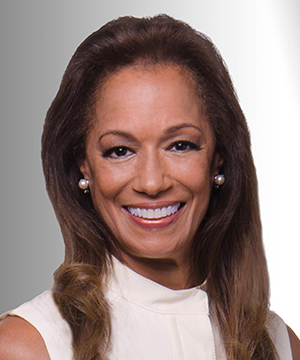
For almost 40 years, Carmen Harlan, BA ’75, has been synonymous with news in Metro Detroit.
The Emmy-winning journalist has covered 10 presidential elections, Pope John Paul II, South African President Nelson Mandela, the automotive industry, and the rise and fall of Detroit’s former mayor, Kwame Kilpatrick. The list goes on. And on. And on.
“As journalists, we get a chance to see history being made and it’s not something we have to wait for. Having that front-row seat has been extremely satisfying over the years,” says the lifelong Detroiter.
Harlan signed off WDIV-TV (Channel 4) on Nov. 11, after 38 years. She’s retiring to spend more time with her grandchildren.
“They’re going to grow up so fast. I’ll look around, and they’ll be teenagers before you know it, and they won’t want to pal around with Grammy. They’re in Cincinnati, so I have to carve out time to be with them. I don’t want to miss it,” Harlan says.
Longtime co-anchor Devin Scillian wasn’t surprised by this.
“Carmen’s family has always been paramount. And a few years ago when she got into the grandmother business, I had a feeling this day would be coming sooner rather than later. Her grandkids (are) such a joy in her life. Working nights and getting home around midnight isn’t the best grandma schedule,” he says.
A natural storyteller
The eldest of three, Harlan grew up on Detroit’s northwest side during a period of rapid change in the United States. The Civil Rights Movement promised change for the better even as the devastating assassinations of President John F. Kennedy, Martin Luther King Jr., and Sen. Robert F. Kennedy shocked the nation.“I was always interested in what was going on, not only locally but in the world,” she says. “That began at an early age. I always wanted to be a reporter. I was always interested in telling stories. We had a youth movement that certainly captivated my attention and the rest of the country’s during the 1960s and early 1970s.”
In 1978, Harlan joined WDIV at a time when the glass ceiling was beginning to crack for female news anchors, and for women of color.
“[Producers] recognized the audience they were providing programming for needed to reflect the people who were watching,” she says. “I think that was smart on the part of TV stations – especially local ones – to ask, ‘Are we really reflective in our newsrooms of people who we want to watch? Because they’re going to tell us what’s important and what the problems are in their community, what they like or don’t like. What perspective are we getting by just having a white male-dominated newsroom?’”
Chemistry set
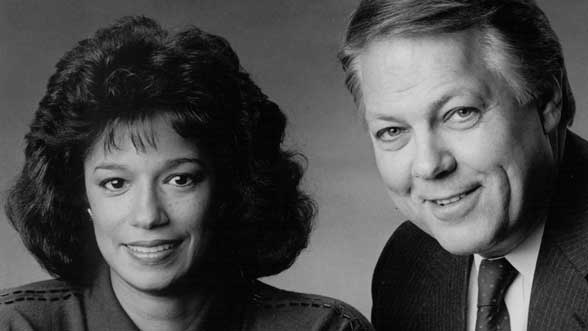
Harlan was not Detroit’s first African-American female anchor; Diana Lewis, Doris Biscoe, and Beverly Payne preceded her. However, she’s one of the most prominent. With veteran anchor Mort Crim, Harlan co-anchored the 5 p.m., 5:30 p.m., and 11 p.m. newscasts from 1981-97.“Mort had the experience of working in other markets – Philadelphia, Chicago, New York – and he brought that with him. Being a Detroiter, I brought something else to the team,” says Harlan. “Having someone from Detroit has given our station an advantage. It wasn’t someone just talking about the city, but someone who grew up in the city and someone who knew the city.”
Harlan’s next long-term partner, Scillian, was her co-anchor for nearly 20 years – something uncommon in TV news. This contributed to Channel 4 becoming the nation’s No. 1 NBC news affiliate.
“It didn’t happen overnight, I can tell you that,” Harlan says. “It took a lot of hard work. What I can tell you that really made the difference is we had the kind of team that people not only felt comfortable with but trusted. If you asked me what it is, I don’t know. The word chemistry comes to mind. Likability. Respect. If it’s there, you can make that work.”
The work never stops
Another factor in Channel 4’s success is that Detroit is a news town. So many stories have gotten national attention throughout Harlan’s career. She has fond memories of covering Pope John Paul II and Nelson Mandela when each of the world leaders visited Detroit, but for very different reasons.“The Pope arrived on a Friday and left on a Monday. We were on from the moment that he landed,” she says. “That was the longest I’ve ever been on the air. I don’t think I was very tired at all due to the excitement of covering him; it feeds the adrenaline.”
When speaking of Mandela, meanwhile, Harlan’s eyes glisten with tears.
“It’s one of the stories I’m just grateful I was able to cover: Nelson Mandela speaking as a free man who was willing to come to Detroit to share his message of not just hope for better race relations in South Africa, but certainly in America too,” she says. “And here we are still struggling with it today. The work never stops.”
The human connection
There’s also a tragic local story that Harlan takes with her into retirement. She recalls being tapped to interview the mother of a girl who’d been accidentally murdered by a classmate. A young boy had brought a gun to his elementary school and was showing it to his peers when it fired.
“The girl died instantly – way too young,” says Harlan. “I got a call from the station that morning and they said, ‘The mother’s willing to talk. But she’ll only talk to you. Can you be ready?’”
For Harlan, it wasn’t that this grieving mother wanted to talk exclusively to her, it was what she said during the interview that still resonates.
“She wanted the boy to know she didn’t have any malice in her heart for him. She was hurt, she was grieving, but she knew he’d have to live with this the rest of his life and she did not want him to think she held anything against him.” Harlan says. “She meant that.”
An “extraordinary run”
Throughout the years, Harlan has had numerous job offers in other markets. But she remained at Channel 4 because it felt right.“I hope we can all appreciate how rare this is: 38 years at one station – and in her hometown, to boot,” says Scillian. “That just doesn’t happen. It’s been an extraordinary run.”
However, Harlan isn’t quite done with Channel 4. She was back on the air Nov. 24, hosting Detroit’s Thanksgiving Parade. She will continue to host special events as the station’s ambassador.
“Detroit is a wonderful place. I see so many good things happening here – big and small,” Harlan says. “People are feeling good about Detroit again. I take a great deal of pride in that.”
(Top image, circa 1980, courtesy of WDIV-TV.)


