Flipping the switch in Puerto Rico
Power to the people
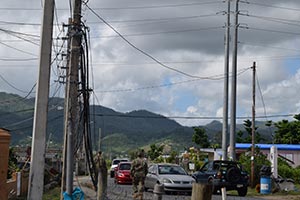
Electrical posts, the lines still attached, lie on the ground next to the road. They are piled with debris that’s been pushed aside so vehicles may pass. On the hills, vegetation, uprooted or snapped in half by the category 4 hurricane that hit Puerto Rico in September, has started to come back. Such resilience offers a glimpse of hope amid a devastating scenario in which more than 3 million Puerto Ricans have lived since Hurricane Maria.
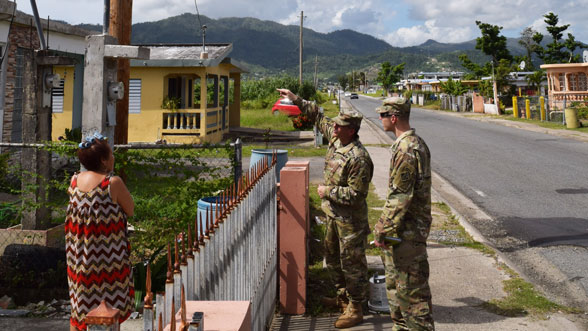
“I don’t think you can be prepared for what you’re going to see,” says Capt. Aaron Anderson, MS ’16, an operation officer with the U.S. Army Corps of Engineers (USACE) Task Force Power Restoration. “You go up in the mountains and the destruction is just . . . monumental.”
Anderson arrived in Puerto Rico shortly after Thanksgiving to begin the process of rewiring the storm-ravaged island. He spent six weeks in the U.S. territory setting up microgrids to temporarily power areas left in the dark since the Sept. 20 storm.
“If this happened on the continent, it would be devastating,” he says. “The fact that it happened on the island makes it 10 times more challenging.”
Damage control
According to the U.S. Department of Energy, power has been restored to nearly 86 percent of the island’s residents. Yet some 2 million people still live in areas at risk of water contamination.
“When you’re without power for a day, it’s a big deal,” Anderson says. “They have been without power for [five months]. People there, they don’t let their spirits get down. They are very resilient. I have nothing but love and respect for the people of Puerto Rico.”
Power supply — and lack thereof — has become an increasingly politicized issue in the storm’s aftermath. In January, Gov. Ricardo Rosselló (also a Michigan alumnus, MSE ’03/PhD ’07), announced the privatization of the power company, Puerto Rico Electric Power Authority (PREPA). The utility entered Title III bankruptcy proceedings in July 2017; it has approximately $9 billion in outstanding debt.
The storm’s damage added new layers of complexity to the already troubled economy; last May the territory filed for bankruptcy protection after defaulting on its $73-billion debt. The slow disaster response from the federal government and ongoing financial crisis on the island has fueled calls by some, including members of Rosselló’s party, to rally for statehood while other political groups seek to maintain independence.
Lights on
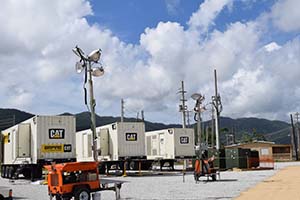
Still, the work continues. The Task Force Power Restoration works closely with local mayors, FEMA, and PREPA to identify and prioritize areas that could most benefit from the temporary electric grid. Crews assess such factors as population and whether electricity is needed to power nearby hospitals and water supply infrastructure. The first microgrids were installed in Isla Culebra, with additional microgrids in Patillas, Maunabo, Naguabo, and Yabucoa, on Puerto Rico’s southeast side.
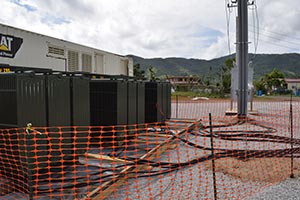
The diesel-powered generators are the size of semi-trailers, Anderson says. And it’s risky business connecting them to the transformers and substations. Since the system has been down for so long, it has to be turned back on in stages.
“You have to find the faults and build up the system from there,” Anderson says. “If you turn on the system all together, some of this equipment . . . it would literally blow things up.
“I’m going to be the happiest person in the world when I’m out of a job, because it will mean the people in Puerto Rico don’t need back-up power anymore, that the main grid is restored.”