

The Tappan Oak: A tale of life, death, and rebirth
Branching out
You can be lonely even in a crowd, and certainly on a college campus. That’s how it was when Chayce Griffith, BS, ’16, was a sophomore at Michigan in 2013-14.
He was majoring in engineering, but he didn’t like it, and he couldn’t find the right friends.
Many nights, for company, he would drive 10 miles home to Saline to have dinner with his family. Other nights he would just wander around the Diag by himself, stopping to read the old bronze plaques on buildings and boulders. And he liked to look at the trees.
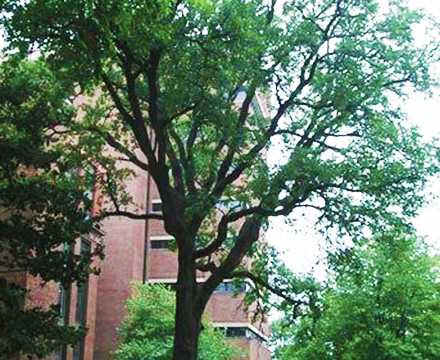
One night he stopped by the towering old Tappan Oak, between the Hatcher Library and Haven Hall. The ground was strewn with acorns. He thought about how the tree was older than the oldest of the historical markers, yet still growing. Then, without quite knowing why, he knelt down, held open his backpack, and scooped in a couple handfuls of acorns.
He took them to his parents’ house. He Googled: “How to grow a tree from an acorn.”
Following the instructions, he put 20 or so acorns in styrofoam cups, added potting soil, then set the cups in the refrigerator in his parents’ garage.
In the spring, he took them out and lined them up outside in the sun. A few months later, he had half a dozen seedlings. A year after that, he planted the seedlings in the backyard.
His dad’s lawnmower took down a few by accident. Griffith put up markers to guard the two survivors. Then he waited.
A hardy acorn
Some 250 years before Chayce Griffith was born, a hardy acorn dropped from a bur oak 40 miles west of the frontier settlement of Detroit and sprouted in the soil. The people roundabout belonged to the Anishinaabe nations — Ojibwe, Odawa, Potawatomi. By the time their children’s children were pushed off the land by American settlers moving west after the War of 1812, the acorn had become a flourishing tree, dropping acorns of its own.
Elisha Rumsey, one of the first Ann Arborites, staked a claim to the property in the 1820s. His brother Henry cleared 40 acres but left the fine bur oak alone. So did the people who took possession in 1837 and began to erect a frontier college.
By 1852, when the philosopher Henry Philip Tappan became the school’s first president, the students numbered hardly more than 150. Tappan’s biographer said “the young men … as they came under President Tappan’s personal influence as an instructor, became to a man profoundly impressed by and drawn to him.” Enrollments soared.
In 1857, Tappan hired a young historian, Andrew Dickson White, not long out of Yale. “The ‘campus’ … greatly disappointed me,” White wrote later. “It was a flat, square inclosure of forty acres, unkempt and wretched. Throughout its whole space there were not more than a score of trees … Coming, as I did, from the glorious elms of Yale, all this distressed me.”
So, without permission, White began to plant trees. Students came out to help him. Members of the class of 1858 brought in maple seedlings. Around the native oak, the tallest tree on the campus, they planted the little maples in concentric circles, and named the oak in Tappan’s honor. The president was there to thank the students for the new trees. He remarked that the maples would long outlive the native oak, which by now was a century old.
The tallest tree
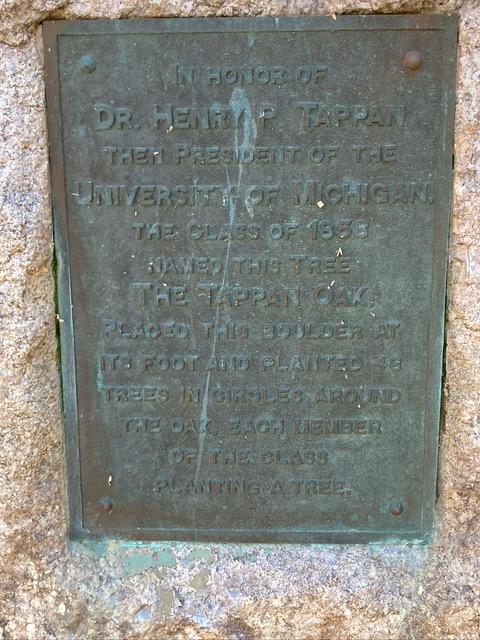
Twenty-five years later, on June 26, 1883, 18 members of the class of 1858 returned to Ann Arbor for a reunion. Next to the oak they set a boulder to memorialize Tappan, who had died just a year and a half earlier. To his widow, Julia Livingstone Tappan, they wrote: “Today we have visited our old haunts to find much that is changed. The growth of the university has been a thing remarkable. But all this time men have only been building on foundations laid and ideas conceived by President Tappan.”
Andrew Dickson White had long since gone off to become the founding president of Cornell University in his native New York. In 1911, now an old man, White came back to Ann Arbor to inspect his trees. Around the Tappan Oak, he counted the surviving maples planted by boys in the class of 1858. Many of them had gone off to southern battlefields in 1861. White was heard to say: “There are more trees alive than boys.”
As the Univerity grew, the limbs of the Tappan Oak sent out new twigs every spring.
It was a landmark and a meeting place, though not always in ways worthy of fond nostalgia. Every spring for decades, members of the senior honorary society called Michigamua, in keeping with its faux-Native American motif, initiated new members at the base of the oak, where they doused the newcomers with water and smeared them with red brick dust — the “red” equivalent of “blackface.” The dust seeped into the bark to a height of six feet or so, staining it the color of rust.
Arborists with saws
The tree lived on for decade after decade as construction crews built and rebuilt the neighboring General Library (now the Hatcher Graduate Library), dug tunnels for pipes through neighboring soil; laid concrete sidewalks above its vast root system. The clean air and rain of the 1800s took on the taints of the industrial 1900s. But the tree stood through World War I and World War II, through the 1960s and the coming of a new century. On a day unknown to anyone, it passed its 200th birthday. The groundskeepers planted more trees every year. By the 21st century, there were 15,000 trees on the campus.
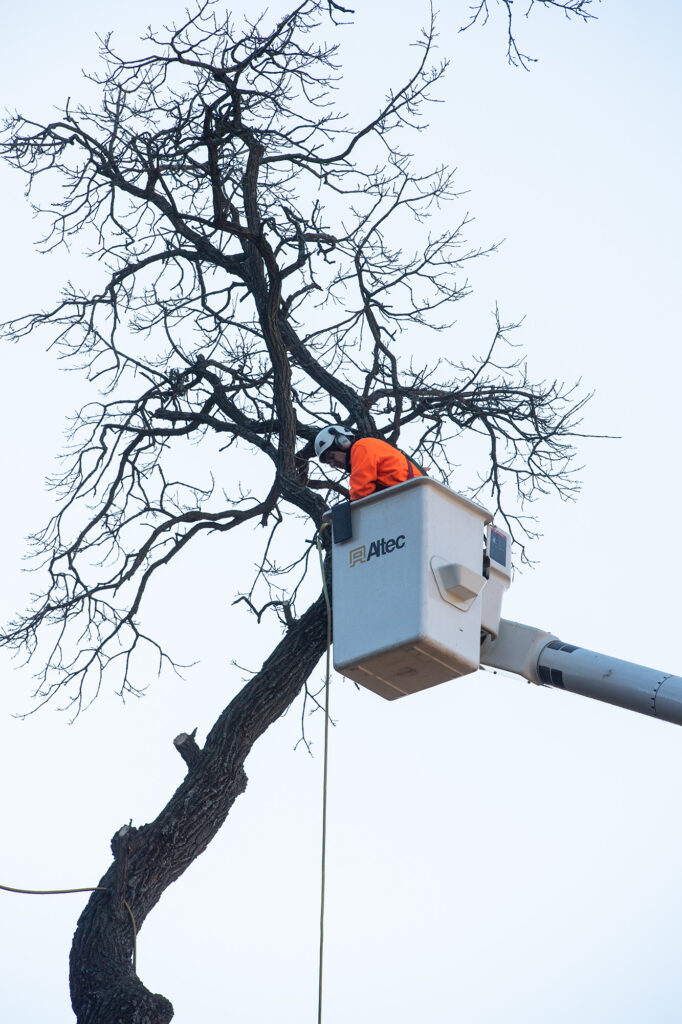
One day a microbial invader broke in through a cleft in a root or a branch. It multiplied and spread. By the 2010s, there was rot in the core of the trunk. The tree was weakening. A branch or two fell. Arborists did their inspections and shook their heads. The University couldn’t take the risk of giant oak branches raining down on passers-by, or that the tree would keel over into the Hatcher Library in a windstorm. It would have to come down. The arborists came back with saws on November 23.
Because of the rot and abrasions from saws, it was hard to get a definitive count of the rings. But it looked like about 250.
There was mourning among those who admire the campus’ trees and especially among staff members who keep watch over the University’s “public goods” in its many libraries and collections. Surely, they said, the Tappan Oak would not become a mountain of mulch — would it? They had ideas about how to keep the tree alive in memory and even in physical forms — possibly sculptures by students in the Stamps School of Art & Design, or fine furniture to be used on the campus.
They were soon assured there would be careful deliberations about what to do with the salvageable wood of the tree, now safely stored on North Campus. No formal decisions have been made, said Michael Rutkofske, the campus forester, but the plan is for the wood “to be used in university buildings, university projects or university research.”
Direct descendant
When Chayce Griffith heard about the Tappan Oak, he had his own idea.
He had graduated from Michigan with a degree in chemical and environmental engineering in 2016. But he had no aspirations to make that his career. He decided instead to work with trees. He entered the master’s program in horticulture at Michigan State and began to study apple trees.
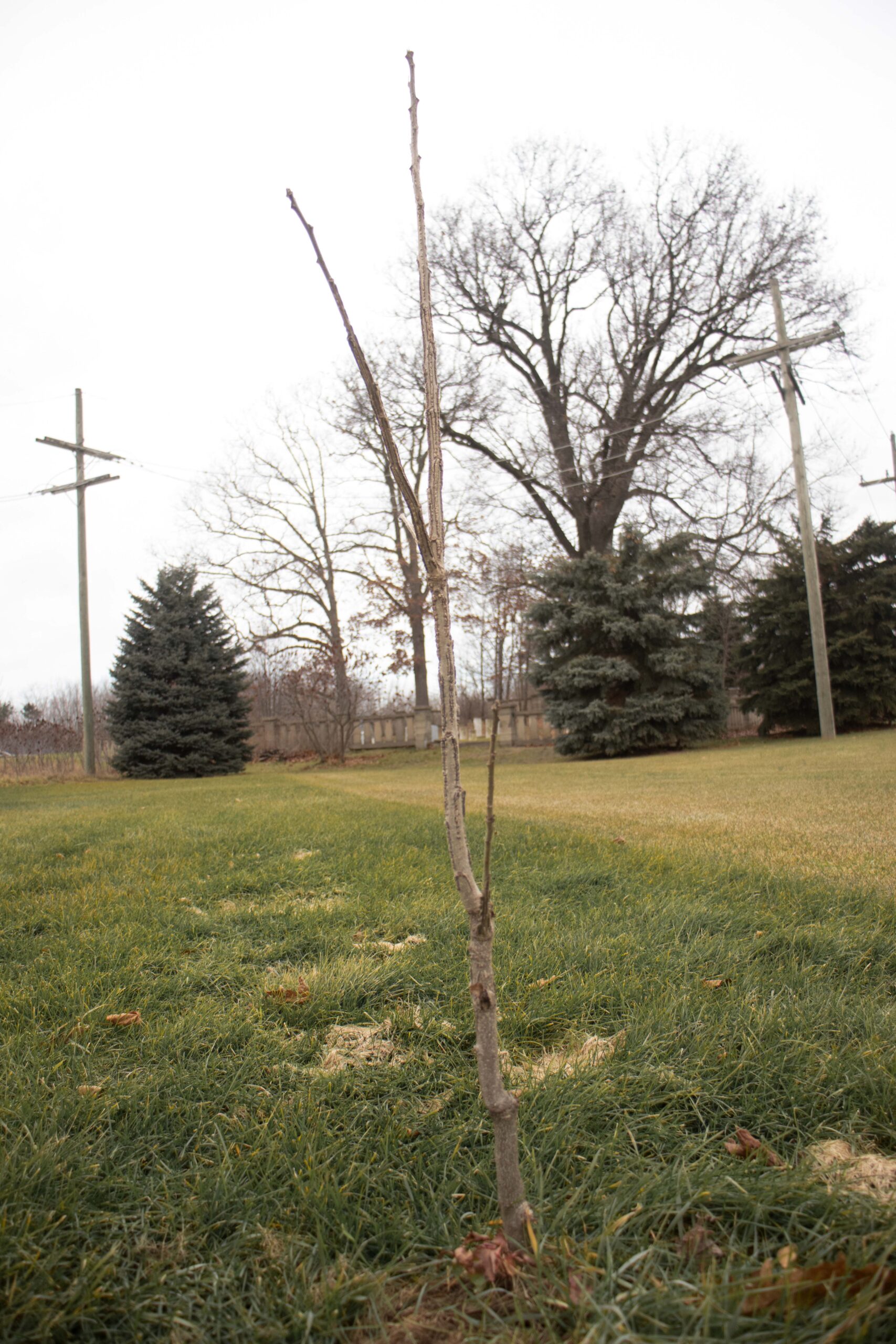
He got in touch with Rutkofske and told him what he had done with the acorns. Now, he said, there were two sturdy oak saplings in his parents’ backyard, growing well in the native soil of Washtenaw County — direct descendants of the Tappan Oak. They were about four feet tall.
Would the University like to have one of them?
The answer was yes.
“I couldn’t believe it when Chayce contacted me; I think my jaw is still on the floor,” Rutkofske told me. “We all agree that it’s an incredible story and a tremendous opportunity. We are currently working on facilitating his donation and focusing on logistics and timing.”
Griffith expects to complete his master’s program in 2022. Then he’ll keep going in apple research or start his own orchard.
“But if U of M decides to create a position for a ‘Sentimental Tree Replacement Caretaker,'” he said, “I’d apply.”
Sources included Karl Longstreth, Aprille McKay, Cathy Pense Garcia, Jane Immonen, Michael Rutkofske, Chayce Griffith and “Professor White’s Diag,” University of Michigan Heritage Project.
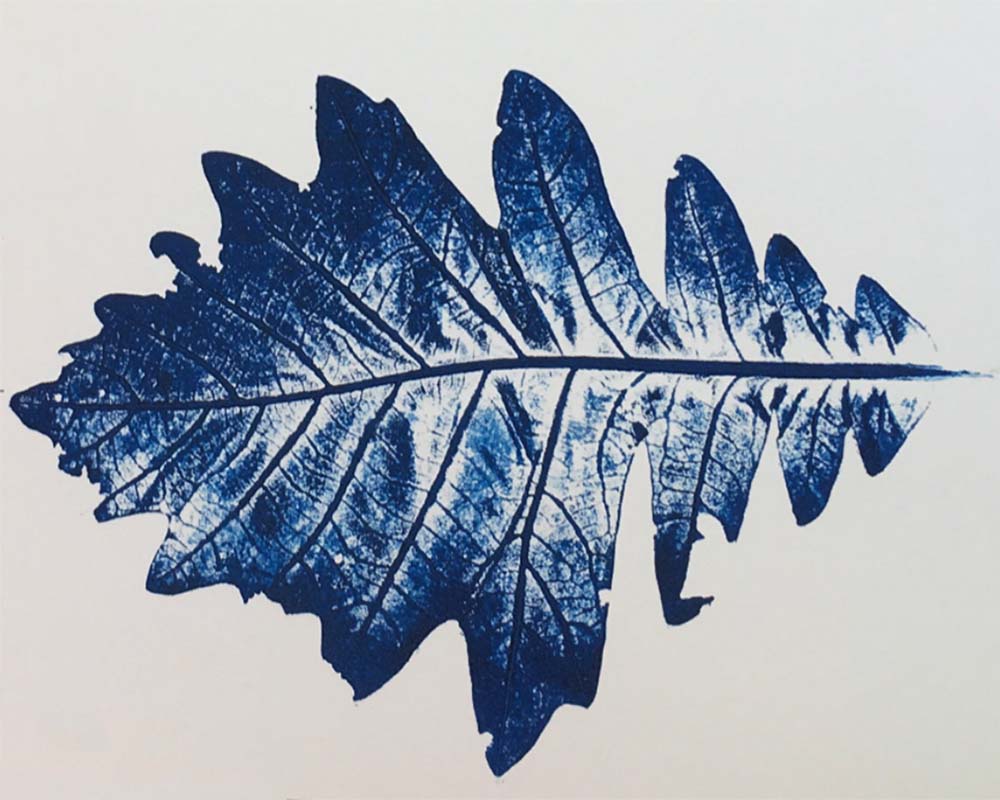
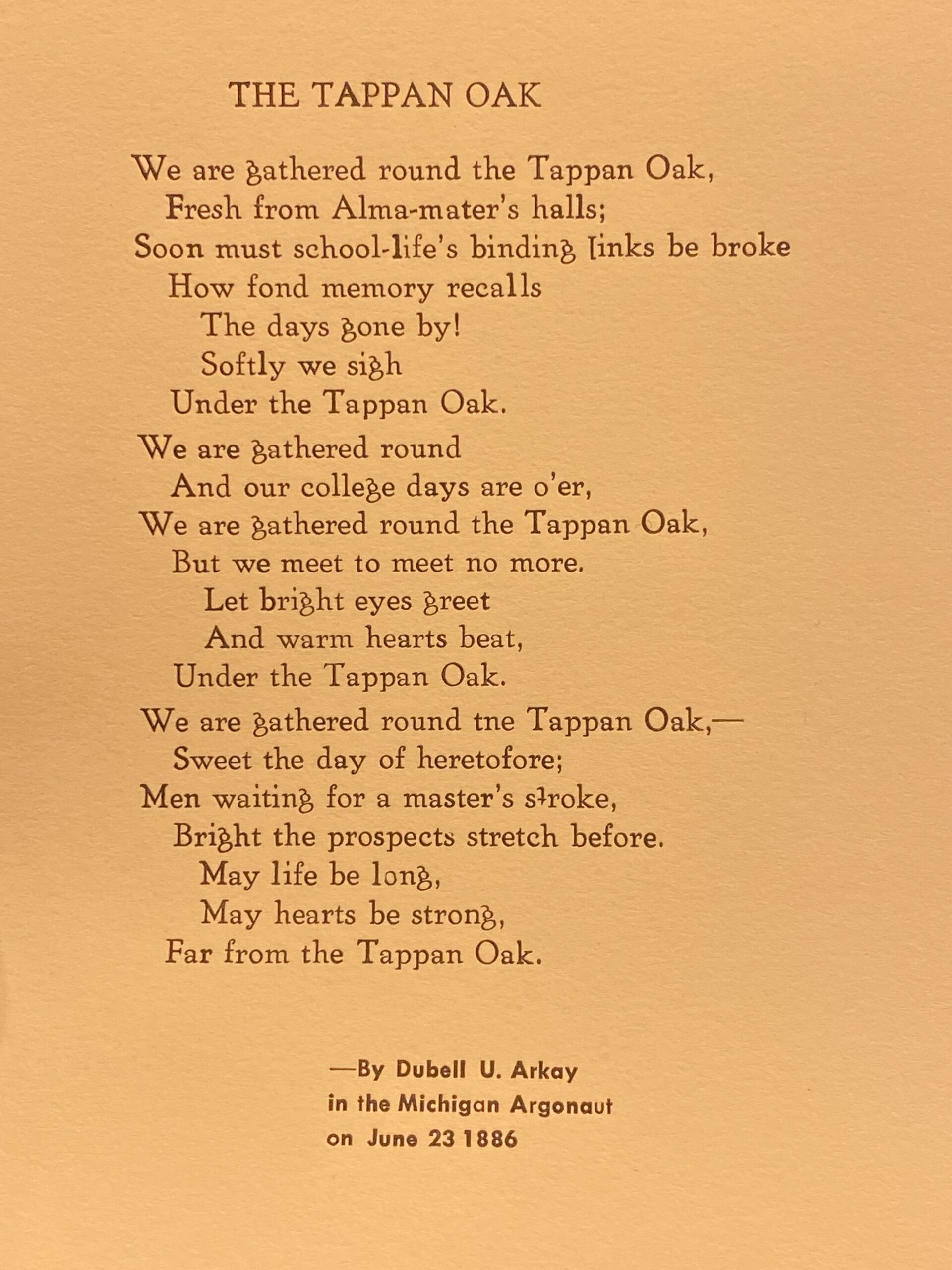
About the lead image: In 2017, as a way to commemorate the University’s Bicentennial, Fritz Swanson, a lecturer in the English Dept.’s writing program and director of the Wolverine Press, found Dubell Arkay’s poem (showcased above) using the Hathi Trust archive. A team at Wolverine Press set the poem in Artcraft 12 pt and printed blanks. Then, on the day of the commemorative event on the Diag, they asked the grounds crew to gather leaves from the Tappan Oak. He says, “We inked up both sides of the leaf, put it between two poem blanks, and ran them through the press for pressure. This produced a print of both sides of the leaf. That tree meant a lot to me personally, and to so many people on campus. Thank you for inviting me to celebrate it again with these prints. Best, Fritz Swanson.”


