The first Teach-In
Rolling Thunder
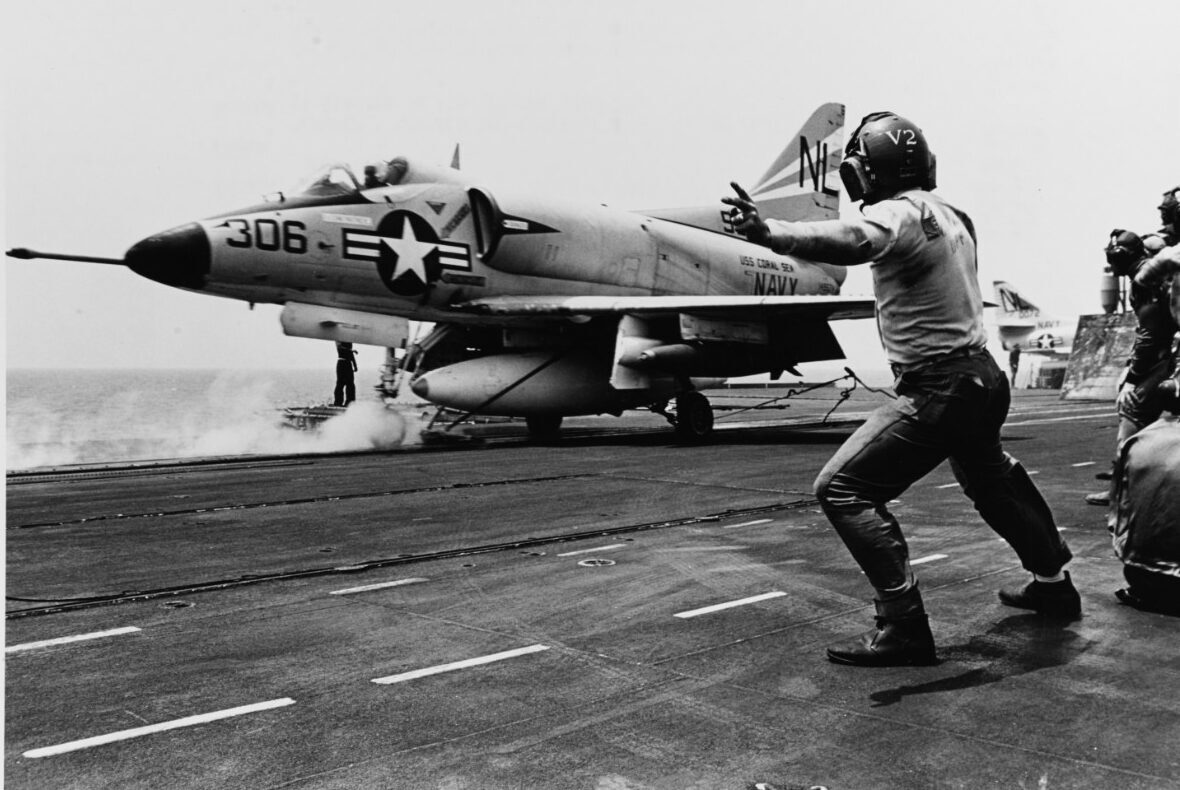
Operation Rolling Thunder began on March 2, 1965. That night, one hundred U.S. and South Vietnamese heavy bombers crossed into North Vietnamese air space to pound supply routes between Hanoi and the south. It was the first time U.S. forces had taken the offensive in the war between South and North Vietnam.
On March 8, at the orders of President Lyndon Johnson, 3,500 U.S. Marines waded ashore at Da Nang. They were the first U.S. combat troops to enter the conflict.
Johnson had promised to draw down the American commitment. That had been a centerpiece of his campaign the previous fall against the hawkish Barry Goldwater. Voters chose Johnson in a landslide. Now he was escalating the war.
On March 9, the Rev. Martin Luther King, Jr., marching at the head of hundreds demanding civil rights, set out from Selma, Alabama, toward the statehouse in Montgomery. State troopers and vigilantes turned them back.
At the University of California at Berkeley, students and faculty were barely recovering from days of disorder and mass arrests set off by the student-led Free Speech Movement, which had rebelled against the administration’s crackdown on political protests.
In Ann Arbor, all this news broke in thunderous waves. In 1965, only a handful of students were radical in their politics. But the faculty included a scattering of progressives involved in the early stirrings of dissent against the war. The attack on North Vietnam rang in their ears like a shrieking alarm.
“We’ve got to do something!”
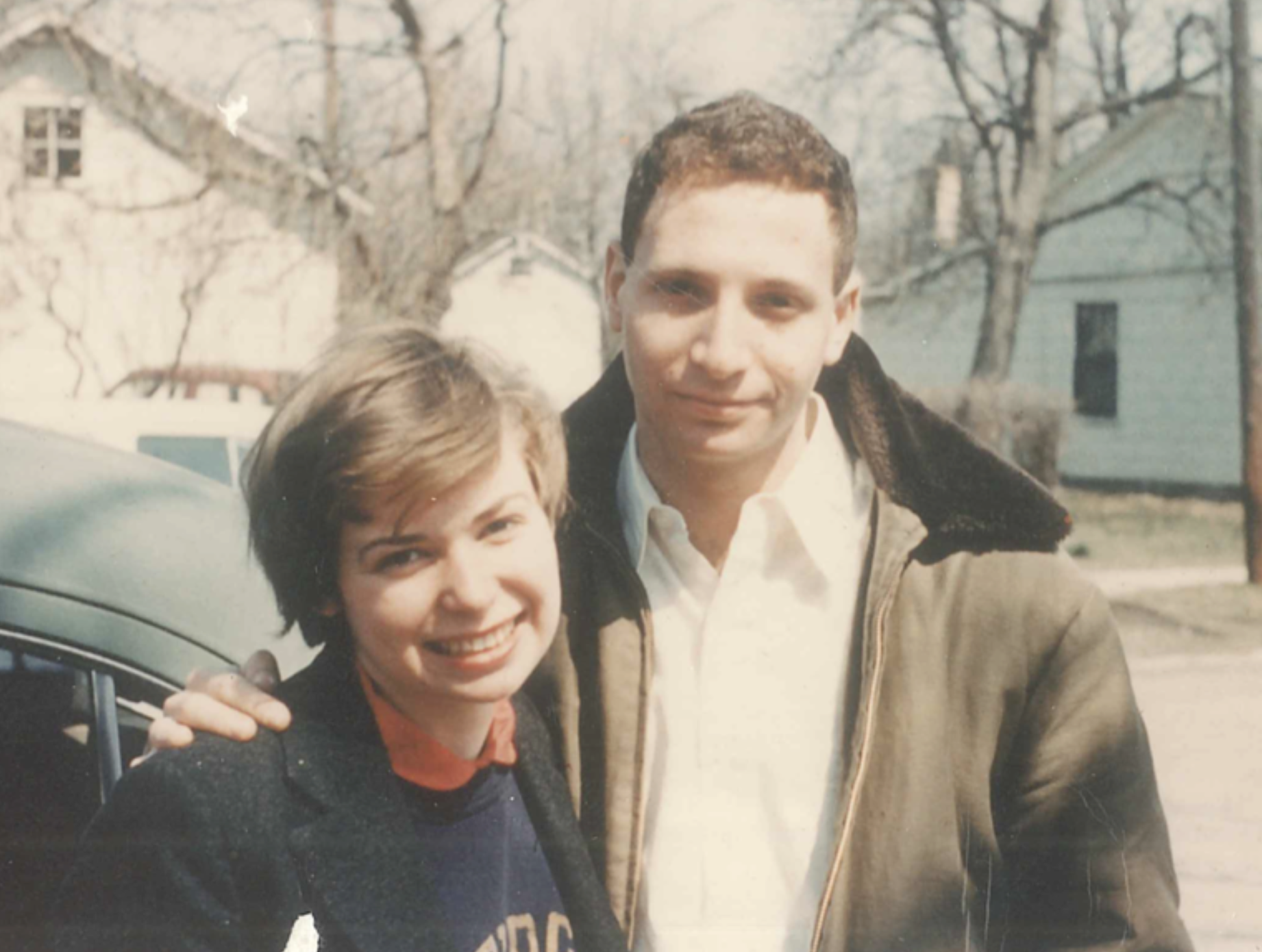
(Image: Contexts magazine.)
One of them was Jack Rothman, a young professor of sociology. He had marched for civil rights and campaigned for Johnson in 1964. Now he felt betrayed.
Reading news of the escalating war, Rothman remembered later, “I was left with a sense of unbelief… Our ‘Great Society’s’ mechanized monsters were casually annihilating a tiny, underdeveloped country thousands of miles away, and nobody was aroused: the American people were silently, disinterestedly accepting this eerie atrocity.”
Two others appalled by the news were Zelda Gamson, a sociologist at U-M’s Survey Research Center (later a professor in the Residential College), and her husband, William Gamson, a professor of sociology. Her PhD was from Harvard, his from Michigan. They’d been active in the Congress on Racial Equality (CORE) and a peace group called Tocsin.
She turned to him and said: “We’ve got to do something!”
The Gamsons decided to invite like-minded colleagues to their home (1417 Granger, in the Burns Park neighborhood) for a meeting on the evening of March 11, nine days after the start of Rolling Thunder.
They had an idea — a faculty strike to protest U.S. policy in Vietnam. Sympathizing professors would cancel their classes for one day. Instead, they would hold a conference where students could learn about U.S. policy in Southeast Asia.
“Aggressively pacifist”
It would be highly provocative. By the age-old conventions of academe, professors were not supposed to mix politics with their professional obligations. So even among the 15 or 20 who showed up, there were reservations.
“Though I was not yet certain what to think,” recalled Arnold Kaufman, a professor of philosophy, “my wife was in an aggressively pacifist mood. Prudence is the better part of sloth, so I went.”
A rough division was obvious right away. Militants like the Gamsons strongly favored a strike. Moderates like Kaufman spoke of less aggressive tactics, maybe a petition and a polite advertisement in the newspapers.
That night, the militants held the initiative. The decision was for a strike, though they chose a softer term — “work moratorium.”
A core of organizers quickly drafted a letter pitching their plan to the faculty. Thirty-two professors signed it, most in the social sciences and humanities, most without the security of tenure.
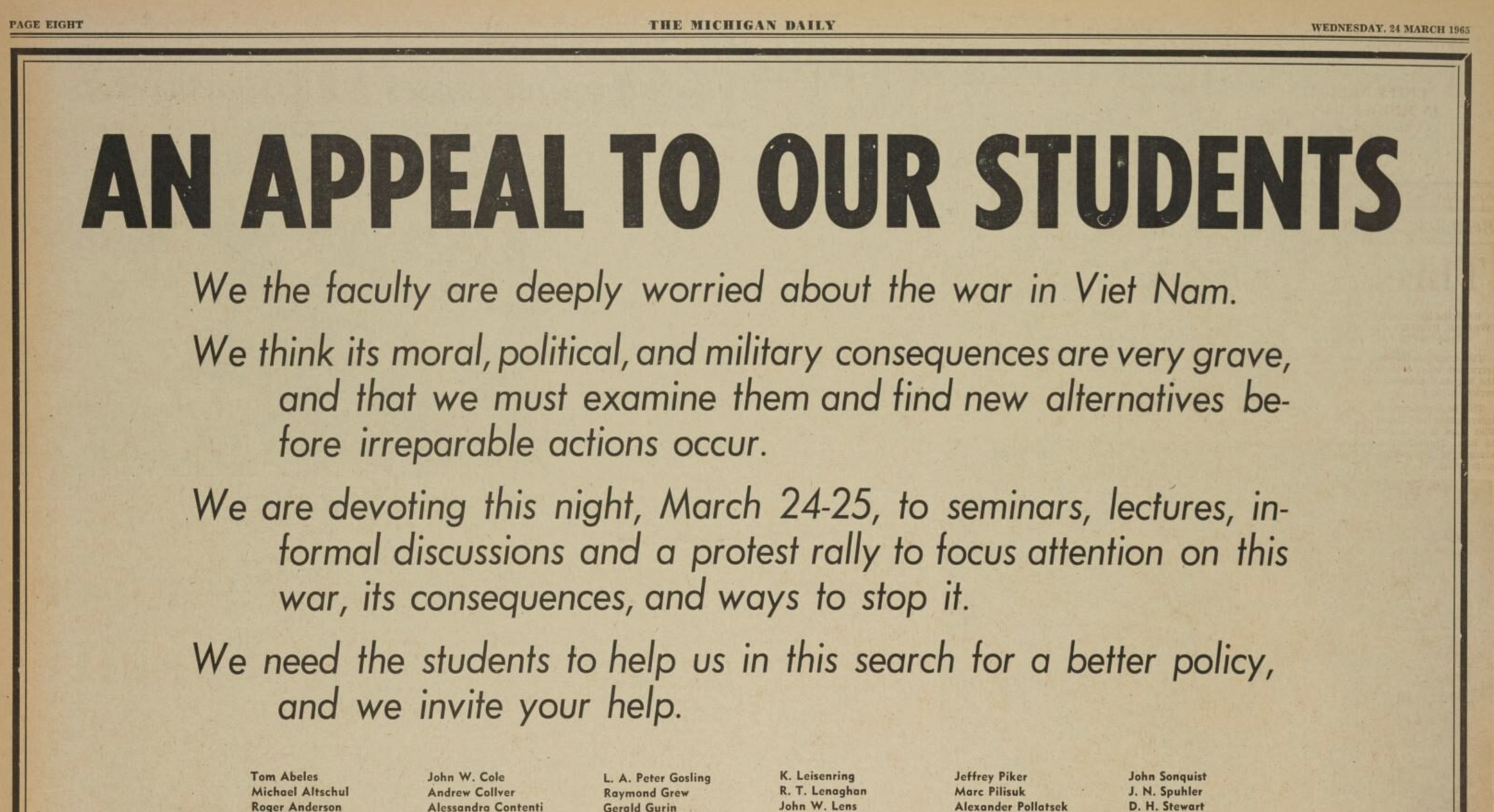
The letter announced the date — Wednesday, March 24 — and defined what was at stake. The escalation in Vietnam “not only makes a peaceful solution more difficult,” the letter said, “but also risks catapulting the United States into a major conflict with China and perhaps the entire Soviet bloc — a conflict which might well lead to nuclear war.”
It was not enough to sign petitions and write letters to Congress, the planners said. Their mission as teachers demanded bolder action. “By holding a conference instead of classes, we hope to demonstrate that a critical analysis of government policy is essential… As scholars and teachers, we believe that this action is a necessary responsibility to our students and to the larger community.”
The letter made the news. In East Lansing, sympathetic faculty at Michigan State announced their own plan for a strike. And then, as one of the organizers said later, “all hell broke loose.”
“One-Way Ticket to Hanoi”
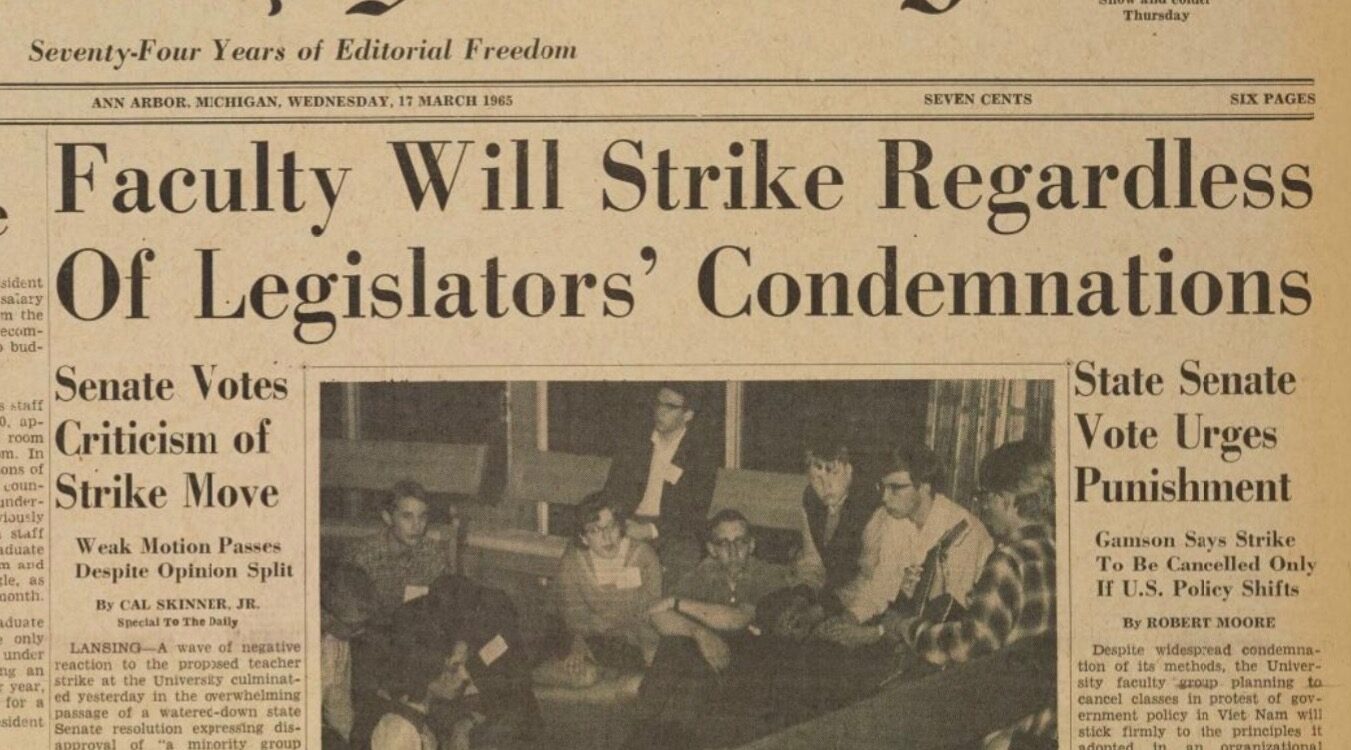
The backlash was instantaneous.
In Ann Arbor, Harlan Hatcher, president of the University, said: “There is a time and place for making protests, but canceling classes is certainly not an acceptable one.”
The influential U-M regent Frederick C. Matthaei said: “They get their living from the taxpayer. They have no license to abrogate their duties. They are robbing the payroll!”
On the floor of the Michigan Senate, which called on Hatcher to discipline the organizers, Senator Terry L. Troutt, a Democrat from Romulus, declared: “They should be given a one-way ticket to the University of Hanoi in Vietnam.”
Governor George Romney, a likely candidate for the 1968 Republican presidential nomination, said: “This is about the worst type of example professors could give to their students.”
Bill Gamson stood his ground. “We respect the governor’s feelings and the state legislature’s,” he said. “But in the end, we have to answer to our consciences and meet our responsibilities to students, University, and country.”
Still, the heat was intense. There was opposition on the faculty, too. Even professors who shared the planners’ outrage about Vietnam were uneasy about a strike. Some asked: Why strike against the University when the target was the Johnson administration? Why deprive students of their education because of professors’ private political views?
The planners were especially dismayed when Kenneth Boulding, a revered senior economist and lifelong pacifist, refused to sign the strike pledge. “I am in complete sympathy with their objectives,” he told The Michigan Daily, “but I have great reservations about the means.” He said everyone would be talking about whether it was right for professors to strike, and no one would be talking about U.S. bombs falling on the North Vietnamese.
“In a pickle”
Even as the strikers were firming up their plans, Boulding’s prediction was coming true, and colleagues were not speaking to each other in the halls.
Hearing the outcry from conservatives off campus, Jack Rothman noted a double standard. “Had each [signer of the strike letter] canceled a day’s classes to consult with a private corporation for a fat fee,” he said later, “no official eyebrow would have been raised. But to announce a suspension of classes because of one’s concern about issues of war and peace, that was unacceptably frivolous and irresponsible.”
Still, Rothman had thought from the first that a strike would attract only a handful of supporters. He was right. Even the moderates at the Gamsons’ meeting had signed the strike pledge out of a sense of solidarity, not because they thought it the best tactic. Now, with the date of the “work moratorium” fast approaching, only a dozen more professors had pledged to cancel classes.
“We were in a pickle,” recalled Frithjof Bergmann, a charismatic young professor of philosophy. “We had announced a strike, but the strike was fizzling. So the question was: ‘Now what?'”
Continue reading at heritage.umich.edu. (Scroll to Chapter 4.)