Sending thoughts and prayers — and research, research, research
Everything is broken
As a student reporter at The State News at Michigan State (in the previous century, yikes), I lived in a constant state of roiling self-doubt and fear of spelling someone’s name wrong. I tended to hang in the back of the newsroom with the entertainment writers and the sports dudes. I wrote goofy features about students “adopting” grandparents and a guy who analyzed handwriting. My closest relationship to the news department was pitching a story about a snake that escaped in the house of some guys I knew in high school.
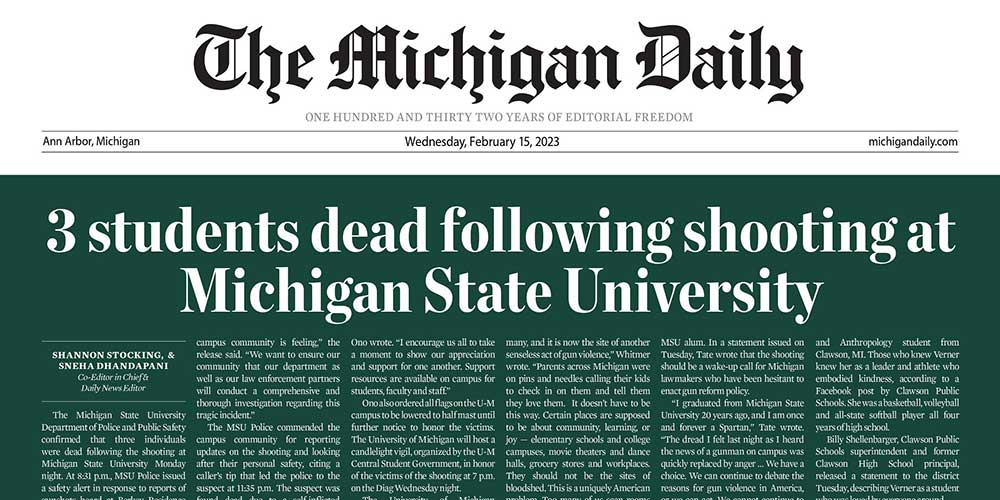
So walking into work on an eerie and melancholy morning two days after a mass shooting at my alma mater, I gasped when I saw The Michigan Daily and its dramatic front page. The tears really spilled when I looked below the fold. The seemingly hand-drawn graphics of MSU’s Beaumont Tower, Sparty, and other icons touched my cynical heart. And then this:

I think it was the phrase “our colleagues at The State News” that got me. “Colleagues.” These are student journalists. They are seeking to learn a craft, go to class, figure out who they are on this planet. They should be staying up all night in that newsroom, not locked away with a computer in their dorm. Their doors should be open and their music should be blaring. They should be thinking about nothing more than scooping The State News, checking their facts, and spelling everyone’s name correctly. And yet, here they are, writing about their “colleagues” — some of whom are still teenagers — who are reeling from a horrific loss to their community.
How are we supposed to function in a society like this?
U-M’s Firearm Injury Prevention Institute

Debates about the Second Amendment rage on, families bury their children, and survivors set up go-fund-me accounts to offset lifelong medical expenses. Meanwhile, the rest of us strive to manage the never-ending rage and abject sadness coursing through our veins. Thankfully, U-M offers a lifeline in its Institute for Firearm Injury Prevention. The institute “harnesses the research might of the University of Michigan, the nation’s largest public research university, to address the root causes of, and potential solutions for, the most important issues surrounding firearm violence.”
Before you troll me with your gun-toting bravado, please note, this is not the Institute to Take Away Your Firearms.
Researchers study firearm injury prevention, and from a wide array of disciplines (i.e., public health, criminology, medicine, sociology, psychology, social work, nursing, engineering, economics, public policy, education, etc.). They focus on suicide, youth violence, community violence, unintentional injury, intimate partner violence, school shootings, mass shootings, technology and firearms, and police violence. They are looking at primary, secondary, and tertiary prevention, and are particularly interested in research addressing existing inequalities, disparities, and inequities related to firearm injury.
Save your social media platitudes
In light of recent events, the institute is sharing resources to support the community:
- Tips for Disaster Responders: Understanding Compassion Fatigue
- Resilience Strategies for Educators: Techniques for Self-Care and Peer Support
- Federal Resources for Helping Youth Cope after a School Shooting
- Helping Children and Adolescents Cope with Disasters and Other Traumatic Events: What Parents, Rescue Workers, and the Community Can Do
- Resources for Child Trauma-Informed Care
The institute also is working to provide evidence-based solutions to address firearm violence and school shootings. Below is a list of select resources:
- Getting Buy-in for Anonymous Reporting Systems
- Essential Elements of School Threat Assessment
- Trauma-Informed Practices Across School Settings
- Reducing Gun Violence: Extreme Risk Protection Orders
- Extreme Risk Protection Orders Assist in Preventing Mass Shootings
- Fact Sheet: Improving Access and Care for Youth Mental Health and Substance Use Conditions
Armed with data
If we have to live in a world that looks increasingly like RoboCop, where toddlers toy with their parents’ handguns and elementary school children shoot their teachers, we better get our act together. This constant cocktail of dread and fear about being mowed down in a grocery store or a student union smacks of a heinous social hangover.
Thankfully Michigan is maximizing its “research might” to help us survive our collective madness. There’s no apparent cure, but at least we’ve got options. And as we seek to thrive in this nation where firearms outnumber citizens, I am heartened by the practical and common-sense approach Michigan is taking. Thoughts and prayers are good. But knowledge, as we all know, is power.
Listen to the song “Everything is Broken” by Bob Dylan.