How the Michigan Union came to be
A barstool ambition
Late one night in the spring of 1903, a Michigan junior named Bob Parker had a big idea.
Admittedly, he was a little drunk.
He had spent a long session down at Joe’s, a saloon on Main Street much frequented by students. Now he was back in his boarding house on Lawrence Street. (Fittingly, it was Miss Gagney’s house, the one in which a music professor named Charles Mills Gayley composed Michigan’s alma mater, “The Yellow and the Blue.”)
Parker and his pals had been griping, not for the first time, about animosities between fraternity men and “independents,” between the seniors and the juniors and the sophomores, between the Lits and the Meds and the Laws. Why couldn’t they all just rally around Michigan itself?
What could be done? Parker asked himself.
“We wanted an organization ‘for Michigan men everywhere,'” he recalled long afterward, “an organization that would be the one recognized all-inclusive medium to tie up the loose ends, to centralize the campus life, to bring us all together as Michigan men.”
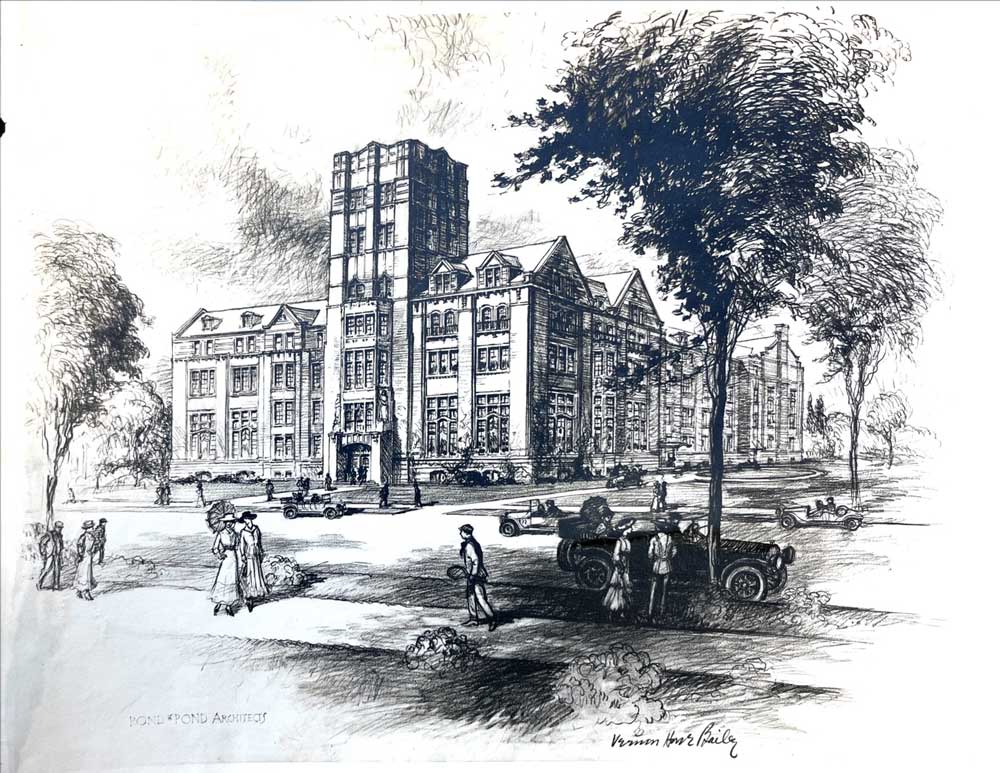
Unlike most ambitions conceived on barstools, Parker’s survived the coming of the next day. Eventually, the idea was turned over to Irving K. Pond, a gifted, slightly eccentric architect who embodied Parker’s notion in the blueprints of a great building.
Both men, the student and the architect, were acknowledging a new reality.
From colonial times through the mid-1800s, there had been essentially two sorts of American colleges — finishing schools for sons of the wealthy and seminaries for ministers in training. Then the University of Michigan and its peers — the early public universities — opened the doors wider. They invited more students to be schooled for an urbanizing, industrializing society.
From 1850 to 1900, Michigan swelled from a few dozen students to several thousand, and the number was climbing fast. Those new students built a world separate from their professors’ classrooms and labs — a hive of societies and clubs, organizations and teams. In the new century, going to college now meant competing in a social sphere that would prepare students for the milieus they would encounter in business and the professions.
Parker the student and Pond the architect embraced that new reality and proposed to enhance it — Parker with a sprawling organization, Pond with a grand edifice.
The organization and the building would carry the same name: The Michigan Union.
Today people say the name and think only of the building. But the building never would have come into being without the organization. Bob Parker’s era is long gone. But the building is the physical remnant of that early-1900s movement to forge a new ethos for the “Michigan Man.”
Segregation by sex
Bob Parker tried his idea on a few friends. They liked it. He sounded out President James Burrill Angell, who gave his blessing. Next, Parker took the plan to his fellow members of Michigamua, a new honorary society of leading senior men. They endorsed it, spread the word in their circles, and hosted early meetings.
Parker enlisted several young professors, including the hard-charging Henry Moore Bates, who had just joined the law faculty. Bates had been quoted as saying that the campus needed “a common meeting place, not only for the material conveniences but also as a social and intellectual clearing house.” He became an energetic supporter.
It never occurred to Parker and his allies to include women either in the planning or the organization. That merely reflected the segregation by sex that prevailed across the campus.
Only males had attended U-M until 1870, when a handful of women were admitted. In that era, there were no dorms. For a time, both sexes conducted their lives outside class without University supervision and freely mixed. Men and women often lived in the same boarding houses and broke bread together.
But in the 1890s, when women made up 20 percent of all students, an informal alliance of feminists and faculty wives organized a Women’s League to offer female students their own organizations and activities. Soon women students were guided into female-only boarding houses approved by the League. A dean of women was appointed to supervise them.
By the time Bob Parker enrolled, male students lived in one sphere, women in another. They met and mingled only in classes and closely supervised social settings. Men dominated the major student organizations. The University, with its virtually all-male faculty, was still organized to educate men for an adult world in which they led the institutions and filled the ranks of business and the professions. Women, with few exceptions, were expected to move into the private sphere of home and family.
So when Parker ruminated about student rivalries and antagonisms, he thought only of men, and his solution was an all-male solution.
‘A great club and center’
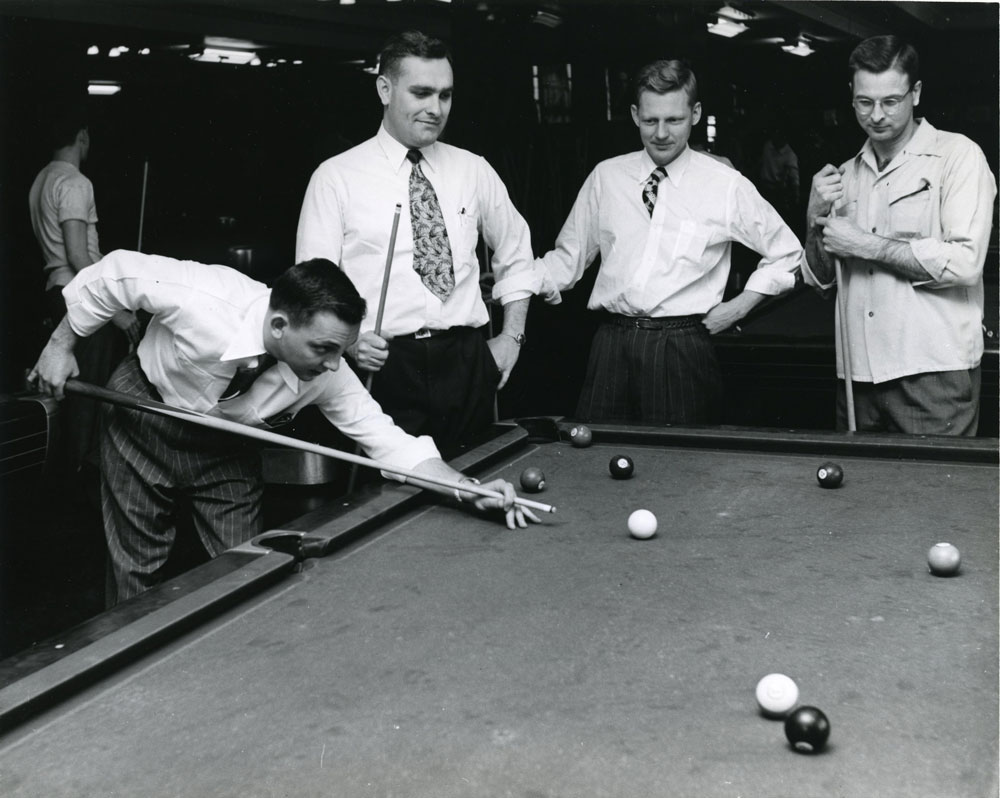
The idea was to provide “a great club and center for all student, faculty, and alumni activities.” It would draw in “all the societies in the University that care to affiliate with it” — not to govern their affairs, but to act as a coordinator and clearinghouse.
The club would need a clubhouse, a place for rest and recreation. That was the concrete goal. But the campaign to build a headquarters for the union of student organizations was meant to engender a more profound ideal. By bringing groups together to create a physical home for student life, the Michigan Union would engender a unifying “school spirit.” It would bind students and alumni to the University as patriots are bound to their country. In turn, it was hoped, tensions would dissolve between fraternity men and “independents,” Lits and Laws, the class of ’03 and the class of ’04, and so on.
“Primarily, we are here for work,” declared the editors of The Michigan Daily, who approved of Parker’s campaign, “but there ought to be a place in which the men of several departments could get together and become better acquainted… Unless a man is a fraternity man at Ann Arbor he has no very strong ties to bring him back to his alma mater in after years. A Union of this sort would tend to unite the spirit of the entire college, and would become in time as great a factor as athletics in keeping and bringing the men together.”
Parker and company plastered the campus with signs to advertise a mass meeting in Waterman Gymnasium. Eleven hundred showed up to join — a substantial portion of the whole student body — and the Michigan Union was launched. Articles of association were drawn up. Parker was elected the first president.
Fundraising ensued. Members paid annual dues of $2.50. They put on a carnival (later Michigras) in Waterman Gym and sold tickets; they staged shows and held dinners. Well-to-do alumni were targeted, though Parker beat back the idea of soliciting a handful of major gifts from millionaires. Instead, he wanted as many alumni as possible to take shares in the campaign.
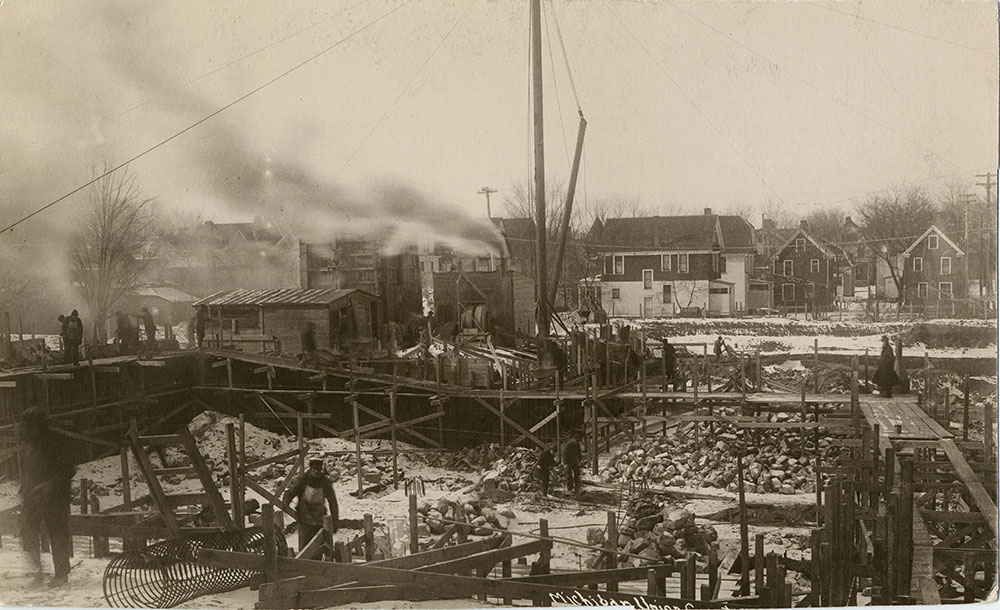
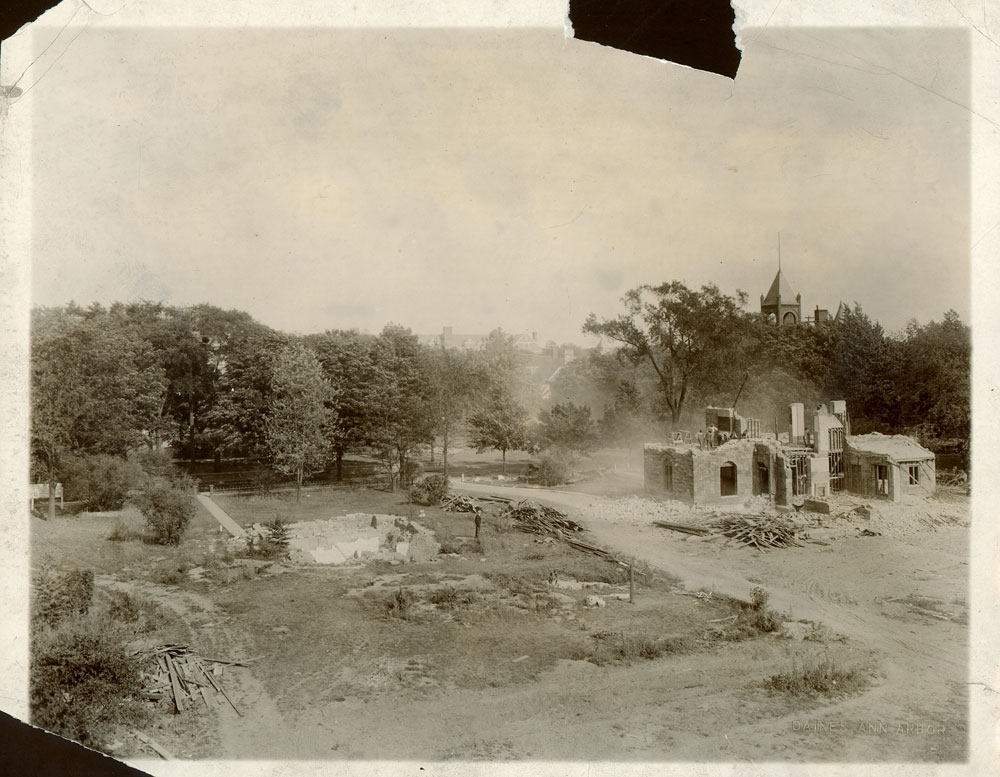
At the same time, alumni were raising money for what would become Alumni Memorial Hall to honor the University’s war dead. (That building now houses the U-M Museum of Art.) This campaign confused matters and slowed the Union’s drive. But by 1907, there was enough money to buy a temporary home.The Union chose a broad fieldstone house with three towering gables on the west side of State Street looking eastward down South University. For many years it had been the home of Thomas McIntyre Cooley, dean of the Law School and a justice of the Michigan Supreme Court. Remodeled by Professor Emil Lorch of the Department of Architecture (with crucial funding from Levi Barbour, a wealthy Detroiter and U-M regent), it had two dining rooms, a reading room, a large lounge, and rooms for games and meetings.
It opened as the first headquarters of the Michigan Union in November 1907, and it soon swarmed with events and activities — dinners, receptions, lectures, parties, and meetings by the dozen every month. The Union hosted visiting dignitaries. It organized a student council. It launched the student-run Michigan Opera. Professor Bates, who remained the Union’s chief supporter on the faculty, claimed that after only a few years, it was “conceded to be the most powerful, the most energizing and the most helpful factor in University life.”
The Cooley house was not big enough for the purpose. But it would do while the Union moved on with its grandiose long-term plan.
… Continue reading at heritage.umich.edu. Scroll to Chapter 4, “The Wide Pond,” to pick up where we left off. Then come back and leave us a comment if you are so inclined. We always love to hear from you.