Rebel in the multiversity
Roger and the U
As Roger Rapoport said himself, “No one ever has a good word for the multiversity” — the 1960s term for universities grown too big and powerful to serve the public good.
And in 1967, one might have expected any student but Rapoport, the quintessential campus gadfly of the Vietnam era, to speak up for the University of Michigan.
But so he did, in the pages of one of the nation’s most prestigious magazines, the Atlantic Monthly.
Sure, he wrote, the University was “a government-dominated dictatorship” where the average male student might conclude he was “only being groomed for a slot at Dow Chemical, where he will build a better napalm.”
However, he continued, “In spite of all the drawbacks, I and many of my friends find ourselves enjoying rewarding and productive lives at the multiversity.”
And he meant it.
An aggressive edge
In the early 1960s, years before Marvel Comics’ “multiverse” entered the pop culture lexicon, the “multiversity” concept spread through higher education. The term was popularized by Clark Kerr, president of the University of California system, to denote a new kind of university dominating the landscape of higher education since World War II — huge and powerful, serving society’s needs from government to business to agriculture, with classroom teaching almost an afterthought.
To student radicals, the term signified higher ed’s complicity in “the military-industrial complex.” To the average student, it symbolized the feeling of being a tiny cog in an impersonal machine. The multiversity was the local version of George Orwell’s “Big Brother,” an all-powerful and pervasive force beyond one’s control.
If any Michigan student had cause to feel victimized by the University’s heavy hand, it was Roger Rapoport, BA ’68.
As a fledging reporter at The Michigan Daily in 1965, he had made himself persona non grata to the University’s power structure. While still a sophomore, Rapoport published articles showing that Eugene Power, a U-M Regent and a significant benefactor of the University, had benefited from a commercial relationship between his private company, University Microfilms, and the University Library. Michigan’s attorney-general declared a conflict of interest, and Power stepped down from the Board.
Rapoport continued to cover the University with an aggressive edge and a tart tongue. As his senior year approached, he was the obvious choice to become the Daily’s editor-in-chief.
But not so fast.
In those days, the newspaper’s outgoing editors nominated their successors. But their choices had to be ratified by professors and administrators on the Board in Control of Student Publications, chaired by Professor Luke K. Cooperrider of the Law School.
In February 1967, the Daily’s editors chose Rapoport to become editor-in-chief by a unanimous vote. U-M President Harlan Hatcher, a frequent target of Daily editorials, then summoned Professor Cooperrider to advise about the Board’s decision on Rapoport.
In a private talk with the Regents — leaked to the Daily by a sympathetic insider — Hatcher reported what he had said to Professor Cooperrider.
‘Irresponsible and unacceptable’

“I was not my usual sweet, lovable self,” Hatcher told the Regents. “I was very stern with [Cooperrider]. I told him that I consider Rapoport irresponsible and unacceptable for editor because he would continue The Daily’s present policies.”
The Board in Control then voted 7-4 to reject the new slate of editors. Rapoport was “unacceptable,” the Board decreed.
But the Daily’s editors refused to nominate anyone but Rapoport.
The story of a university trying to strong-arm student journalists then jumped from Ann Arbor to the Detroit newspapers to Lansing, where some 35 state legislators signed a telegram to Hatcher saying they were “appalled” by the Board’s action. Newspapers around the U.S. picked up the story.`
Opinion trended in Rapoport’s favor.
Robert P. Weeks, a U-M English professor and Daily veteran of the 1930s, wrote to say he had read hundreds of Daily articles as a judge of the newspaper’s annual writing contest. The staff, he said, “are probably the most alert, vital group of students on this campus, year in and year out. But even among these unusually able students, Roger Rapoport has stood out.” He wrote with “an admirable combination of wit, understanding, and responsibility.”
Three days after rejecting Rapoport, the Board reversed itself. In his first column as editor-in-chief, headlined “Introducing ‘Irresponsible Unacceptable,'” Rapoport began: “First, I want to thank the Board in Control of Student Publications for making it possible for me to be here today.”
‘Make bigness work’
Yet, Rapoport never became the full-blown radical haunting President Hatcher’s nightmares.
He had grown up in Detroit, Los Angeles, and Muskegon. He enrolled at Michigan with a definite intention to become a journalist, and his timing was good. The campus was teeming with news. Student activists were working for civil rights and opposing the war in Vietnam. And the Daily’s staff covered it all with a vow to serve as “the New York Times of Ann Arbor.”
Rapoport read the radical critiques of “multiversities” like Michigan — their bureaucracies were overgrown and inhumane; their scientists supported the Pentagon’s war-making; their curricula churned out cogs for America’s corporate economy.
And to a degree, he sympathized.
But he also spotted weaknesses in the radical position. Ever alert for a new angle on the news, Rapoport realized that his experience as a college student contained the seeds of a saleable essay. He tried out a version in the Daily, then revised it and pitched it to the Atlantic Monthly. The article, “In Defense of the Multiversity,” appeared in June 1967, between his junior and senior years.His message, in essence, was this: Hey, I’m against The Man, too. But I’m still getting a good education.
Students just had to “shun the anti-multiversity cliches,” adopt an “enterprising” mindset, and “make bigness work in their own interests,” the young writer advised. Take his case, he said. He had realized the University employed 3,000 instructors offering thousands of courses. Surely he could discover a few who suited his needs.
When he found himself drowning in “a frightful 100-student economics lecture,” he dropped it, then signed up to be one of 15 students working with Allan Seager, a respected novelist in the English Department. The switch took a few minutes of paperwork.
As Rapoport soon discovered, professors thrived among students who wanted to learn. “No one ever comes to the office to talk,” one told him. “I guess the students don’t have the time. They’re too busy protesting alienation and anomie.”
If you were smart, Rapoport learned, you could use the system to fight the system, like the grad students using U-M computers to trace interlocking directorates among U.S. corporations. Or the students who protested for a more intimate education and wound up helping to found the Residential College.
He’d seen students conclude that “school is hopeless.” But, he wrote, “I can’t share their pessimism. It’s been too exciting tangling with the multiversity establishment to give up so early in the game… And the hope is that the innovations rebellious students are now prompting will lead to humanizing the multiversity into a place where any student would feel welcome.”
Sixty years later
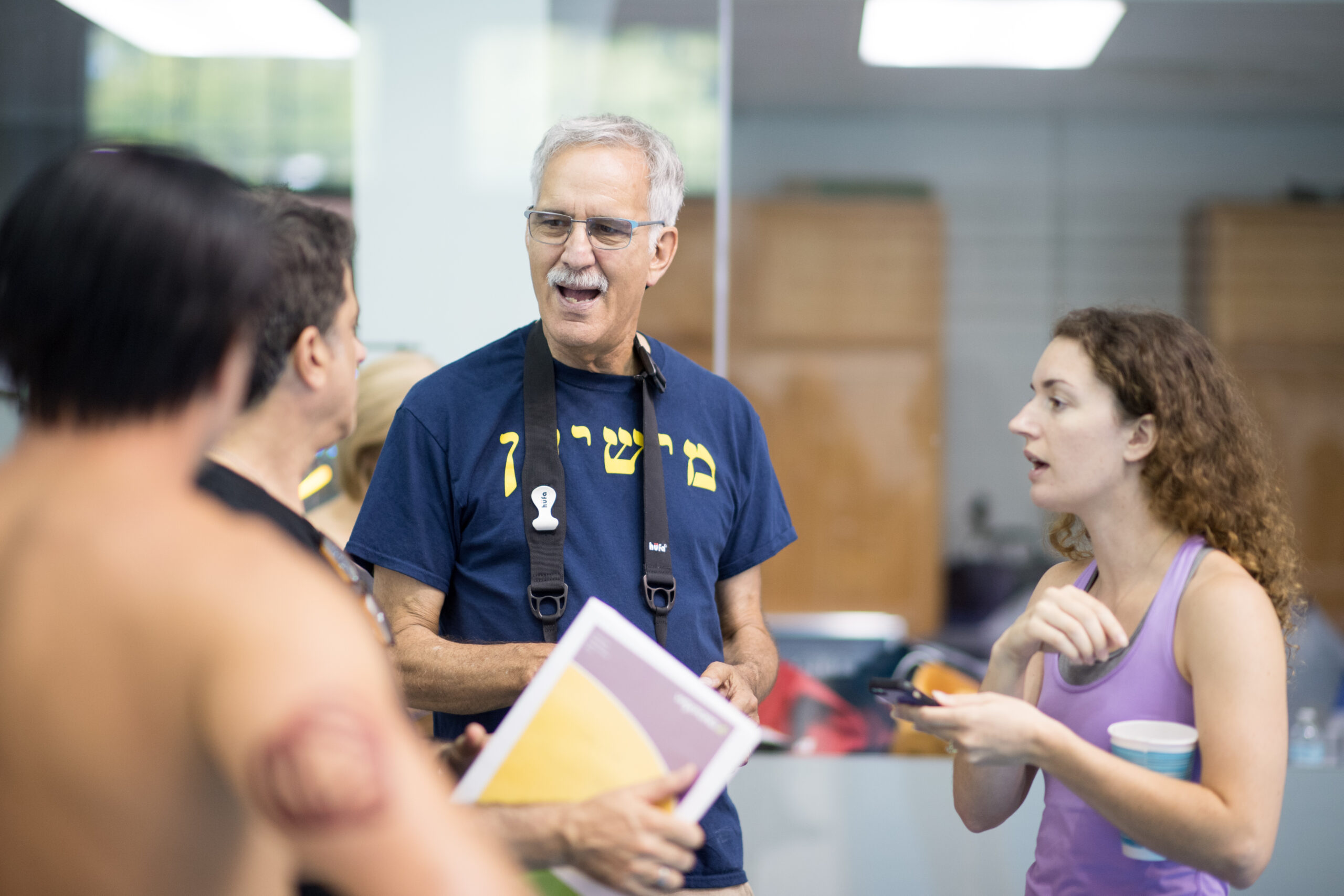
Upon graduation, Rapoport spent a year researching and writing Is the Library Burning?, a book about student power at universities and colleges nationwide. (His co-author was Larry Kirshbaum, BA ’66, another former Daily editor, who became CEO of the Time Warner book group and head of Amazon Publishing.)
Rapoport went on to a multifaceted career as a journalist, author of several books, playwright, filmmaker, editor, and publisher. In 2004, after many years in California, he returned to live in Muskegon, where he writes, edits, and makes films.
As for his view that students at a giant university like Michigan can find the education they want, he said recently: “I think that’s still true.
“There’s no question that the environment itself — the struggles and the conflict that is inherent in everything from academics to athletics and beyond — is a great opportunity to chart your own path.
“The classroom experience was great. The administrative battles that we wrote about endlessly [at the Daily] — that was a real primer.
“I would say it this way: There’s never a day when I am doing something that doesn’t have some connection [to U-M]. It’s my entire life’s connective tissue — before, during, and after. It’s like a mural that never ends. We’re part of this never-ending story.”
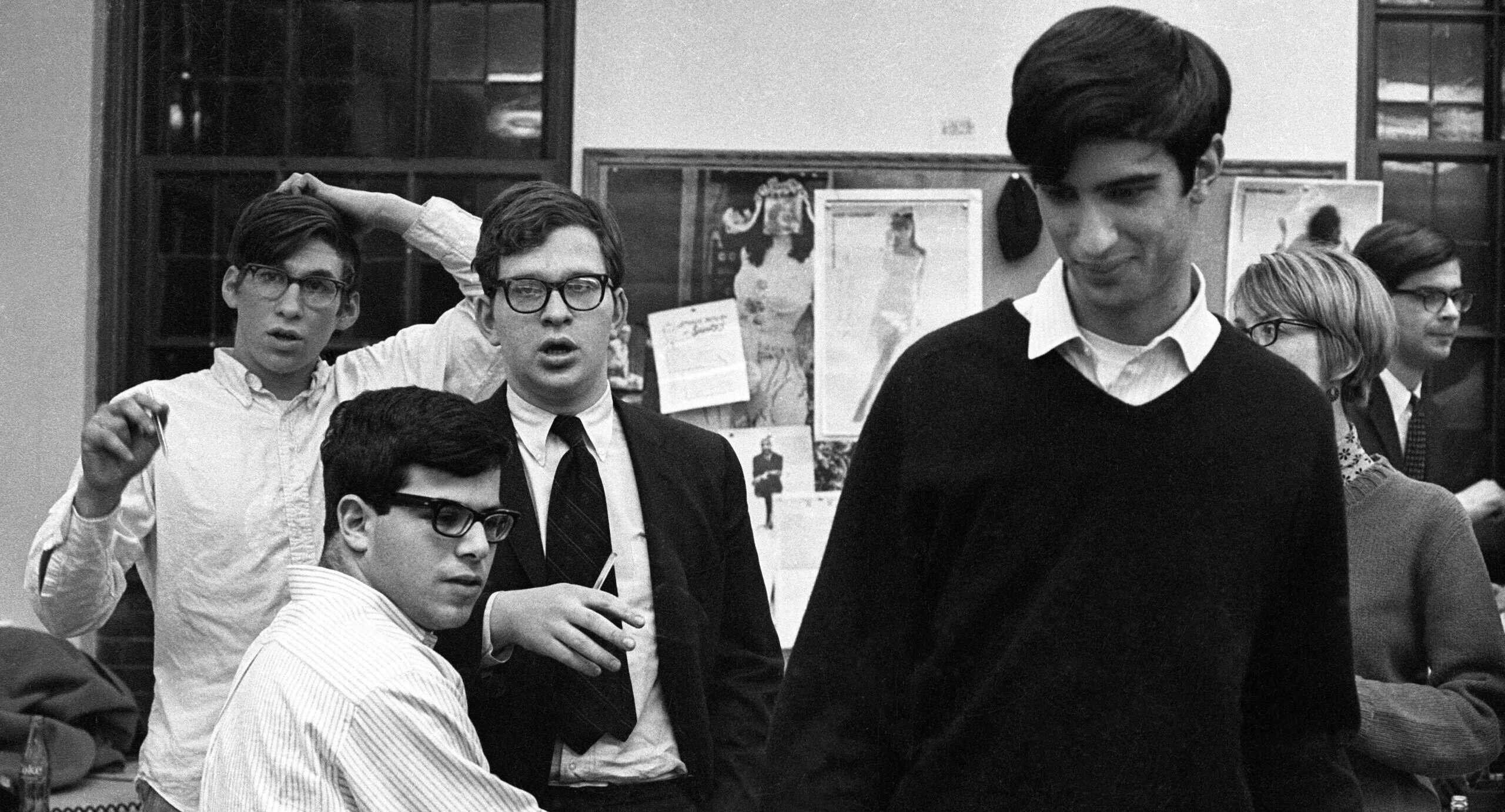
(Lead Image: Michigan Daily staff — Roger Rapoport, right, with other leaders of the Michigan Daily, circa 1967, whom one professor called “probably the most alert, vital group of students on this campus, year in and year out.” Standing at left: Harvey Wasserman, who became a prominent environmental journalist and anti-nuclear advocate; standing at center, Bruce Wasserstein, who became a major investment banker and philanthropist. Image credit: Tom Copi/Michael Ochs Archive/Getty Images.)