November 1969: ‘It just changed everything’
‘Bo who?’
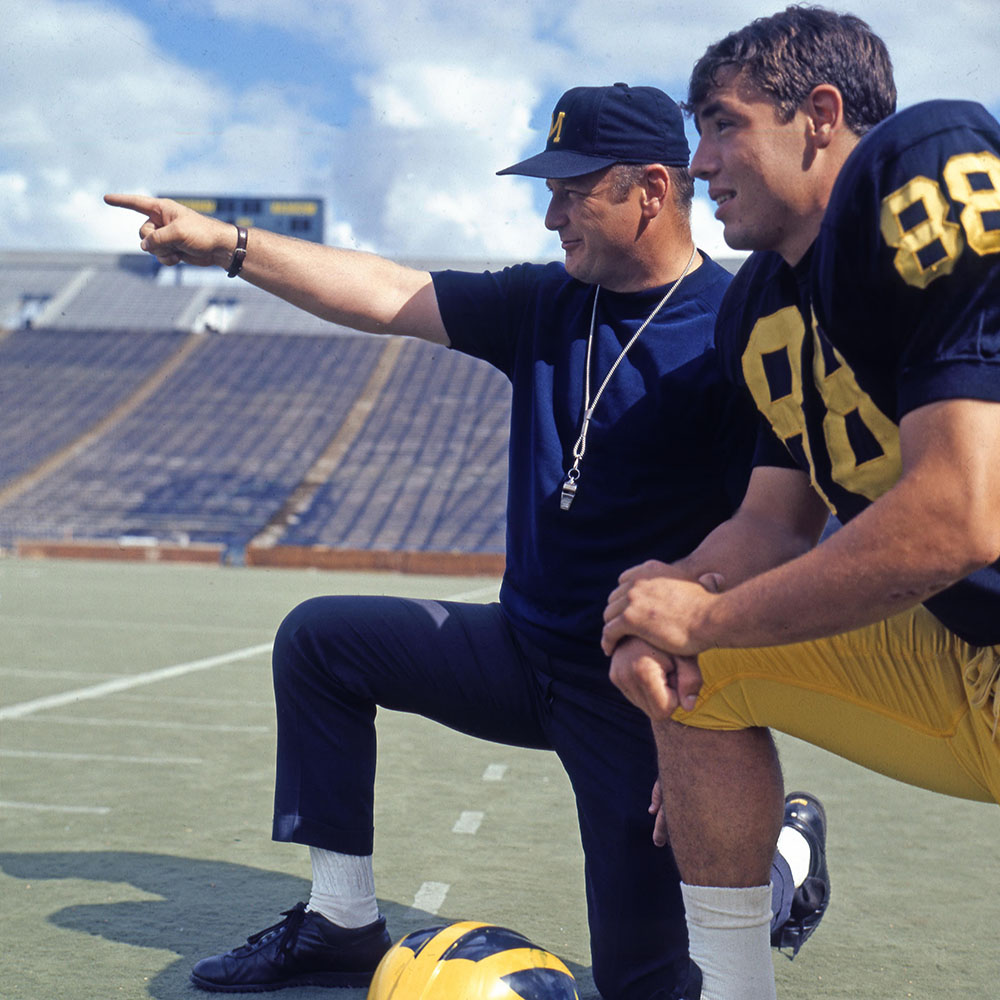
By the end of the 1968 season, Michigan football had been on the ropes for some 20 years. The new athletic director, Don Canham, offered the job of head coach to Penn State’s Joe Paterno. He said no. So Canham hired his second choice, Glenn E. “Bo” Schembechler, a little-known coach at Miami of Ohio and a former assistant to the renowned Woody Hayes of Ohio State.
People asked: “Bo who?”
At spring workouts in 1969, Schembechler unleashed volcanic intensity on his new charges. He told them their overarching aim was to beat Ohio State. And he hung a sign over the locker room door: “Those Who Stay Will Be Champions.”
That seemed highly unlikely.
The year before, en route to the national championship, the Buckeyes had piled on to beat Michigan 50-14. Leading by 34 points with two minutes to go, they went for a two-point conversion just to ram the humiliation home.
In 1969, with no fewer than three Heisman Trophy contenders, they were called the “Team of the Century.” They won their first eight games by a cumulative score of 371-56.
The Wolverines, meanwhile, started the 1969 season slow, winning only three of their first five. Then they won every week. Standouts included quarterback Don Moorhead, offensive lineman Dan Dierdorf, and a powerful complement of sophomores — Thom Darden, Reggie McKenzie, Butch Carpenter, Mike Oldham, Glenn Doughty, and Billy Taylor — who shared a house they called the “Den of Mellow Men.”
“That was the time of the Black Action Movement and Vietnam protests,” Taylor said later, “but Bo wanted us to stay out of politics. And we vowed we were going to be part of a championship team together.”
The signs just said: 50
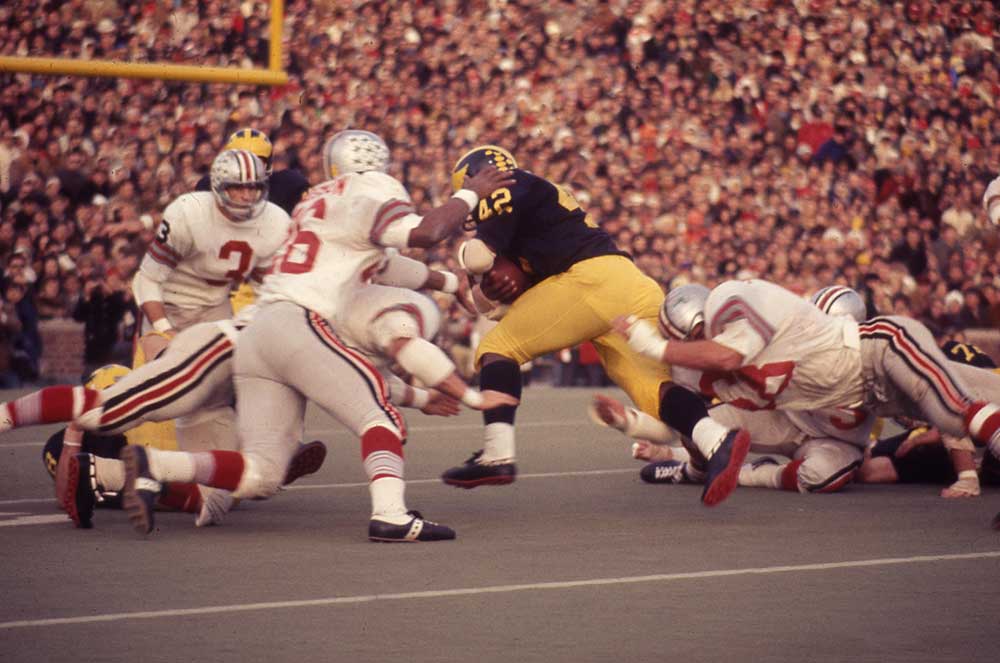
Still, the national press gave them no chance against OSU. ABC Sports scheduled its second-team announcers to call the play-by-play in Ann Arbor.
But the national press didn’t know Schembechler. He revered Hayes, his old boss. But he also knew Hayes’ tactics, and he had an ambitious student’s zeal to outdo his teacher.
The week before the game, to keep his players’ minds on their mortification in 1968, Bo posted signs all over that just said: “50.”
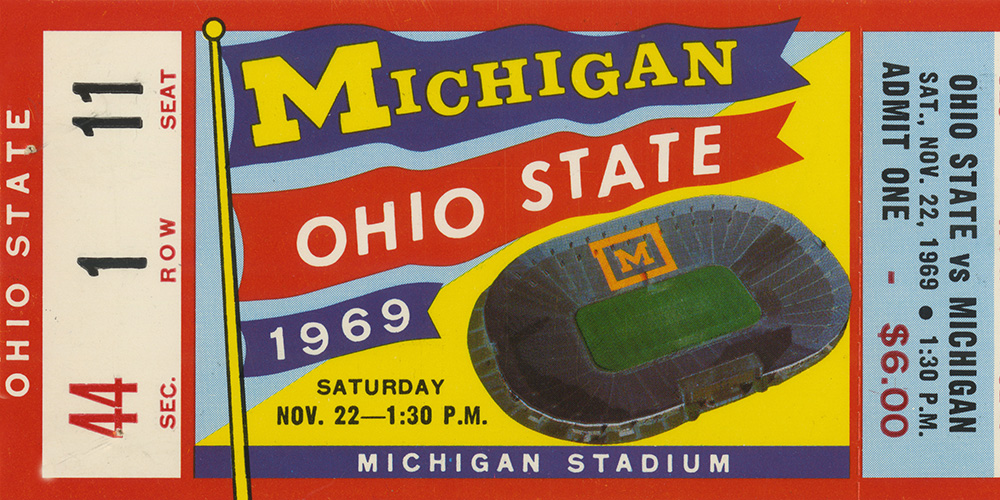
At last, the day came — Saturday, November 22. When the Wolverines emerged from the tunnel of Michigan Stadium, they saw the Buckeyes warming up on Michigan’s side of the field — a calculated move in Hayes’ mind game. Bo charged up to Hayes and ordered him to get his team where they belonged. His players took note.
OSU scored first but missed the extra point. U-M struck back to make it 7-6. The Buckeyes had not trailed an opponent since New Year’s Day at the Rose Bowl.
‘One of the greatest performances’
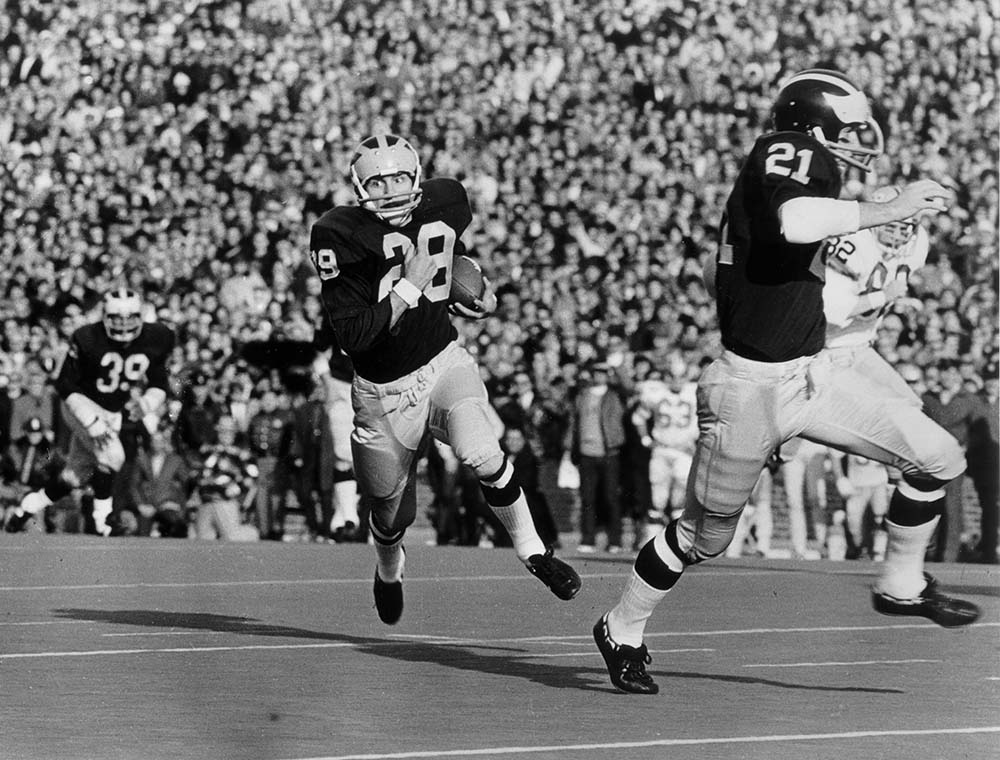
In the second quarter, Michigan exploded. An obscure defensive back named Barry Pierson raced a punt back to Ohio State’s three-yard line, the first act in a stunning performance that included three interceptions and a touchdown.
Pierson was “a small guy,” Bo said later. “All he had going for him was his heart and his toughness. He gave one of the greatest performances I have ever seen in a single game.”
But Pierson gave Bo the credit for what was happening on the field. All week, at practice, the Wolverines had heard him predict Ohio State’s tactics. As the game unfolded, they saw those predictions come true. Pierson said: “We were so confident because Bo had them down cold.”
By now, the Michigan crowd had departed the state of sanity. Thirty-three thousand Buckeye fans sat in near-silence, absorbing shock after shock.
When the half ended, it was Michigan 24, Ohio State 12.
In the Michigan locker room, defensive coach Jim Young, normally reserved, was diagramming plays when he began to pound the blackboard, his voice rising: “They … will … not … score… again!”
In fact, neither team scored again.
Michigan’s defense in the second half was invincible. In all, OSU committed six interceptions and a fumble.
At the end, the Michigan crowd sang at the top of its lungs: “Goodbye, Woody … goodbye, Woody … goodbye, Wood-eeee … we hate to see you go!” Fans swarmed the field in a mad jubilee.
‘It just changed everything’
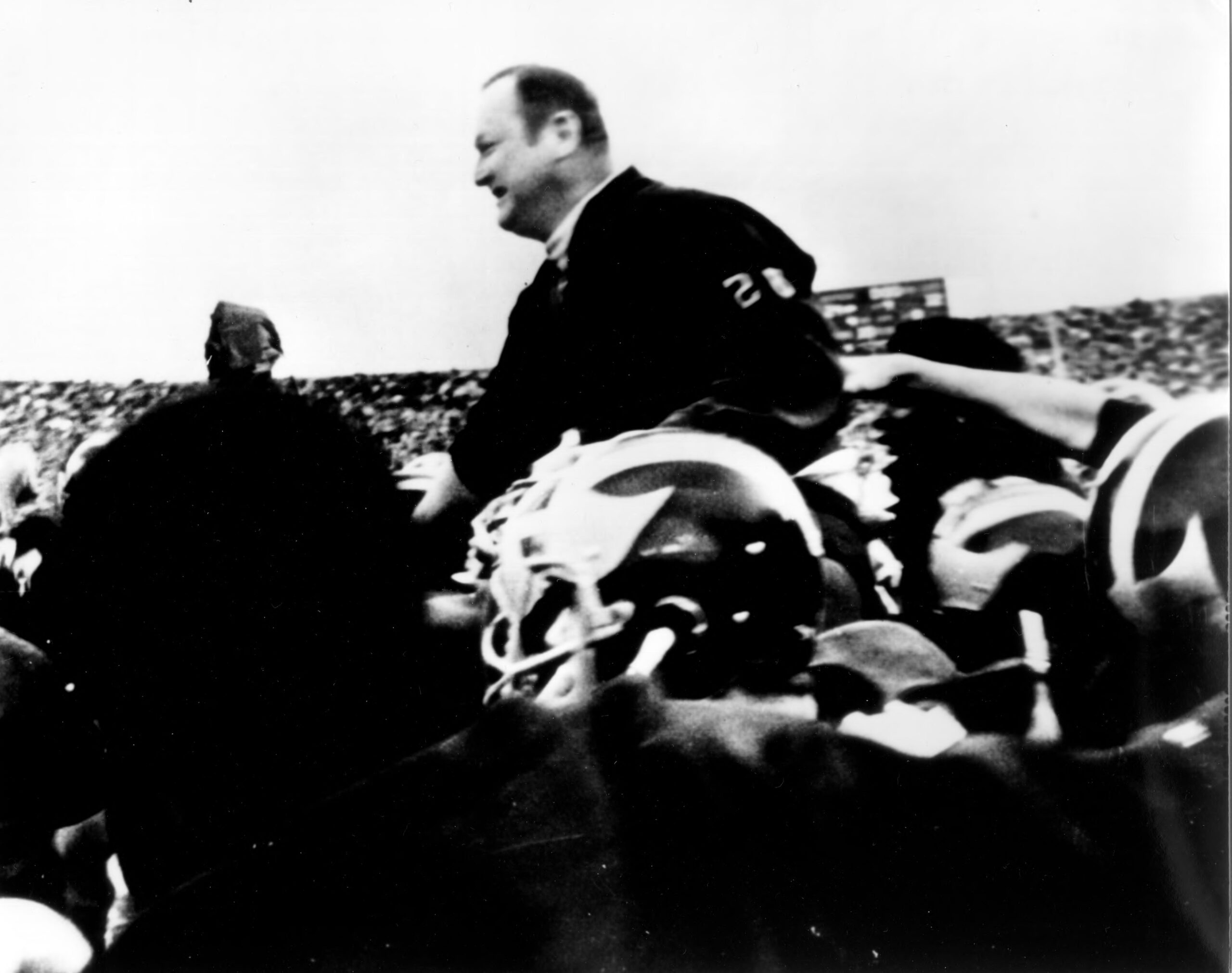
“All that night,” Bo recalled, “people came by my house, strangers, people I had never met, just to say what a great win it had been. We watched the sun rise.”
Michigan Captain Jim Mandich said: “That game was the signature event of my life.”
Gary Moeller, assistant coach in 1969 and head coach from 1990-94, said: “It just changed everything.”
And Bo himself said: “That win ushered in a new era of Michigan football. . . You can trace it all back to November 22, 1969.”
Schembechler coached for 20 more years, compiling a record at U-M of 194-48-5, and served two years as athletic director. He retired as the most revered figure in Michigan athletics since Fielding Yost. He died in 2006 on the night before the Michigan-Ohio State game.
In the Hayes-Schembechler rivalry, eventually known as the Ten-Year War, the final tally was Michigan five, Ohio State four, and one tie.
“For one wonderful decade,” Bo wrote later, “I got to feel what deep, gut-twisting, all-you-got football was all about. Hey, if that was war, sign me up forever.”
Sources included Joel Pennington, “The Ten-Year War: Ten Classic Games Between Bo and Woody” (2005); Bo Schembechler and John U. Bacon, “Bo’s Lasting Lessons: The Legendary Coach Teaches the Timeless Fundamentals of Leadership” (2008); and Bo Schembechler and Mitch Albom, “Bo: Life, Laughs and Lessons of a College Football Legend” (1989).