How Michigan planted its flag on Greenland — or tried to
An island under ice
What is it about Greenland that tickles the acquisitive spirit?
After all, it’s a pretty desolate place. Some 80% of its 836,000 square miles is covered by glacial ice to a depth of 10,000 feet. Maybe 1% of the ice-free territory accommodates human settlement.
But the Vikings wanted Greenland and settled it for a while. So did their descendants, the Danes and Norwegians, who tussled over it until Denmark was awarded sovereignty in the mid-20th century. And the native Inuits, who were granted self-rule in 2009 (with Denmark still in charge of foreign policy and defense), figure it’s been theirs since their ancestors arrived about 2,500 B.C.
Whatever instinct makes people want to claim a piece of the world’s largest island, it certainly animated William Herbert Hobbs, professor of geology at the University of Michigan from 1906-34.
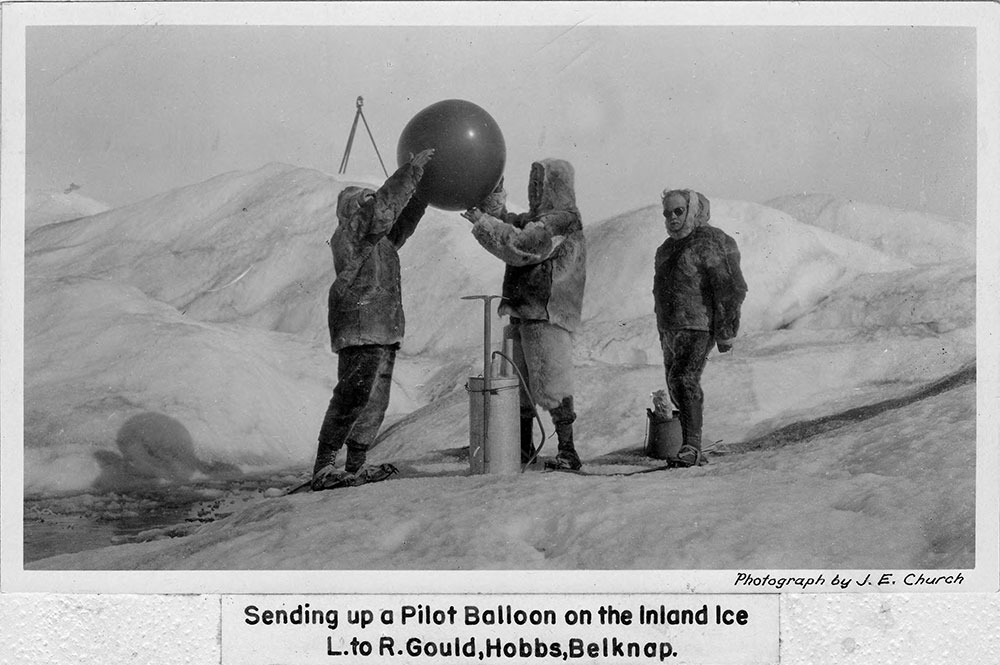
A century ago, Hobbs led three U-M expeditions to study the weather high above Greenland as well as its sprawling ice pack. But he also planted U-M names all over the land mass — or tried to, at least.
Prone to argument
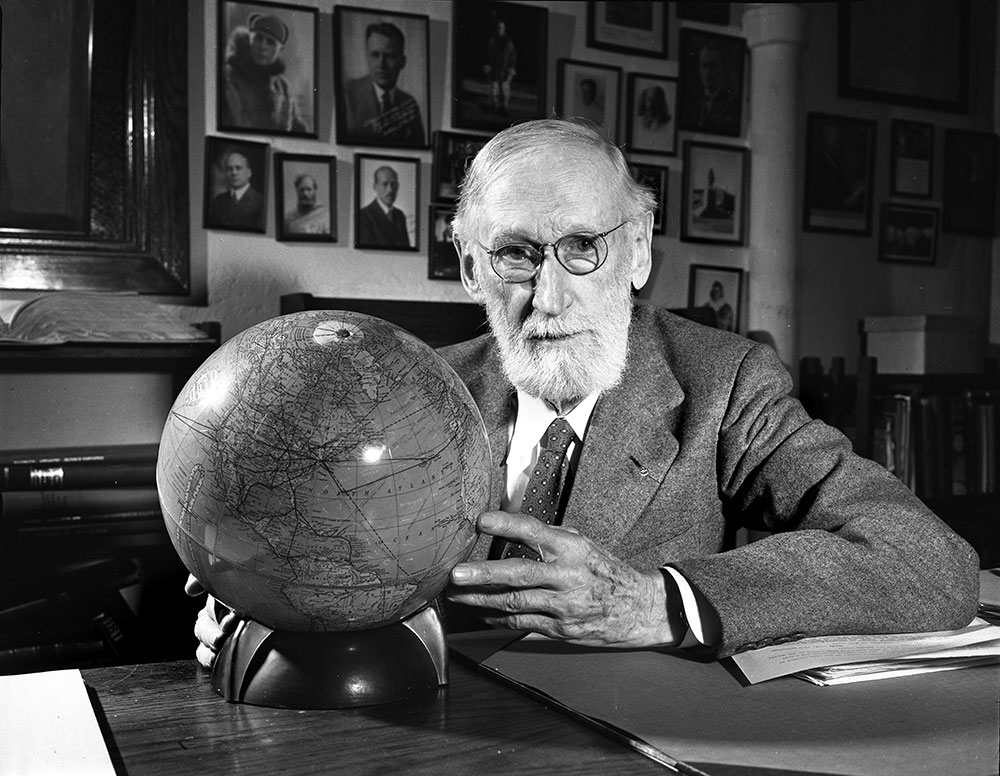
A wiry, bearded man of fierce energy, Hobbs went questing to both poles, Africa, Asia, Europe, and Central America to study how mountains and glaciers are born and sculpted by time and weather. He built U-M’s geology department nearly from scratch. He was both a rugged mountaineer and a sociable host who wined and dined the rich and famous at his Ann Arbor home — and he never hesitated to drop their names. He was a hawk for military preparedness and bitterly opposed President Woodrow Wilson’s League of Nations. His hard edge offended many a colleague. One of them remarked that Hobbs’ “proneness to argument often brought down violent storms on his head.”
In the 1920s, well into his 60s, Hobbs set his sights on Greenland.
His purpose was to study the connections between polar glaciers, the weather, and the land masses beneath the ice. He planned a series of expeditions, all conducted under U-M’s aegis but with private funding. The first, in the summer of 1926, would lay the groundwork for the ones to follow.
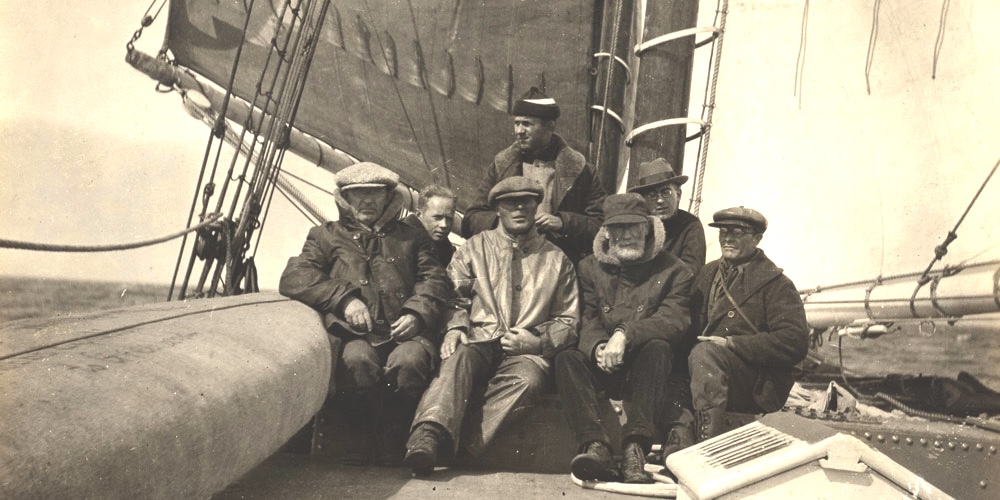
From Nova Scotia, Hobbs sailed on a fishing schooner with a party of five — another U-M geologist, two meteorologists, a surveyor, and a radio man. They maneuvered through “many fleets of icebergs” and thick fog to a spot on Greenland’s southwest coast 25 miles north of the Arctic Circle.
Hobbs now showed he was either homesick or eager to court favor at home.
Presidential range
The little group had barely set down their gear when Hobbs set off on a spree with a map and a pencil, planting Michigan-connected names on practically any feature of the landscape that caught his eye.
To the expedition’s base encampment, he gave the name Camp Clarence Cook Little to honor Michigan’s president. (This may not have been the shrewdest public-relations move, since Little was already making himself unpopular in Ann Arbor for his autocratic style, not to mention his support for eugenics, birth control, and Prohibition.)
Soon Hobbs sent a party 100 miles inland to make a camp for the release of weather balloons. This second camp he named for Mortimer E. Cooley, the longtime dean of Michigan’s College of Engineering.
Back at Camp Little, he gazed out at a broad inlet and dubbed it University Bay. Then he surveyed the icy peaks that circled the bay and slapped on names to honor the five U-M presidents before Little — Mount Tappan, Mount Haven, Mount Angell, Mount Hutchins, and Mount Burton.
Mount Tappan rose from a great stone buttress that Hobbs named for Stevens T. Mason, the “boy governor” of Michigan who oversaw the University’s beginnings in Ann Arbor. Then, never one to overlook an anonymous buttress, he named the bulk under Mount Burton for Alfred Henry Lloyd, the professor of philosophy who served as interim president between Burton and Little.
Of mountains and lighting fixtures
The tallest mountain in one sector already had a name given by the Inuits — the Pingo. But a mountain next to the Pingo had no name, so Hobbs said it was now Mount Charles F. Brush — for the inventor of the Brush arc light, of course, a Michigan graduate of 1869. (That was no minor light; it replaced gas lights on the streets of many cities.)
Another peak became Mount Roy D. Chapin, named for the co-founder of Detroit’s Hudson Motor Company, who dropped out of U-M in 1901 to pursue his fortune in the fledging auto industry. Finally, Hobbs left behind Mount Willard M. Clapp. Clapp’s relationship to U-M, if any, seems to have escaped the historical record, but he was a well-to-do Clevelander, so possibly he was one of Hobbs’ benefactors.
Hobbs led two more expeditions to Greenland. One made international headlines — not for scientific discoveries, but for an airplane crash. Hobbs and his party rescued the two American fliers, who had been trying (partly at Hobbs’ urging) to prove the value of the “great circle” route from North America to Europe. [See “An Arctic Escape.”]
None of Hobbs’ U-M names stuck to the map of Greenland. But his own name was given by others to glaciers and a couple of land masses in both Greenland and Antarctica, plus a mountain range in the Arctic.
Hobbs died in Ann Arbor at age 88 on New Year’s Day, 1953.
Sources included William Herbert Hobbs, “The First Greenland Expedition of the University,” Michigan Alumnus, 10/23/1926 and An Explorer-Scientist’s Pilgrimage (1952); Madeleine Bradford, “An Arctic Escape,” Bentley Historical Library; Lawrence M. Gould, “Obituary: William Herbert Hobbs,” Geographical Review (July 1953); Donald H. Chapman, review, An Explorer-Scientist’s Pilgrimage, Journal of Geology (March 1954); and George D. Hubbard, “William Herbert Hobbs: 1864-1953, Science (5/15/1953). Lead image of Hobbs, third from right, with members of his team on one of the later Greenland expeditions, comes from U-M’s Bentley Historical Library.)