Don’t look, don’t tell
A measured response
“If you can’t measure it, you can’t manage it.” I have heard this statement many times. It has been proffered as a fundamental premise of business and evidence-based government policy.
What’s most important: Many people believe it.
But these types of “absolute truths” tend to be quoted without appropriate context. They often are falsely attributed to people who never said them. No matter the origin of the statement’s use in business and management, measurement is at the foundation of scientific investigation. Indeed, measurement moves investigation from speculation about observed behavior to quantitative experimentation and prediction.
Role play
While working at NASA more than 25 years ago, I became sensitive to the different roles of measurements in business and science. At the time, we were in the formative stages of developing a space instrument to measure nitrogen compounds in the atmosphere. The instrument was proposed to study air quality.|
Opposition to the instrument in Congress came from representatives who were concerned it would be used for regulation – notably, to reduce emissions from cars and trucks.
My scientific colleagues stated (sincerely, I believe) that they were only interested in chemical processes, not regulation. They also maintained that instruments for regulation would probably be surface-based sensors, likely run by a city or state government.
And, of course, NASA was a science agency, not a regulatory agency. The EPA was the place to go for regulations.
I thought the points made about the potential use of the measurements to inform policy made sense, at least politically. I anticipated this regulatory element of observations would become increasingly prominent, especially for measurements of carbon dioxide.
Real-world consequences
Throughout my time at NASA, we felt constant political pressure regarding Earth science observations. I used to write white papers and strategic positions on why this was the case. At the core of my argument: There were real-world consequences of Earth observations. They were not simply taken for discovery.For a while at NASA, every proposal was met with the question: “So what?” Then there were a few years of: “How would this reduce uncertainty?” And that led to: “When would uncertainty be reduced enough to stop taking the measurements?”
On the surface, I could see the motivation for these questions. However, I also thought they were leading us down a precarious path. For example, new measurements might reduce some uncertainties. But they always revealed more uncertainties as they probed the complexity of the planet. I ultimately co-authored a paper on the “uncertainty fallacy.”
The “so what?” era and the “societal benefit” justifications were concerning. For carbon dioxide instruments, the answer to “so what” often leaned on the measurements contributing to policy, or being used to monitor compliance with mitigation efforts.
The situation got more complex, in a political context, as we started to measure methane and other greenhouse gases. Space-based methane measurements quickly revealed hotspots, often associated with fossil fuel extraction.
On the surface “everyone (fossil fuel companies and climate advocates) agreed” that methane emissions were bad. However, the revelation that fossil fuel extraction was a large source of methane emissions was universally appreciated only in the face of methane regulation.
Power surge
Though there are many reasons that Project 2025 and the current administration are hostile to climate science, I believe we have understated one significant factor: the potential to regulate.
Regulation can be framed as a barrier to economic growth and innovation. And since evidence-based regulation is usually based on scientific investigation, opponents have spent decades focusing their ire on research, the practice of science, and the behavior of scientists. Anti-regulation proponents dispute the authority of federal agencies and claim they act as an unelected branch of government that relies too heavily on scientific advisers.
The concerted effort to limit the role of climate science in policy and regulation has persisted and grown since the 1990s when scientists definitively concluded that carbon dioxide’s warming effect was discernable. The (excellent) book “The Fifth Branch: Science Advisers as Policy Makers” provides valuable context for much of the resistance we have seen in the past 30 years when it comes to the role of climate science in government regulation.
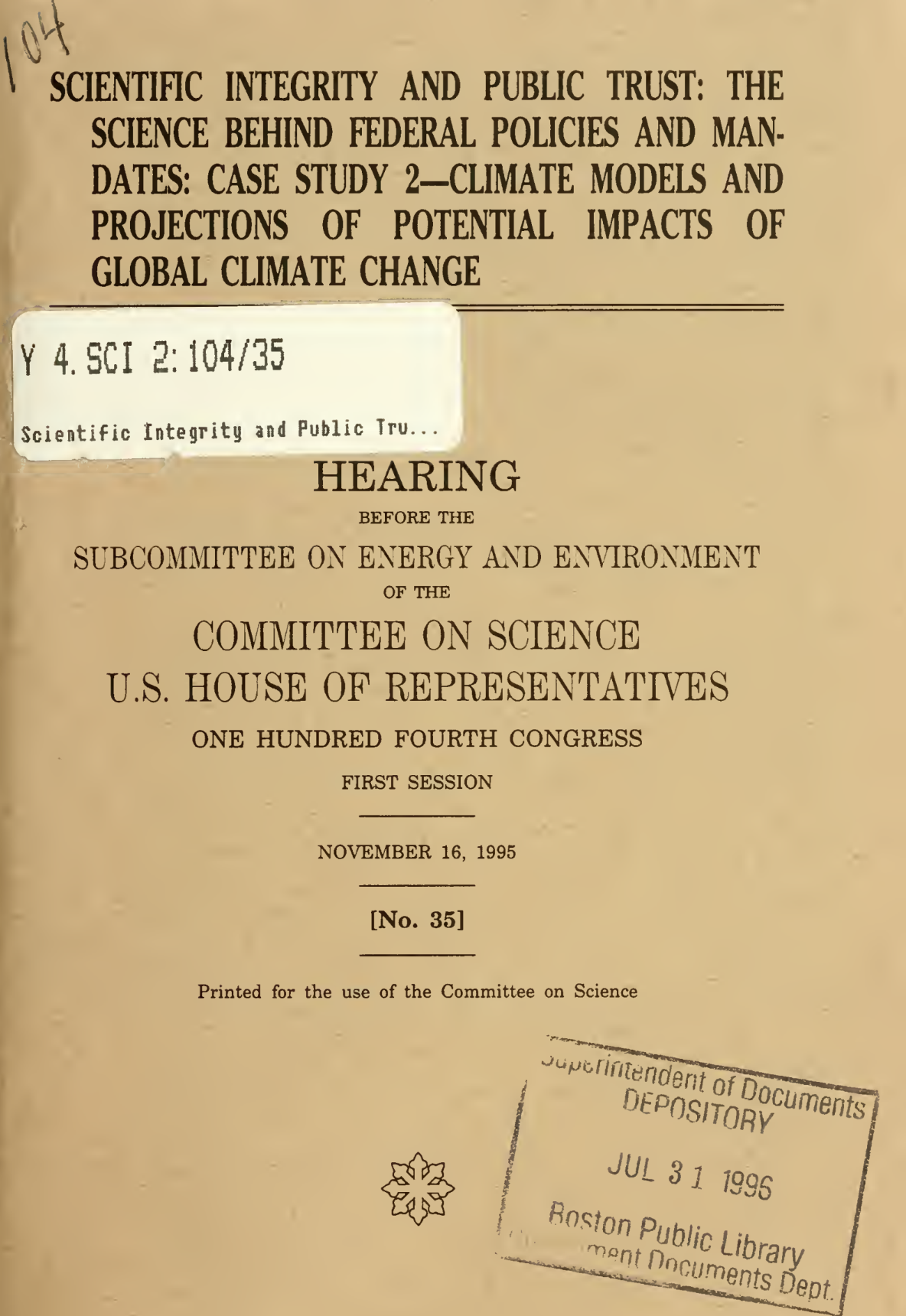
In 1995, there was a Congressional hearing called “Scientific Integrity and Public Trust: The Science Behind Federal Policies and Mandates: Case Study 2 – Climate Models and Projections of Potential Impacts of Global Climate Change.” These hearings were designed to sow doubt about climate science and to limit, if not preclude, the use of climate models in policymaking. Indeed, one subtext of the questioning was whether or not carbon dioxide emissions played any role in global warming.
At about the same time, fights grew over the use of peer review and expert witnesses in legal proceedings and policymaking (The Daubert Standard, Information/Data Quality Act ).
Target practice
As the stakes have gotten higher in climate change, efforts to undermine the ability to regulate carbon dioxide and methane have escalated. The Environmental Protection Agency is the most obvious target. The EPA was in the sights of the 2016 Trump administration and is there again, today.
Recently we have seen deactivation of the U.S. National Climate Assessment website, the suspension of data services, and threats to the collection of key observations.
Science advisory panels (usually made up of volunteers willing to share expertise) are another easy target. Many have been dissolved; some have been reconstituted to be more politically favorable.
Similarly, expert author groups, such as those supporting the National Climate Assessment, are dismissed. Federal scientists and diplomats are prohibited or limited in their participation in international assessments and negotiations.
Along with this tactical behavior, strategic efforts, such as the Supreme Court overruling the 1984 Chevron v. Natural Resources Defense Council decision, strongly restrict the rulemaking ability of the federal agencies.
Another disturbing proposal is an effort to institute federal review of climate science through Red Team/Blue Team exercises. This process is to assure alignment with political priorities.
Don’t look now
The cuts in the President’s budget targeting climate modeling and observations at NOAA, NASA, the Department of Energy, and the National Science Foundation are unambiguous statements that knowledge about climate change should not be collected or curated. Likewise, climate-focused units in other agencies, for example USDA and the Department of State, have seen budget reductions or elimination.All told, we see a strategy emerging that harkens back to “If you can’t measure it, you can’t manage it.” That is, if you don’t measure it, then it cannot be managed or regulated.
We might find solace in knowing the U.S. is merely one player in climate research. However, it is easy to declare that the U.S. can only use government-certified observations and approved research to shape regulation. And, of course, we are presently reducing or eliminating that capacity.
The role of science in regulation and policymaking has been understated in the current deconstruction of our science enterprise. The persistent and consistent efforts over many years to dismantle the infrastructure and institutions for climate regulation show that this is more than the actions of a single administration.
In thinking about what’s next, it is worthy to consider a way to disentangle scientific research, scientists, and the role of scientists from regulation and policymaking. We need boundaries – checks and balances. Imagine that.
(Lead image: iStock.)