Lost on the last day
The kid from Detroit
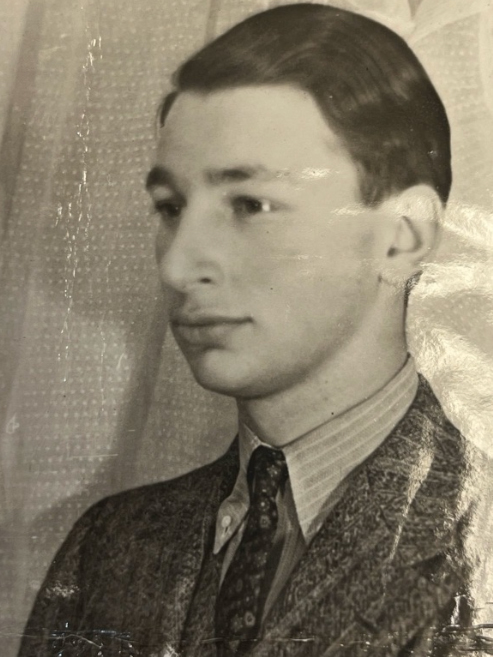
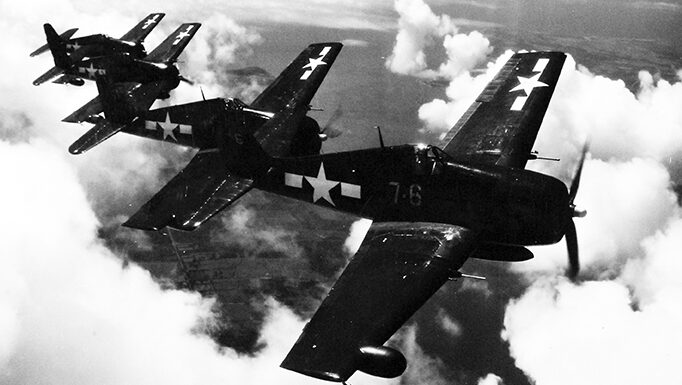
Eugene Mandeberg graduated from Michigan with a B.A. in English Composition in January 1943. Within weeks, he was training to be a naval aviator. By 1945, he was ready to fly the Grumman F6F Hellcat against the feared Japanese Zero.
In the summer of that year, with the war in Europe over, Mandeberg went as a member of Fighter Squadron 88 to the western Pacific. Allied forces were closing in on the Japanese home islands but enduring suicide attacks by kamikaze pilots. The Navy aviators, with their Army and Marine counterparts, were trying either to compel the Japanese to surrender or to weaken them in advance of an Allied invasion.
Squadron 88 was based on the aircraft carrier U.S.S. Yorktown. Many pilots had barely finished their training. Superiors worried about two of the youngest — Billy Hobbs, of Kokomo, Indiana, and Mandeberg, the skinny kid from Detroit. They seemed “too excitable,” one officer said. But they soon proved themselves in sortie after sortie against Japanese targets.
On August 6 and August 9, the squadron learned the U.S. had dropped atomic bombs on the cities of Hiroshima and Nagasaki. Few if any aboard the Yorktown could comprehend the bombs’ power or significance. But the ship’s crew and pilots sensed the end of the war must be at hand.
On August 10, news reached the Yorktown that Japan was considering the Allies’ surrender terms. Joyous roars erupted. One of Mandeberg’s fellow pilots wrote home: “We really thought the war was over for us today.”
It wasn’t.
A son of immigrants
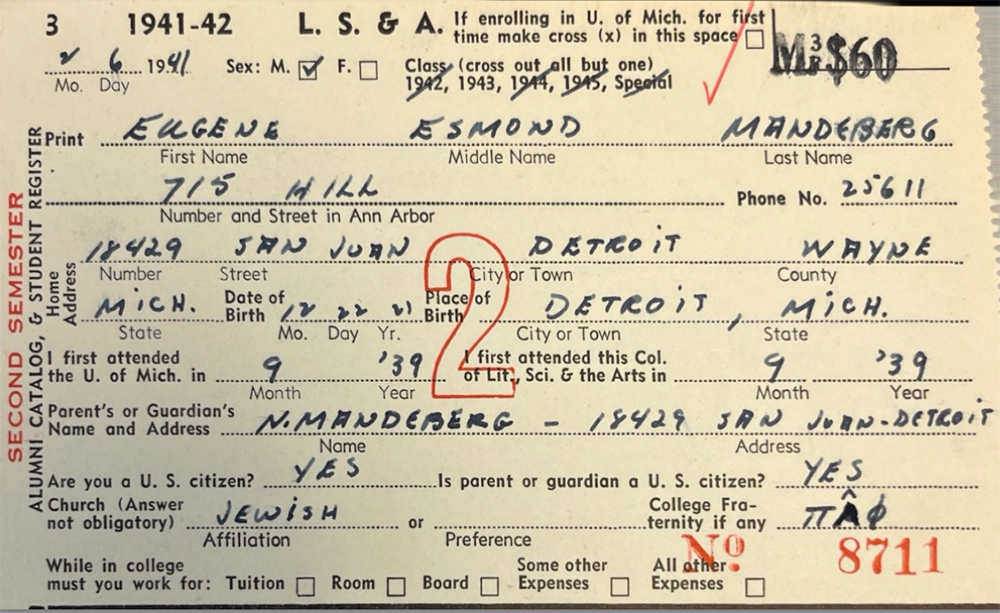
Eugene Mandeberg was born in Detroit in 1922, the younger of two sons of Russian Jewish immigrants. As a student at Detroit Central High, he worked part-time in a department store and graduated in the second quarter of his class. In September 1939, just as World War II was starting in Europe, he entered the University of Michigan.
He pledged the Pi Lambda Phi fraternity at 715 Hill Street (now Chabad House). That in itself was a statement of principle. “PiLam” had been founded at Yale in 1895 as an explicitly nondiscriminatory fraternity after three Jewish students were denied membership in any house. Prospective pledges were to be judged only by their character, not race or religion.
Mandeberg made The Michigan Daily his second home on campus. He specialized in editorials. His first, published during the defense build-up of 1940, applauded the Roosevelt administration for withholding a defense contract from the Ford Motor Company after Ford refused to comply with labor laws. His last, in November 1942, chastised Congress for failing to ban the southern poll taxes that prevented Blacks from voting. Criticizing a plan by which foreign-born workers would be expelled from military-production plants, he wrote: “These people are human beings, even if they are not citizens; even if they have foreign names. They too have the desire to eat and sleep under a roof. They too have a right to live.”
His transcript shows that he aced his courses in English composition and creative writing, flunked his second semester in German, and scraped by in math, history, and psychology. He dreamed of becoming a writer, but only in the hazy future. He knew the war would come first.
Rumors of peace
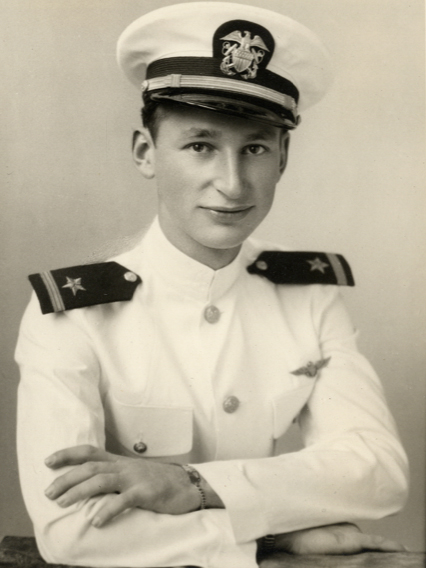
Mandeberg entered the Navy’s pre-flight program and for months was immersed in training for aerial combat. On April 5, 1944, he received his commission as an ensign in the U.S. Naval Air Corps. Then came more flight training, first at Otis Field on Cape Cod; then in Florida and Hawaii; and finally at the U.S. airfield on Saipan in the far western Pacific.
On leave in New York City, he met a young woman named Sonya Levien, who helped to organize Broadway’s famous Stage Door Canteen for service members on leave. The two were soon engaged. But now their relationship could be conducted only through letters as Mandeberg moved with his unit from base to base and finally to the Yorktown.
For several weeks, the squadron hammered the Japanese home islands. Then came the atomic bombs and swirling rumors of peace.
Aboard the Yorktown, the Hellcat pilots waited and watched the sky for two days as bad weather kept them grounded, hoping desperately for word that Japan had surrendered. But none came.
So, just after 4 a.m. on August 15 (U.S. time), the pilots left the carrier to strike the Atsugi Airfield near Tokyo.
Two hours later, the Yorktown’s commanders were notified that Japan’s Emperor Hirohito had promised to surrender.
Eight Hellcat fighters were now approaching the airfield. Two were to stay at high altitude, waiting in relative safety for a cease-fire order. If the order came, they would relay it to Mandeberg and the five others assigned to attack the airfield.
The cease-fire order reached the pilots at 6:45. They began to turn away. But they spotted 17 Japanese fighters descending on them.
The six Americans shot down nine attackers. Two Americans got away. Four fell in or near Tokyo Bay, Mandeberg among them.
Lost and found
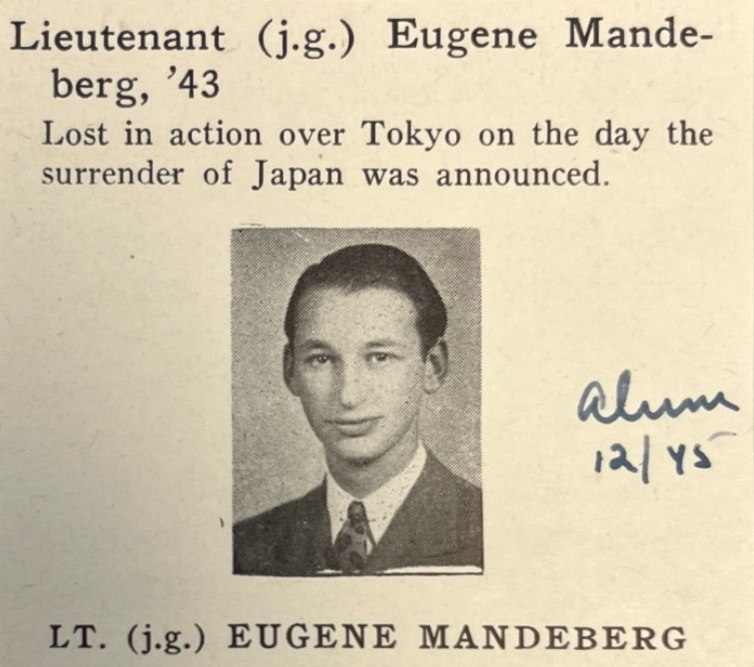
The Navy declared Mandeberg missing in action.
In March 1946, U.S. servicemen searching for missing American war dead came to a Buddhist temple in Yokohama. There they were led to a set of remains linked to the Yorktown — apparently Mandeberg’s, though it was impossible to be sure. His family asked that the body be buried as an “unknown” at the Manila American Cemetery and Memorial in the Philippines.
In 2019, the remains were exhumed and sent to the U.S. Defense POW/MIA Accounting Agency.
In March 2025, after extensive analysis of anthropological, dental, and DNA evidence, examiners identified the body as Mandeberg’s. His relatives were notified.
On Sept. 14, 2025, his body was buried at Beth El Memorial Park in Livonia, Michigan.
(Sources included Eugene Mandeberg’s records at the Bentley Historical Library; the Michigan Daily; John Wukovits, Dogfight Over Tokyo: The Final Air Battle of the Pacific and the Last Four Men to Die in World War II (2019); Press release, “Sailor Accounted For From World War II (Mandeberg, E.),” Defense POW/MIA Accounting Agency, 9/15/2025; Sam Moses, “In the last hours of war, blood and heroism and irony and loss,” Navy Times, 12/31/2018. “War Hero Returns Home After 80 Years,” Detroit Jewish News, 9/12/2025. Lead image: Mandeberg flew Grumman F6F-5N Hellcat fighters like these, designed to challenge the Japanese Zero. Credit: National Archives)